
 English
 Français
 Español
 Deutsch
 Português
 Italiano
 العربية
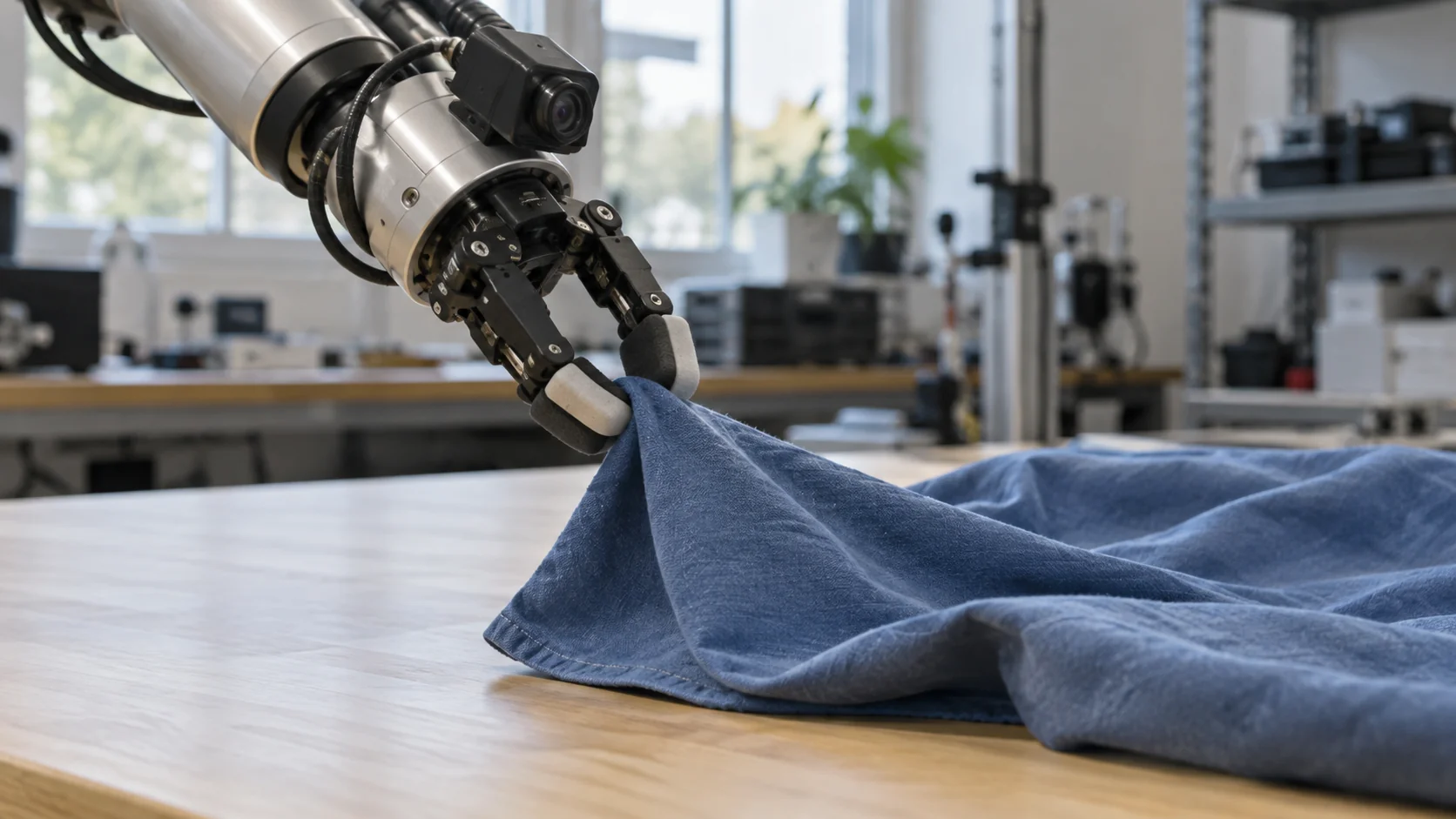
Embodied AI is artificial intelligence that lives in a physical body. It senses the world through its own cameras, microphones and touch sensors, acts on the world through its own motors, and learns from what happens when it moves. A robot arm that learns to pick up unfamiliar objects is embodied AI. So is a walking robot that keeps its balance on gravel, and a car that drives itself through traffic.
The idea sounds obvious once it's said out loud, but it marks a real break from the AI most people use every day. A chatbot answers questions from text. An embodied system has to deal with weight, friction, glare and the fact that the world doesn't wait while it thinks. That difference shapes how these systems are built, trained and tested, and it also explains what a single robot can't know, however capable it is.
In short
- Embodied AI is intelligence inside one body, learning through its own senses and its own actions.
- It runs a loop: sense, decide, act, then sense the result and adjust.
- Robots, drones and self-driving cars are the familiar examples, and each one only knows what its own sensors report.
- Physical AI is the wider idea: connecting robots with sensors, doors, cameras and machines so they share context.
How does embodied AI work in robotics?
Every embodied system runs some version of the same cycle, many times a second:
- Sense. Cameras, depth sensors, joint encoders, force sensors and microphones produce a stream of raw data.
- Interpret. The system turns that data into something usable: where the objects are, where the floor ends, how hard the gripper is squeezing.
- Decide. Given a goal, such as "put the red box on the shelf", it picks the next movement.
- Act. Motors move the arm, wheels or legs.
- Check. The sensors report the new state, and the cycle starts again with that result.
Classic robotics split this cycle into separate modules written by engineers: a perception module, a planner, a motion controller. That approach still runs most factory robots, and it works well when the environment is predictable, like a welding cell where every car body arrives in the same place.
Embodied AI robotics leans on learning instead. Rather than hand-coding how to grasp a mug, researchers train a model on many examples of grasping and let it work out the mapping from what the camera sees to how the joints should move. A recent and influential family of these models is called vision-language-action models. They take a camera image plus an instruction in plain language and output motor commands. Google DeepMind's RT-2, published in 2023, was one of the early widely discussed examples, and several companies have released similar models since.
Training data holds most of these models back. A language model can learn from text scraped across the internet, but there's no internet-scale archive of robot movements. Teams fill the gap three ways: people remotely operating robots to record demonstrations, simulation, where virtual robots practice millions of times before the skills are transferred to real hardware, and ordinary video of humans doing tasks. The step from simulation to the real world, often called sim-to-real, is where many skills fall apart, because real lighting, friction and sensor noise never quite match the simulator.
Another idea gaining ground is the world model: a model that predicts what will happen next if the robot takes a given action. A robot with a decent world model can try out a few candidate movements in its head before committing to one, and engineers can use the same model to generate extra training scenarios that would be slow or risky to stage for real.
None of this replaces the safety engineering underneath. Learned policies usually run on top of conventional controllers that enforce speed limits, force limits, joint limits and an emergency stop. If the learned part proposes something unsafe, the lower layer refuses it. That layering is a big reason learned robots can work near people at all.
What is an embodied AI robot?
An embodied AI robot is any robot whose behavior is grounded in its own sensing and at least partly learned, rather than fully scripted step by step. The form doesn't matter much. Wheels, legs, arms and propellers all qualify.
It helps to think of a spectrum rather than a yes-or-no label. At one end sits a traditional industrial arm that repeats a path an engineer taught it, point by point, and stops if anything is out of place. In the middle are robots with vision that adjust a taught motion to where a part actually lies. At the far end are robots whose grasping or walking was learned from data and that cope with objects, floors and situations nobody programmed in advance. The further a robot sits toward that end, the more people call it embodied AI.
| Robot | What it senses | What it does | What it can't know on its own |
|---|---|---|---|
| Robot vacuum | Lidar or camera, bump sensors, cliff sensors | Maps rooms, cleans, avoids obstacles | That a pipe is leaking in the next room |
| Warehouse mobile robot | Lidar, cameras, floor markers | Moves shelves or totes between stations | That a dock door across the building is open |
| Four-legged inspection robot | Cameras, thermal camera, microphones | Walks routes and reads gauges | That a pump on another floor just started vibrating |
| Robot arm with a learned grasp | Wrist camera, force sensor | Picks unfamiliar items from bins | That the next delivery is running two hours late |
| Self-driving car | Cameras, radar, sometimes lidar | Drives, brakes, steers | That the car park it's heading to is full |
Look at the last column. Each robot can be excellent inside its own field of view and still be missing information that already exists somewhere else in the same building, recorded by some other device.
Why does embodied AI matter?
For most of AI's history, the hard problems seemed to be the intellectual ones: chess, logic, mathematics. Robotics researchers kept running into the opposite. In the late 1980s, Hans Moravec pointed out that it was comparatively easy to make computers play checkers at an adult level and very hard to give them the perception and movement skills of a one-year-old. That observation is now known as Moravec's paradox, and robotics researchers still cite it today.
Around the same time, Rodney Brooks at MIT argued that intelligence doesn't have to start from a complete internal model of the world. His robots reacted directly to what their sensors reported, with simple behaviors stacked in layers, and they could walk and find their way around real rooms without a detailed map of them. That line of research is a big part of where embodied AI comes from: the view that much of what we call intelligence develops through a body interacting with its surroundings.
Today the question matters for a practical reason. Language models can now explain how to fold a shirt in perfect detail, yet that knowledge doesn't move a single finger. Embodied AI is the work of turning understanding into reliable movement, and it's why robots are starting to handle messy, varied jobs such as sorting mixed parcels or picking items they've never seen before.
The jobs that benefit most share a pattern. They're physical, repetitive enough to be tiring but varied enough that a fixed script breaks: picking orders in a warehouse, inspecting equipment in places that are hot, high or hazardous, moving supplies around a hospital. Fixed automation has served the highly repetitive end of that range for decades. Embodied AI is aimed at everything in between, where the work changes slightly every time.
Is embodied AI the same as physical AI?
The two terms often get used as synonyms, but they point at different things. Embodied AI is about one body getting smarter: better perception, better grasping, better balance. Physical AI is about connecting all the physical things in a place, such as sensors, doors, cameras, meters, machines and robots, so they share context and can act as a group. In that picture a robot is one participant among many.
Take a cleaning robot working the corridors of a shopping center at night. Its embodied intelligence is impressive: it maps the floors, steers around a stray chair and docks itself to charge. It still has no idea that a wireless leak sensor in a restroom on the far side of the building just detected water on the floor. Once both are connected to the same system, a rule can react to that leak by raising an alarm to the maintenance team and, if the robot's integration exposes a "go to location" command, by sending the robot to that restroom, while the robot keeps handling its own navigation and safety.
The same pattern shows up well beyond shopping centers. On a farm, a gate sensor in a remote paddock knows something a feeding robot in the barn doesn't. In a factory, a vibration sensor on a pump knows something the inspection robot won't find until its next round. The distinction also matters when you plan a project. A smarter robot improves one machine's work, while connecting what's already installed improves how the whole site responds, and the two investments are made by different teams with different budgets.
Connecting a site this way is the job we built Kilo for. The restroom leak sensor and the cleaning robot become devices in the same organization, and one rule can raise the alarm for the maintenance team and send the robot its configured command in the same run. Before that rule goes live, you step through it in the debugger with the robot's command mocked, so nothing moves while you test. To work out what a robot on your own site is missing, fill in the last column of the table above for your own machines, then check which of those facts a sensor could report into an operating system that connects robots with sensors and machines.
Embodied AI FAQ
What is the difference between embodied AI and generative AI?
Generative AI produces content, such as text, images or code, and runs entirely in software. Embodied AI produces movement in the real world. Some of the newest robot models borrow generative techniques, for instance by predicting the next motor action much as a language model predicts the next word.
Is a self-driving car embodied AI?
Yes. It senses its surroundings with its own cameras and radar, decides in real time and acts through steering, throttle and brakes. Self-driving cars are among the most heavily tested embodied AI systems, partly because their mistakes happen at speed and in public.
Is ChatGPT an example of embodied AI?
No. A chat model runs on servers and has no body or sensors of its own. Researchers do connect language models to robots, usually as a high-level planner that turns an instruction into steps, while separate learned or classic controllers handle the actual movement.
Do embodied AI robots learn after they're deployed?
Most commercial robots don't change their core model on their own in the field. Teams usually collect data from deployed robots, retrain the model offline, test the new version and then update the fleet, which keeps behavior predictable between releases.
The pump from the factory example works as a small project without any robot. Fit a wireless vibration sensor to one pump and a temperature sensor to its motor, chart both on a dashboard, and write a rule that alerts maintenance when the vibration stays above a level you choose for ten minutes. Two sensors and that one rule run on Kilo's free plan, and the readings show you exactly what an inspection robot walking past on its round would have missed.