
 English
  Français
  Español
  Deutsch
  Português
  Italiano
  العربية
 01 · OBSERVE
AIoT — Artificial Intelligence of Things
IoT Platform for Physical AI
Kilo is the operating system for the physical world. Connect devices, monitor your sites and give AI a reliable way to act through tested automation, configured commands and device feedback.
Free for 5 devices · No credit card · Cloud or on-premise
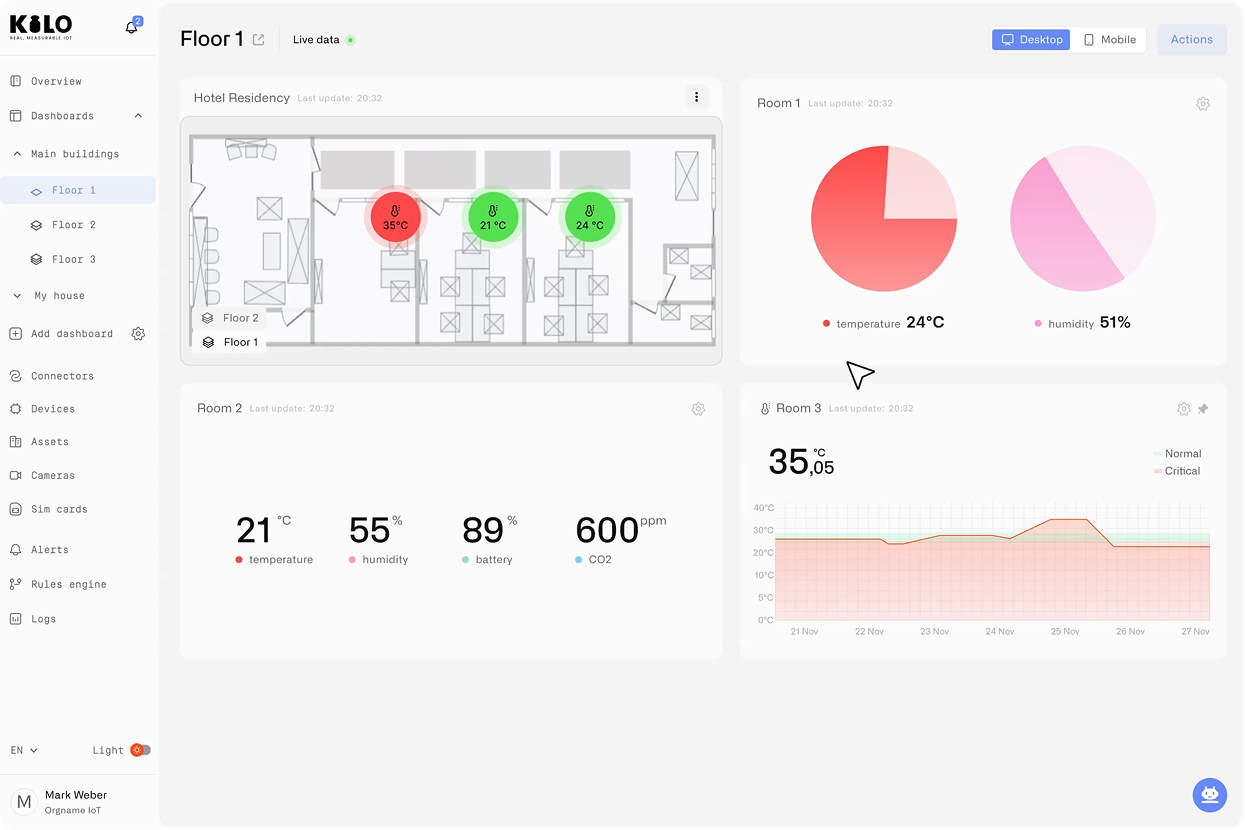
app.kiloiot.io · Live dashboard
LIVE New white paper: What is an operating system for physical AI? Read it →
AI Assistant
An AI IoT platform that answers — and acts
AIoT—the Artificial Intelligence of Things—connects AI with data from connected devices. In Kilo, the assistant can investigate readings, help configure devices and build automation using your deployment’s context. For physical actions, it works through supported commands and the platform’s operating controls.
Kilo · AI Chat
CONNECTED TO YOUR DEPLOYMENT
Two of your 14 cold stores exceeded 8 °C last night, both between 01:10 and 04:30:
COLD STORE 2 · PEAK 9.4 °C · 2H 40M ABOVE
COLD STORE 7 · PEAK 8.6 °C · 55M ABOVE
00:00 — 06:00 · °C above setpoint
Here is a rule draft to review and test before deployment:
Rule draft · “Cold store overnight drift”
Any cold store above 8 °C for 10 minutes → alarm to the Facilities on-call escalation chain.
Ask anything about your deployment…
01
Grounded, not guessing
Every answer is read from your live deployment the moment you ask — scoped to your permissions. If it can’t retrieve something, it says so.
02
It acts, it doesn’t just advise
It provisions devices, writes and tests rules, and sets up alarms with escalation chains. It does the work, not just the talking.
03
It remembers — and it confirms
“Make it 15 minutes instead of 10.” Multi-turn memory shapes automations in conversation. Direct device commands in the built-in assistant ask for confirmation before dispatch.
Physical AI
Physical AI with tested automation and controlled device actions
An AI model can understand a request. It also needs device context and a supported way to carry it out. Kilo brings different IoT connections into one operating layer, with configured commands, workflow testing, version history and feedback from connected equipment.
Explore the Physical AI platform→02 · TEST
Debug rules with mock responses
03 · APPROVE
Review direct assistant commands
04 · VERIFY
Inspect command status and feedback
Modular by design
The IoT platform and the hardware — take one or both
Use the full stack or only the parts you need — either way, we make IoT as easy as possible.
Kilo Cloud
The IoT platform
Device management, dashboards, rules, alarms, AI — every site and sensor in one place, streaming in real time.
Explore the platform →
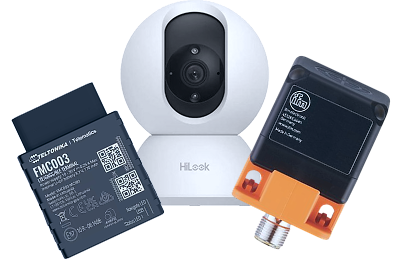
Kilo Electronics
The IoT hardware
Source sensors and gateways from the Kilo Electronics store — and have us pre-configure them, so devices arrive ready to plug in.
Browse hardware →
IoT made easy
Don't want to configure anything? We ship hardware pre-configured, connectivity included, dashboards and alarms ready — plug it in and it works.
The platform
IoT monitoring, automation, and alarms that work as one
Everything between a sensor reading and the right action: real-time dashboards, IoT automation you can trust in production, a live 3D model of your property, and alerts that always reach someone.
Rules Engine
Low-code IoT automation that does more than send alerts
Combine sensor readings, choose a response, and send a configured device command from one visual workflow. Test with mock responses, build and deploy deliberately, and restore an earlier rule version when you need to revise the running logic.
- Step-through debugging
- Version history & rollback
- Decision tables
- Multi-device conditions
- Closed-loop device commands
- CEL expressions, sandboxed
app.kiloiot.io · Rules engine
Real productapp.kiloiot.io · Digital building twin
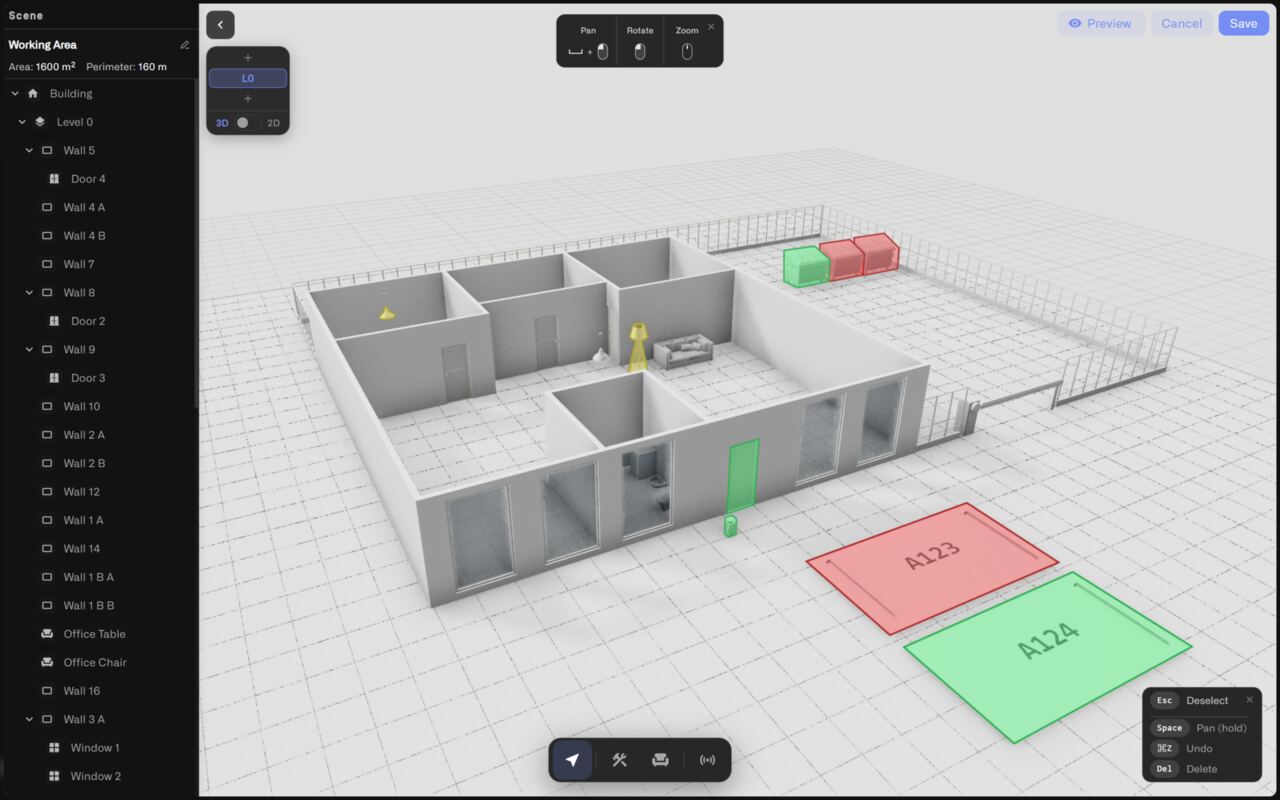
The built-in editor — walls, floors, objects, and live sensor bindings
Digital Building Twin
Your whole property, in one live 3D model
Draw walls and floors, import a DXF plan, or trace your building from an aerial map. Then bind any sensor to any object for a true smart-building view — the model recolors itself in real time as readings arrive. A cold store shades amber, an occupied bay turns red, a faulting pump stands out instantly.
- Built-in 3D editor — no CAD license
- DXF plan import
- Multi-floor buildings
- 60+ ready-made 3D objects
- Live conditional colors
- GPS-anchored to the real world
Alarms & Escalation
Alerts that keep climbing until someone responds
Remote monitoring that refuses to give up: every alarm carries an escalation chain, and if the first responder doesn't resolve it, the next tier is notified — by email, SMS, or push. Critical alarms break through silenced phones with Apple-approved Critical Alerts. Resolving the alarm stops the chain.
- Ordered escalation tiers
- Email · SMS · push, per tier
- Five severity levels
- Quiet-hour schedules
- Suppression windows
- iOS & Android responder app
app.kiloiot.io · Alarms
Real productProduction controls
AI device control with permissions, testing and version history
Physical actions need more than a clever model. Kilo supplies the controls between a request and a real device.
01
Permission inheritance
An agent can never see or change more than the signed-in user is allowed to.
02
Direct command confirmation
The built-in assistant confirms direct device commands. Configure and test tool approvals separately in external MCP clients. Deliberately configured rules can run commands autonomously.
03
Test side effects
For supported side-effect nodes, Execute runs the real operation and is selected initially. Select Skip or Mock deliberately to test without that operation.
04
Restore a rule draft
Restoring a rule creates a new draft version. Build and deploy it separately; restoration does not undo past physical effects.
05
Configured device commands
Use existing command definitions with typed parameters and configured limits. Check delivery status and optional device-state verification separately from the physical result.
06
Execution and version history
Inspect command execution records and rule version history; check the feedback available from your equipment.
Solutions
IoT monitoring solutions for every asset — fixed or moving
From a single basement sump pit to a fleet across three countries — with affordable IoT sensors and one platform. Start with the problem that hurts most; Kilo covers the rest.
Dock 3 DRY
Water leak detection
Catch the drip under the boiler before it becomes the flood in the basement.
Learn more →
Freezer 1 −18.4 °CCold storage monitoring
Every fridge and freezer verified around the clock — with proof for the auditor.
Learn more →
Tank 4 65 %Tank level monitoring
Fuel, water, and chemicals measured remotely. No more drive-outs to check a gauge.
Learn more →
Main feed 48.2 kWEnergy monitoring
Building energy monitoring that shows which floor or machine is quietly burning money.
Learn more →
Pump 2 VIB +12 %Predictive maintenance
Vibration sensors hear a failing pump weeks before it stops.
Learn more →
Trailer 18 ON ROUTEAsset & fleet tracking
Trailers, machines, and vehicles on one live map — 2,000+ tracker models supported.
Learn more →
Hall B 612 ppmIndoor air quality
Indoor air quality monitoring — CO₂, humidity, and temperature where people work, learn, and sleep.
Learn more →
Field 7 31 % VWCSoil & agriculture
Soil moisture, grain bins, and livestock water — even where there’s no power or Wi-Fi.
Learn more →
For operations teams
No IT department required
A complete IoT monitoring system without an IT team: battery-powered sensors that run for years, one gateway that covers the whole site, and rules you set once — in plain language, with the AI, or with our team building it for you.
- Premade templates for popular sensors — enter credentials, see data
- Alerts that escalate until someone acts
- From €25/month; free for your first 5 devices
- Done-for-you deployments for multi-site operators
For integrators & OEMs
Depth where it matters
An industrial IoT platform with depth: bring any hardware and map unknown payloads inline, no support ticket. Isolated organizations, attribute-based access control, and an immutable audit trail make multi-tenant deployments a first-class citizen.
- LoRaWAN + mioty network servers built in — nothing to host
- REST + gRPC APIs, WebSocket & SSE streams
- Inline payload normalization for prototype and legacy hardware
- KiloCenter — our open-source mioty service center product — on GitHub
FAQ
IoT platform FAQ — what operators ask us
What is an AI IoT platform (AIoT)?
AIoT — the Artificial Intelligence of Things — means the AI is built into the core of the IoT platform, not bolted on as a chat box. On an AIoT platform like Kilo, the assistant reads your live deployment, answers questions about any site or sensor, and can act: provision devices, write and test rules, and set up alarms with escalation chains — always confirming before anything consequential.
Which devices and sensors work with Kilo?
Any LoRaWAN or mioty device — the network servers are built in — plus any MQTT-capable hardware, which covers Zigbee, Modbus, BACnet, and OPC-UA bridges, energy meters, PLCs, and custom firmware. GPS and vehicle trackers are supported with over 2,000 preconfigured templates. Popular sensors have ready-made templates for instant IoT device monitoring; anything else is mapped in minutes with inline payload normalization.
Do I need to run my own LoRaWAN network server?
No. Kilo includes a fully integrated LoRaWAN network server — joins, uplinks, downlinks, and deduplication are handled for you. Any gateway that speaks the LoRa Basics Station protocol works; there is nothing separate to deploy or maintain.
How do escalation chains work?
Every alarm carries an ordered chain of steps. The first tier is notified immediately; if nobody resolves the alarm, later tiers fire after their configured delays — each with its own recipients and channels (email, SMS, push). Critical alarms break through silenced phones via the mobile app. Resolving the alarm stops the chain.
Can Kilo run on-premise?
Yes. Kilo Cloud is the managed option, and Kilo On-Premise is the same server self-hosted on your infrastructure — with the same API. Many operators start in the cloud and keep on-premise as an option for specific projects.
What does Kilo cost?
The Free plan covers your first 5 devices with no payment details required. Paid plans start at €25/month and scale with your deployment up to enterprise agreements. There are no gateway fees and no per-user seats.
Setup MINUTES
Know before it breaks
The most expensive failures are the quiet ones. Put a sensor on it, set a rule once, and let Kilo watch — day and night.