 English
  Français
  Español
  Deutsch
  Português
  Italiano
  العربية
 AI AGENT
AI agent reasoning grounded in IoT data
Reason across live telemetry, historical sensor data, site context, and operating policy.
IoT Platform
More products
Explore
Kilo Physical AI Platform
Kilo is the reliable, scalable IoT execution server between AI agents and real-world devices—normalizing sensor data, governing commands, and returning consistent, verifiable results.
MCP · REST · gRPC · Built-in AI · Cloud or on-premise
AI INTENT
“Keep this cold room below 4°C without creating a false alarm.”
Live IoT context loaded
Temperature, door state, command definitions, and recent history
IoT automation simulated
Trigger and non-trigger readings tested; side effects captured
AI-proposed change approved and deployed
Versioned build enters production after confirmation
Device command verified
Controller response and outcome retained in execution history
Consistent IoT data. Controlled device action. Verifiable physical result.
Physical AI infrastructure
AI agents can reason, but controlling real-world devices carries consequences. Kilo handles IoT protocols, live device state, permissions, failure paths, and operational evidence that a language model should never have to improvise.
AI AGENT
Reason across live telemetry, historical sensor data, site context, and operating policy.
SAFE DEVICE CONTROL
Expose consistent device capabilities, enforce boundaries, execute the command, and return the verified result.
OBSERVE
For AI model companies and agent platforms
Kilo gives teams building general-purpose intelligence a mature physical-world control layer they can integrate instead of rebuilding: one professional platform for heterogeneous IoT devices, safe execution, and enterprise operations.
01
Let models observe and operate sensors, machines, buildings, fleets, and future robotic systems through one integration.
02
Kilo already handles protocols, device models, multi-tenancy, deployment, monitoring, failure states, and real-world command delivery.
03
Simulation, approvals, typed commands, verification, execution history, and rollback turn AI intent into governable physical operations.
Safe AI device control
Kilo governs the complete Physical AI control loop. The AI agent does not connect around your operational controls.
01
Read normalized telemetry and live device state.
02
Ground the AI decision in real operations.
03
Test logic and capture side effects safely.
04
Apply permissions and human confirmation.
05
Run typed commands or deployed IoT rules.
06
Follow the command lifecycle and keep the record.
07
Keep execution history and restore known-good logic.
Physical AI example
“Keep this cold room below 4°C without creating a false alarm.”
The AI agent request is accepted inside the operator’s organization and permission scope.
Consistent IoT data. Controlled device action. Verifiable physical result.
Temperature, door state, command definitions, and recent history
Trigger and non-trigger readings tested; side effects captured
Versioned build enters production after confirmation
Controller response and outcome retained in execution history
Production controls
Physical actions need more than a clever model. Kilo supplies the controls between a request and a real device.
01
An agent can never see or change more than the signed-in user is allowed to.
02
Consequential and destructive changes pause for explicit approval.
03
Rules are validated and simulated before they touch live infrastructure.
04
Every automation change is versioned and a known-good build is one click away.
05
Parameter bounds constrain actions; optional verification confirms the device responded.
06
Commands, deployments, permission changes, and outcomes remain auditable.
MCP and IoT APIs
Use Kilo with OpenAI, Anthropic, another MCP-capable AI agent, the built-in assistant, or your own services. Every integration works against the same digital device models, IoT data, permissions, and organization boundary.
INSIDE KILO
Ask about live and historical telemetry, provision devices, build and simulate rules, and configure alarms in plain language.
YOUR AI CLIENT
Connect ChatGPT, Claude, Codex, Cursor, or another MCP client. Sign in with your Kilo account; the agent inherits exactly your permissions.
Proof, not a mock-up
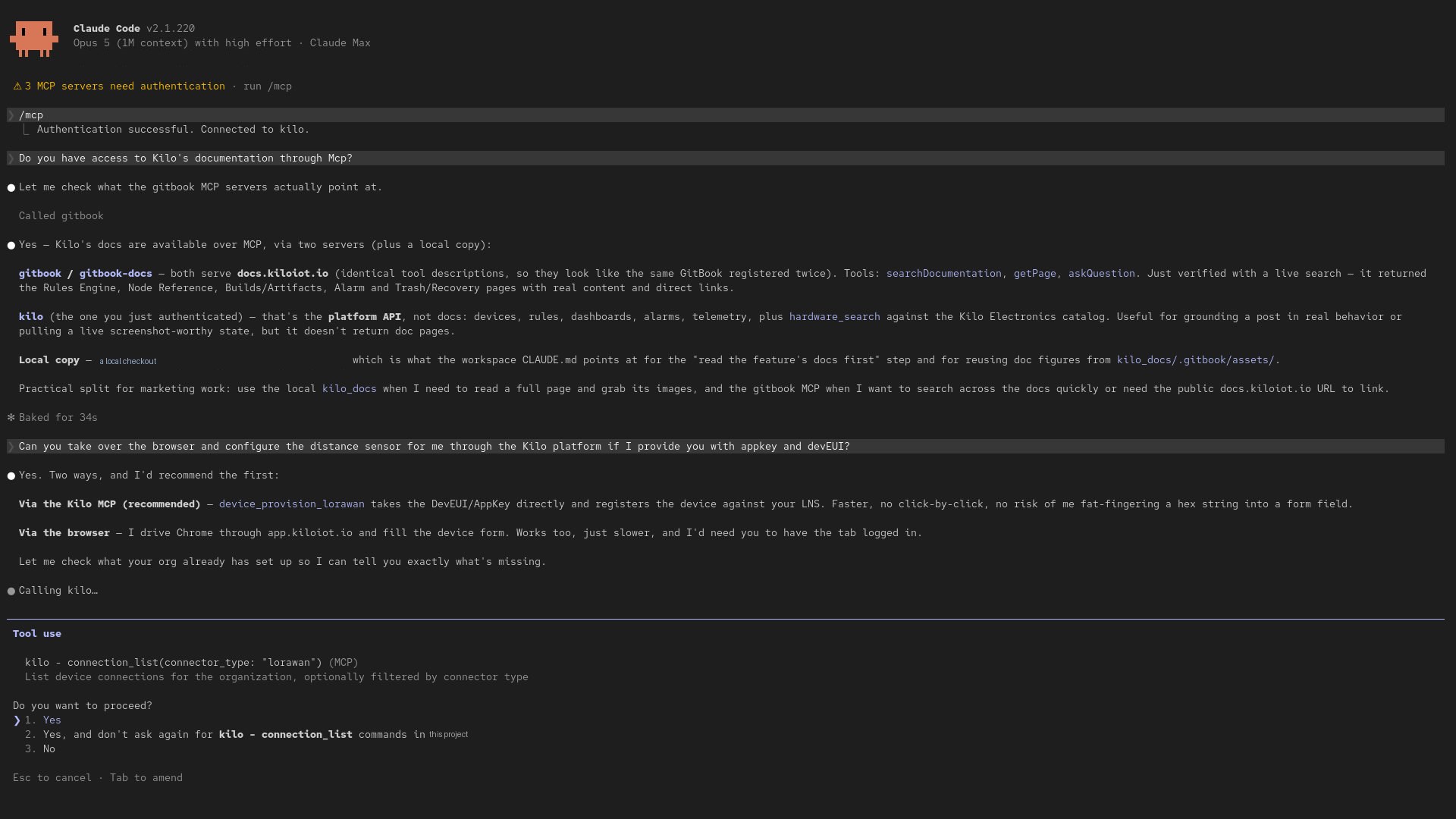
A Claude Code session signed in to a live Kilo organization over MCP. It is asked to configure a LoRaWAN distance sensor, recommends provisioning through the platform rather than driving the browser, calls a real Kilo tool, and stops for permission before continuing.
Enterprise Physical AI platform
Production AI device control needs durable, secure IoT infrastructure—not a collection of fragile demo integrations.
GO
A deliberately designed service architecture built for concurrent, real-time IoT operations.
HA
Fault-tolerant cloud operation, durable data, and deployment from pilot to multi-site device fleets.
ABAC
Fine-grained permissions and strict organization boundaries govern every connected AI client.
CLOUD / ON-PREM
Use managed Kilo Cloud or retain infrastructure control with an on-premise IoT Server.
MULTI-PROTOCOL
LoRaWAN, mioty, MQTT, cellular, APIs, and gateways converge into consistent device state.
NO LOCK-IN
Bring your devices, connectivity, and preferred AI provider without rebuilding the control layer.
Built for operations
CO₂ · LEAKS · ENERGY · ACCESS
Understand conditions across sites, coordinate alarms, and command connected HVAC, valves, gates, and controls.
VIBRATION · POWER · UPTIME
Reason across vibration, temperature, power, and machine state before a rule or operator takes action.
GPS · CAN · TEMPERATURE
Combine position, vehicle telemetry, geofences, and alerts across thousands of tracker models.
WATER · SOIL · WEATHER · TANKS
Operate remote sites where batteries last for years and there is no Wi-Fi or mains power.
The next input layer · Coming soon
Organize supported RTSP and ONVIF cameras across sites, recordings, motion zones, videowalls, and scoped access — next to the sensors and device state Kilo already understands.
Preview Kilo Lens→Physical AI platform
A Physical AI platform connects AI reasoning to sensors, machines, and connected infrastructure. Kilo supplies normalized IoT data, digital device models, governed commands, automation, verification, and audit history so AI agents can observe and act in the real world.
Kilo applies the signed-in user’s permissions, typed command parameters, approval gates, tested and versioned rules, execution history, device-response verification, and rollback before or after an AI-proposed physical action.
Kilo’s MCP server exposes authorized IoT data and device tools to compatible AI clients through OAuth. The client works with consistent device models and remains inside the user’s organization and permission scope.
Yes. ChatGPT, Claude, Codex, Cursor, or another MCP-capable client can connect to Kilo, subject to client support and your Kilo permissions. OpenAI, Anthropic, Ollama, and compatible models can also power the built-in assistant.
Kilo is the governed Physical AI and IoT execution layer behind connected systems. Robots and controllers can integrate through supported protocols and APIs while Kilo handles telemetry, permissions, automation, commands, verification, and auditability.
Connect through MCP, evaluate the Physical AI platform with five IoT devices, or design an enterprise architecture with us.
Read the developer docs →