
 English
  Français
  Español
  Deutsch
  Português
  Italiano
  العربية
 Kilo Center
mioty Service Center
Run your own mioty network infrastructure.
Kilo Center is an open-source mioty Service Center built natively for the mioty protocol — not adapted from another LPWAN stack. Manage base stations, devices, and tenants through a clean web interface. A gRPC-first API provides a universal integration layer for scalable, self-hosted deployments.
Kilo Center
AGPL-3.0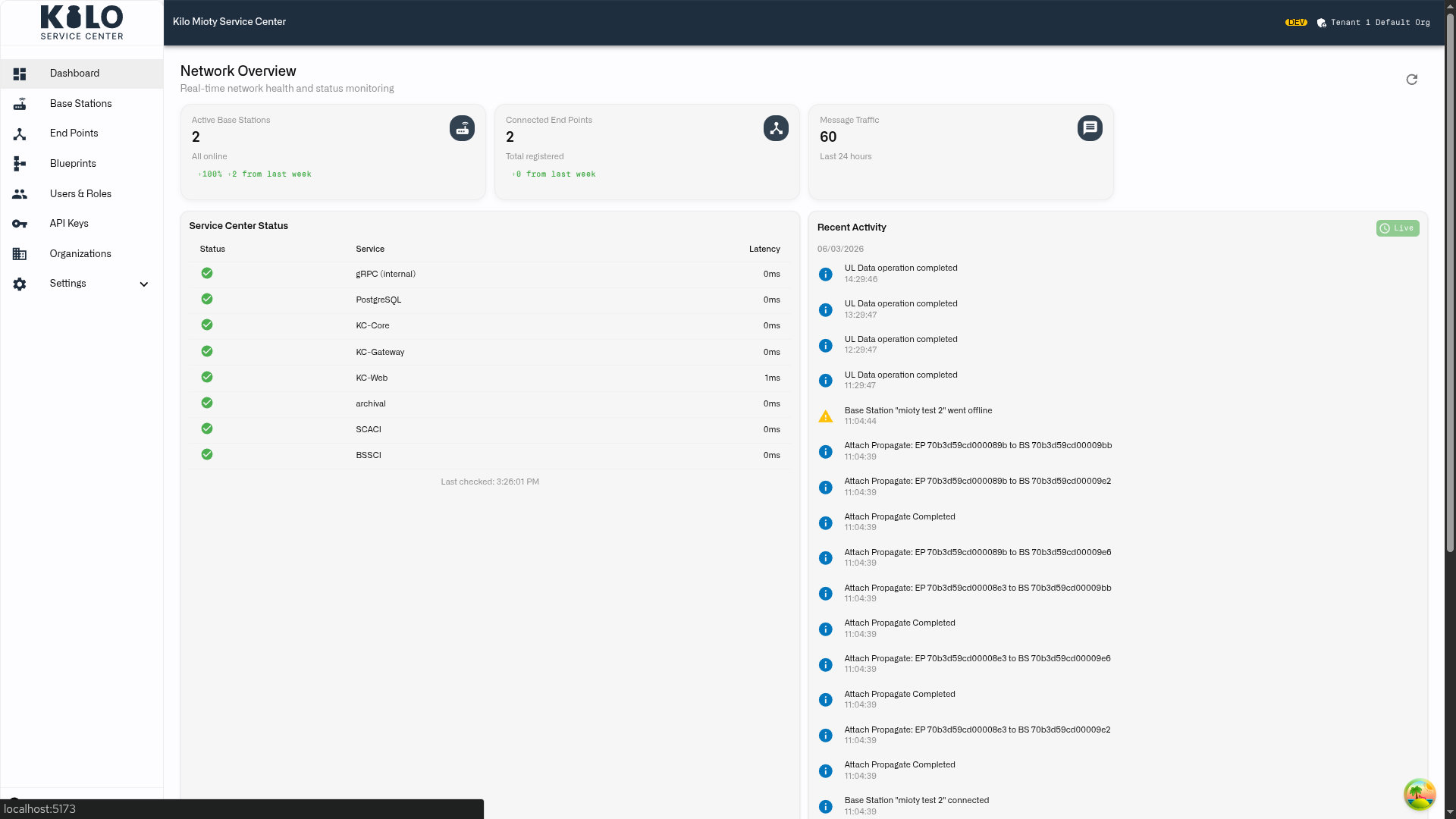
mioty by the numbers
1M+
telegrams per base station, per day
50%
of sub-packets can drop — message still arrives
15 km
range in rural line-of-sight (up to)
20 yrs
battery life on a single cell (up to)
A new wave of LPWAN built for massive industrial IoT
What is mioty?
mioty is a low-power wide-area network (LPWAN) standard built for the industrial Internet of Things. Standardized by ETSI (TS 103 357) and developed at the Fraunhofer Institute, it runs in the license-free sub-GHz spectrum and is engineered for one job: moving small amounts of sensor data reliably, at massive scale, from battery-powered devices that need to last for years.
Where first-generation LPWAN technologies trade range for capacity or robustness, mioty uses a technique called telegram splitting to stay reliable even in crowded, interference-heavy radio environments. That makes it a natural fit for factories, utilities, smart buildings, and large outdoor sensor fleets where thousands of devices share the same airspace.
How telegram splitting works
Instead of sending each message as one radio transmission, mioty splits every telegram into many small sub-packets. Each sub-packet lasts only a few milliseconds and is spread pseudo-randomly across different frequencies and points in time, following a defined time-and-frequency pattern.
Forward error correction is layered on top, so the receiver only needs about half of the sub-packets to rebuild the complete message — up to 50% of the radio bursts can be lost to interference, collisions, or fading and the data still arrives intact. Because each burst occupies the channel for only a brief instant, a single base station can decode huge numbers of overlapping transmissions at once. That is what gives mioty both its capacity and its resilience.
50% · of sub-packets can drop — message still arrives
mioty vs LoRaWAN
Both mioty and LoRaWAN are sub-GHz LPWAN technologies, but they handle scale differently. LoRaWAN sends each message as a single transmission, so in dense deployments simultaneous messages collide and packets are lost. mioty splits every message into short sub-packets scattered across time and frequency, so one base station can decode far more concurrent devices with much lower collision loss.
That makes mioty a natural fit for high-density industrial sensor fleets where thousands of devices share the same airspace. Kilo Center runs a native mioty network — not a LoRaWAN platform adapted to mioty — with the same web console and gRPC-first API.
Read the full mioty vs LoRaWAN comparison →Kilo Center
Why run mioty on Kilo Center
Kilo Center is an open-source mioty network server — a service center built natively for the mioty stack, not forked from a LoRaWAN platform. Base stations connect over the TLS-secured BSSCI protocol, applications integrate through SCACI, MQTT, and a gRPC / gRPC-web API, and operators manage base stations, endpoints, and traffic from a clean web console.
Because it is self-hosted (Docker or Linux) and released under AGPL-3.0, you own your data and your infrastructure end to end. Register base stations and endpoints, watch uplink and downlink traffic in real time, and feed mioty data into your own systems through one universal API surface.
Run your own mioty network infrastructure.
Kilo Center is an open-source mioty Service Center built natively for the mioty protocol — not adapted from another LPWAN stack. Manage base stations, devices, and tenants through a clean web interface. A gRPC-first API provides a universal integration layer for scalable, self-hosted deployments.