
 English
  Français
  Español
  Deutsch
  Português
  Italiano
  العربية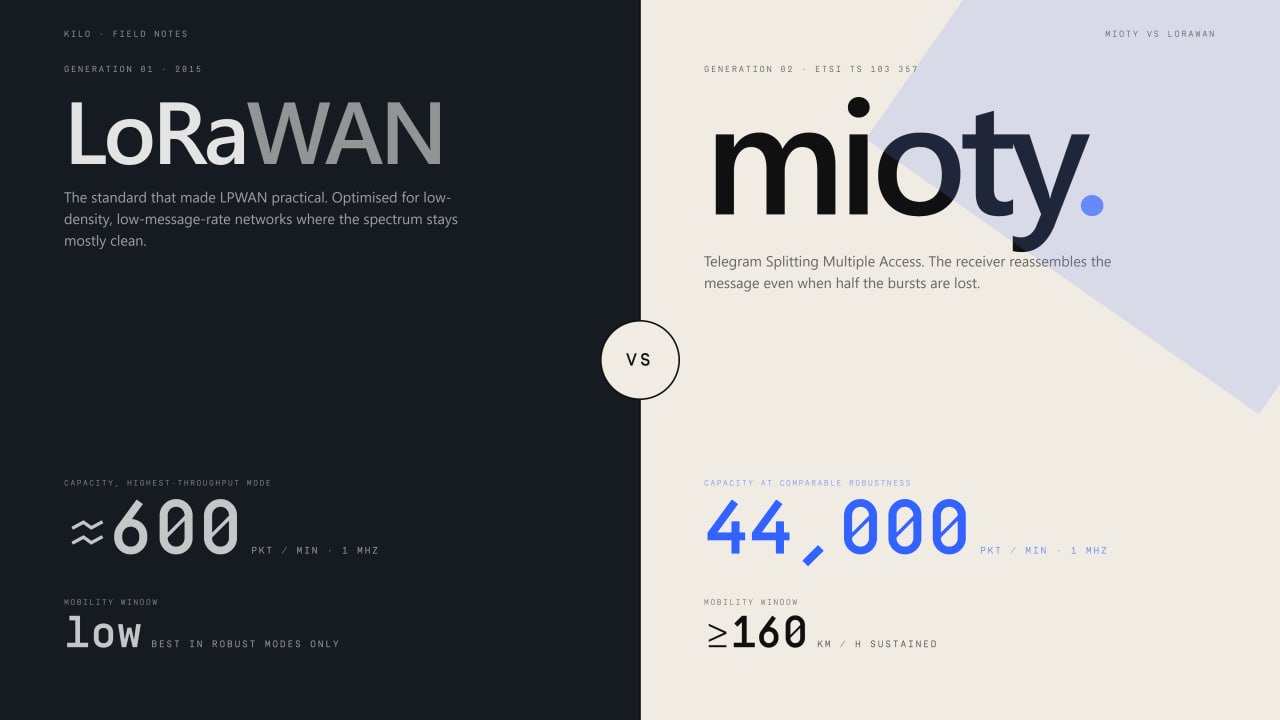
LoRaWAN is one of the reasons I got interested in IoT in the first place.
I still remember when low-power, long-range wireless finally clicked for me. You could take a small battery-powered sensor, place it far away from normal infrastructure, and still get data back without Wi-Fi, without a cellular modem in every device, and without running cable everywhere.
That was exciting. It still is.
LoRaWAN helped make IoT feel practical. It gave developers, cities, businesses, and makers a way to build real sensor networks without needing expensive infrastructure at every location. For agriculture, metering, asset tracking, facility monitoring, smart buildings, and many private sensor networks, LoRaWAN has done a lot for the industry.
LoRaWAN is great technology.
It is also not the best technology for every problem.
That distinction matters. LoRaWAN helped create the LPWAN market and still has a much more developed device ecosystem than mioty. If you need off-the-shelf sensors today, there are simply more LoRaWAN devices available. That is a real advantage, and it should not be ignored.
But when the question shifts from "what has the biggest ecosystem?" to "what is better for dense, interference-heavy, industrial IoT deployments?" the answer changes.
In those environments, mioty has a clear technical advantage.
First does not always mean best.
As IoT moves from pilots to real industrial deployments, the requirements change. It is one thing to connect a few sensors to a gateway and show data on a dashboard. It is another thing to build a network where thousands or tens of thousands of sensors need to report reliably in a noisy radio environment, around metal structures, inside buildings, across utility sites, in logistics yards, or in cities where many devices are competing for the same spectrum.
That is where the comparison between mioty and LoRaWAN becomes important.
Both are LPWAN technologies. Both are designed for low-power, long-range IoT. But they are built on very different ideas. LoRaWAN sends packets using the LoRa physical layer and manages devices through gateways and network servers. mioty uses Telegram Splitting Multiple Access, or TSMA, where each message is split into many small radio bursts and sent across time and frequency.
That sounds like a technical detail, but it changes how the network behaves in the real world.
mioty vs LoRaWAN Capacity: Why Reliable Packet Throughput Matters More Than Device Claims
When people compare LPWAN technologies, they often ask how many devices one gateway or base station can support.
It is an understandable question, but it can also be misleading.
A device that sends one message per day is very different from a device that sends one message every minute. The real limit is not just how many devices are registered. The real limit is how much traffic the network can carry while still delivering messages reliably.
This is where mioty starts to stand out.
Fraunhofer IIS states that mioty can handle around 3.5 million messages per day with one base station. The mioty Alliance also positions mioty as a technology for massive IoT networks with very large endpoint fleets and high daily message volume.
Sometimes this gets simplified into a claim like "one mioty base station supports 160,000 devices." That number can make sense under a specific traffic model, but it needs context. If a base station can process about 3.5 million messages per day, and each device sends one message per hour, then each device sends 24 messages per day. That gives you roughly 145,000 hourly-reporting devices.
That is the right way to think about it.
Not as a magic fixed number, but as a capacity question.
If your devices report rarely, you can support a very large fleet. If they report frequently, the number changes. What matters is that mioty gives you a much larger traffic budget before the network starts to feel crowded.
LoRaWAN Gateway Capacity vs mioty: Why 44,000 Packets per Minute Changes the Conversation
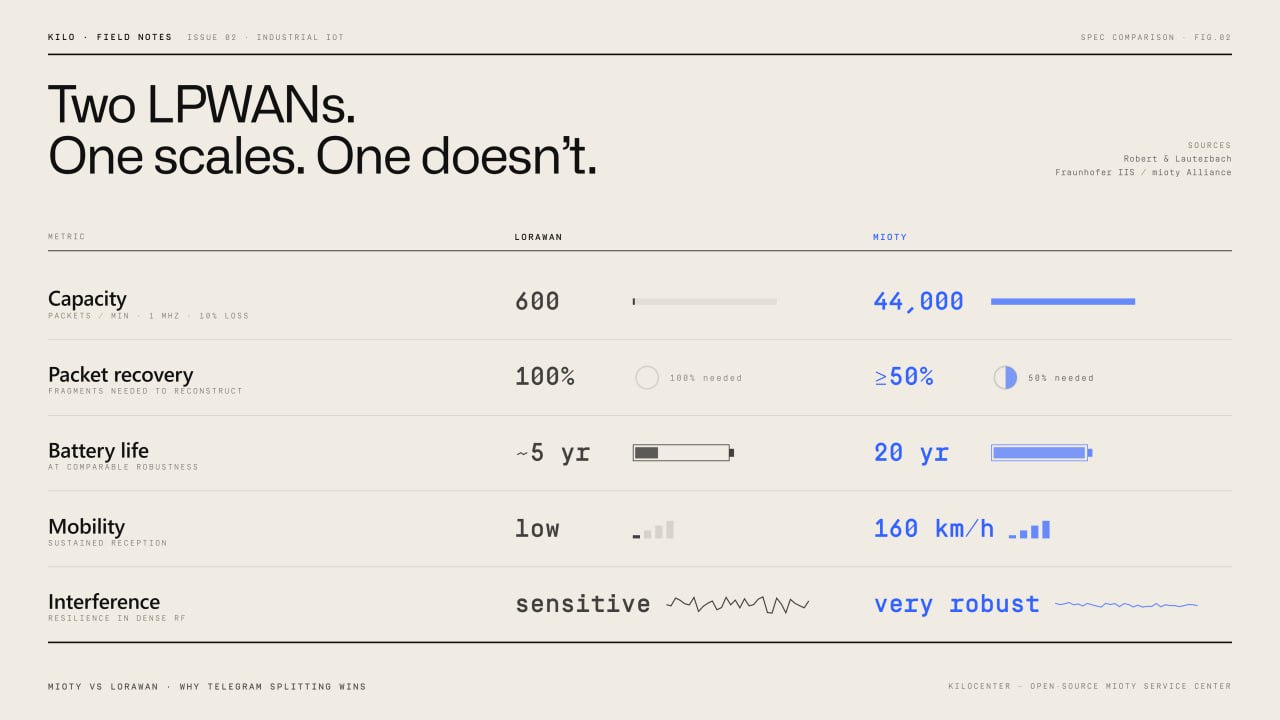
One of the strongest comparisons I have seen comes from a published study comparing mioty and LoRa. The study found that mioty can support about 44,000 packets per minute in 1 MHz bandwidth at a 10% packet loss rate. LoRa reached about 600 packets per minute in a lower-robustness mode, and about 40 packets per minute in its highest-robustness mode.
That is a huge difference.
But it is important to say this correctly. The "600" number is not "600 devices." It is roughly 600 packets per minute under a specific LoRa configuration. In a real LoRaWAN deployment, the number of devices per gateway depends on payload size, spreading factor, channel plan, duty cycle, retransmissions, acknowledgments, gateway density, and how often each device sends data.
Still, the comparison matters because it shows the direction of the technology.
LoRaWAN can scale well when messages are infrequent and conditions are manageable. mioty was designed for the moment when the network becomes dense, traffic increases, and interference becomes part of everyday reality.
And I have seen that problem personally.
When I go to TTN conferences and LoRaWAN events, I meet people building genuinely impressive devices. The creativity in that community is one of the reasons LoRaWAN became so important.
But I also see the limitations very clearly.
In a room full of gateways, sensors, demos, and people trying to show their devices at the same time, interference becomes very real. Sometimes the hardest part of the demo is not the hardware. It is getting the message through.
And that is the point.
In crowded RF environments, LoRaWAN struggles. You can work around it, plan around it, reduce traffic, tune spreading factors, add gateways, and design carefully. But the underlying issue remains: as density and interference increase, packet delivery becomes harder.
mioty was built for exactly that problem.
That is why I do not see mioty as just another LPWAN option. I see it as the better technology for dense industrial deployments where message reliability matters.
LoRaWAN Alternative for Dense Sensor Networks: Why mioty Uses Telegram Splitting
The core difference between mioty and LoRaWAN is telegram splitting.
With a traditional packet-based approach, a device transmits a packet and the receiver has to receive enough of that packet cleanly. If the packet is hit by interference, collision, or poor signal conditions, the message may be lost.
mioty works differently.
It splits a message into many small sub-packets, often called radio bursts. Those bursts are sent across different moments in time and different frequencies. The base station does not need every burst to arrive perfectly. Because of forward error correction, the receiver can reconstruct the original message even if a significant portion of the bursts are lost.
In practical terms, mioty can reconstruct the complete information even if up to half of the telegram pieces fail or are transmitted incorrectly.
That is the part that makes mioty exciting to me.
Telegram splitting is not just a clever radio trick. It is a different mindset. It assumes the real world is messy. It assumes interference will happen. It assumes collisions will happen. It assumes that some pieces of the message may disappear.
And then it still gives the network a way to recover the data.
That is the difference between building something that works nicely in a demo and something that starts to feel like infrastructure.
Best LPWAN for Industrial IoT: Why Interference Resistance Matters More Than Demo Performance
Interference is not some rare edge case in industrial IoT. It is part of the environment.
Factories have machinery, metal structures, moving equipment, electrical noise, walls, pipes, tanks, and all kinds of signal reflections. Cities have buildings, basements, utility cabinets, other wireless systems, and dense device populations. Logistics yards have containers, trucks, vehicles, warehouses, and constantly changing physical layouts.
A small pilot may not reveal these problems. You set up a few devices, place a gateway nearby, get clean readings, and the dashboard looks great. Then the deployment grows. More sensors are added. Some are placed indoors. Some are installed behind concrete. Some are mounted near machinery. Some start sending more often than expected. Other wireless devices appear in the same space.
At that point, the question is no longer whether the sensor works.
The question is whether the network keeps working when the deployment becomes real.
This is where mioty's design matters. Because each message is distributed across time and frequency, a single interference event is less likely to destroy the whole message. The network can lose some pieces and still reconstruct the data.
That is why the mioty and LoRaWAN comparison becomes especially important for dense industrial IoT. It is not just about range on a spec sheet. It is about whether the network can continue to deliver messages when the radio environment becomes crowded and unpredictable.
mioty vs LoRaWAN Range: Why Reliable Coverage Matters More Than Ideal Lab Distance
Range is always one of the first things people ask about in LPWAN.
How far can it go?
That question is useful, but it is incomplete. In industrial IoT, the better question is: how far can it go while still being reliable in the actual environment where it has to operate?
A clean outdoor range test is not the same as a factory, a port, a warehouse, a utility network, or a smart building. Metal reflects signals. Machinery creates noise. Walls, tanks, containers, vehicles, and people change the radio environment. In cities, there are many other devices sharing the spectrum.
LoRaWAN can achieve excellent range in the right conditions, especially with higher spreading factors. But higher spreading factors increase airtime, which reduces network capacity and affects battery life. That tradeoff matters.
mioty takes a different approach. By splitting messages across time and frequency, it reduces the chance that a single interference event destroys the entire message. This can improve the effective range of the network in difficult environments because the receiver does not need one perfect continuous packet. It only needs enough of the bursts to reconstruct the message.
That is the difference between theoretical range and useful range.
For utilities, factories, campuses, ports, water networks, smart buildings, and smart cities, useful range is what matters. A long range IoT sensor network has to work after installation, not just in a clean test. Coverage gaps usually do not appear during the cleanest test. They appear when the real deployment starts.
mioty vs LoRaWAN Battery Life: How Robust Communication Reduces Power Waste
Battery life is another place where the comparison gets more interesting than it looks at first.
LoRaWAN can be very efficient when the device is close to the gateway and can use a low spreading factor. In that situation, airtime is short and the device can spend most of its life asleep. That is one reason LoRaWAN is so useful.
But when conditions become harder, LoRaWAN often needs higher spreading factors to improve robustness and range. Higher spreading factors mean longer airtime. Longer airtime means more energy used per message and less available network capacity.
So the fair comparison is not simply: which technology uses less power in the easiest mode?
The fair comparison is: which technology gives you reliable delivery while keeping the device efficient?
This is where mioty becomes interesting. Because telegram splitting makes messages more resilient, mioty can achieve strong robustness without relying on long continuous airtime in the same way. The mioty Alliance lists endpoint energy consumption of 17.8 μWh per message at 868 MHz and positions mioty for battery life of more than 20 years in suitable deployments.
Of course, battery life always depends on the real device, message interval, payload size, battery chemistry, temperature, firmware, and sensor behavior. No serious engineer should promise "20 years" without context.
But the architecture matters.
If the radio layer is more resilient, you can spend less energy fighting the environment.
mioty vs LoRaWAN for Industrial IoT: Why Pilots Fail When Networks Get Dense
A lot of IoT pilots look good because pilots are usually controlled.
There are a few sensors. The gateway is nearby. The spectrum is not too crowded. The installer knows what is being tested. The dashboard updates. Everyone gets excited.
Then the project moves into the real world.
Suddenly the network has to deal with more devices, worse installation locations, less predictable behavior, and physical environments that were not part of the demo. Some devices are indoors. Some are in basements. Some are surrounded by metal. Some are moving. Some are placed where they are convenient for operations, not where they are ideal for RF performance.
This is where many IoT projects become harder than expected.
Not because IoT is a bad idea.
Because the wireless layer was treated as a detail.
For me, this is where mioty deserves more attention. It was designed for dense sensor networks. It was designed around the assumption that messages will collide, that the spectrum will be noisy, and that the network still has to recover useful data.
That makes it especially relevant for utilities, industrial condition monitoring, smart city infrastructure, logistics yards, ports, warehouses, tank monitoring, environmental sensing, and any private LPWAN network where thousands of small messages need to get through reliably.
To me, this is where IoT starts to become genuinely useful.
Not when we connect one sensor.
When we can trust thousands of sensors to report from the real world.
mioty vs LoRaWAN for Smart Safety Systems: From Exit Signs to Real-Time Emergency Guidance
One example I keep thinking about is fire escape signage.
Most exit signs today are dumb. They tell you where an exit is, but they do not know whether the route behind that sign is actually safe. In a fire, that can be a serious problem. A sign may point people toward an exit, but the corridor beyond it could be filled with smoke, heat, or an active fire zone.
Now imagine a building with reliable wireless sensors monitoring temperature, smoke, air quality, and occupancy across different zones. If those sensors can report through interference and difficult indoor conditions, smart signage could react in real time.
A green sign could mean that the exit route is available.
A red sign could mean: yes, there is an exit here, but do not go this way because there is fire or smoke ahead.
That is the type of IoT application that makes me excited.
Of course, life-safety systems need certification, redundancy, code compliance, and careful engineering. mioty by itself would not replace fire alarms, emergency lighting, or building safety standards. But as part of a smart building safety layer, reliable wireless sensing could make emergency guidance more dynamic and more useful.
This is the type of thing that makes me tick.
I am not excited by sensors because they create charts. I am excited by sensors because they allow physical systems to react to what is actually happening.
mioty vs LoRaWAN for Moving Assets: Why Mobility Makes Wireless Reliability Harder
Many industrial IoT assets do not sit still.
Containers move through yards. Tools move around sites. Equipment moves between buildings. Vehicles move through depots. Pallets move through warehouses. Even people and safety equipment move in ways that change the radio environment.
Movement makes wireless harder. The signal path changes. Reflections change. Distance changes. Obstructions change. The network has to deal with a physical world that is not static.
In comparative testing between mioty and LoRa, mioty showed strong performance at high mobility levels, while LoRa was more limited under the tested conditions.
Not every deployment needs high-speed mobility, of course. A water meter is not moving down a highway. But the result matters because it points to the same pattern: mioty is designed to keep communication robust when conditions are not ideal.
That is the theme running through this entire comparison.
LoRaWAN works well in many practical deployments.
mioty becomes especially compelling when the deployment becomes dense, noisy, mobile, or critical.
Hybrid LoRaWAN and mioty Networks: Why the Practical Answer Is Not One Protocol Everywhere
This is where the practical answer is not religious.
LoRaWAN still makes sense in many deployments because the ecosystem is more mature. There are more devices, more gateways, more integrators, more examples, more documentation, and more people who already know how to work with it.
That matters.
If a customer needs a sensor today and there is already a reliable LoRaWAN version available, it may be the right choice. If the deployment is low density, the traffic is light, the RF environment is manageable, and the application can tolerate the normal tradeoffs of LoRaWAN, there is no reason to force mioty into the project just because it is technically stronger in dense environments.
But where mioty devices are available, and where the deployment needs better interference resistance, higher capacity, stronger reliability, or better performance in difficult industrial conditions, mioty is the better choice.
That is why I think the future is not "LoRaWAN or mioty."
The future is hybrid.
Use LoRaWAN where the ecosystem gives you the best device availability and fastest deployment path. Use mioty where the network needs to be more robust, more scalable, and more reliable under pressure.
Thankfully, this is exactly how we think about Kilo Cloud. Kilo Cloud supports both LoRaWAN and mioty, so developers and companies do not need to lock themselves into one wireless technology. The right approach is to choose the best protocol for each part of the deployment and manage the data in one platform.
That is much more practical than pretending one LPWAN should solve every problem.
Open-Source mioty Server: Why KiloCenter Makes mioty Infrastructure Practical
This is also why we built KiloCenter.
The more I looked at mioty, the more obvious one thing became: the radio technology is only part of the story. If mioty is going to be useful in real deployments, developers need infrastructure they can actually run, inspect, and integrate.
LoRaWAN became successful partly because people could build with it. They could buy devices, deploy gateways, connect to network servers, and start experimenting. mioty needs that same practical path.
That is what KiloCenter is meant to provide.
KiloCenter is an open-source mioty server for developers, integrators, and companies that want to work with mioty directly. It gives teams a way to test mioty, connect base stations, onboard endpoints, process uplinks, handle downlinks, and connect the data into real applications.
And because Kilo Cloud supports both LoRaWAN and mioty, KiloCenter is not about forcing everyone to abandon LoRaWAN. It is about making mioty practical where mioty is the better tool.
For me, that matters because infrastructure should be something engineers can touch.
If we want mioty to grow, people need more than marketing claims about capacity and range. They need working tools. They need code. They need a way to connect hardware, receive messages, and build applications around the data.
That is the role I want KiloCenter to play.
Not as a random product added at the end of a blog post, but as a practical piece of the mioty ecosystem.
Open-source infrastructure helps make that possible.
mioty Service Center for Developers: Why Self-Hosting Matters
One of the reasons open-source infrastructure matters is control.
In industrial IoT, many companies do not want their entire network hidden behind a closed system. They want to understand how the data flows. They want to know how base stations connect, how endpoints are managed, how uplinks are processed, how downlinks are sent, and how the system integrates with the rest of their infrastructure.
That is why a self-hosted mioty server is valuable — and why we built KiloCenter, an open-source mioty Service Center.
It gives developers and operators a way to test mioty networks directly, build integrations, connect applications, and understand the full path from sensor to server. For system integrators and industrial teams, that can be the difference between treating mioty as an interesting protocol and actually being able to deploy it.
KiloCenter is meant to make that path easier.
It gives teams a practical starting point for building with mioty, experimenting with base stations and endpoints, and connecting mioty data into real applications.
For me, this is the most important part.
A protocol becomes useful when people can build with it.
mioty vs LoRaWAN Conclusion: LoRaWAN Built the Market, mioty Solves the Next Scaling Problem
LoRaWAN helped many of us imagine what low-power IoT could become.
It is still useful. It is still practical. It still has the stronger device ecosystem. In many deployments, that matters more than theoretical performance.
But when industrial IoT moves from small deployments to dense infrastructure, the requirements become more serious. Interference matters more. Battery life under difficult conditions matters more. Network capacity matters more. Reliability matters more.
And when a message represents something important, such as smoke in a corridor, water rising near a riverbank, a machine starting to fail, or a blocked escape route, packet delivery is not just a technical metric.
It becomes the difference between knowing and not knowing.
That is where mioty is better.
Telegram splitting is a more realistic way to think about communication in messy environments. It accepts that the world is noisy, that packets collide, and that not every piece of a message will survive. Then it gives the network a way to recover anyway.
That is the kind of engineering industrial IoT needs.
So the real answer is not that every LoRaWAN deployment should become a mioty deployment. The real answer is that industrial IoT needs both. LoRaWAN gives you maturity and device availability. mioty gives you stronger reliability and scalability where the network is under pressure.
With Kilo Cloud supporting both LoRaWAN and mioty, and KiloCenter making open-source mioty infrastructure available to developers, teams do not need to choose one side forever.
They can use the right wireless technology for the right job.
That is what makes this exciting to me.
Not the protocol name. Not the buzzwords. Not even the statistics.
The exciting part is what becomes possible when wireless sensing becomes reliable enough to trust in the real world.