
 English
 Français
 Español
 Deutsch
 Português
 Italiano
 العربية
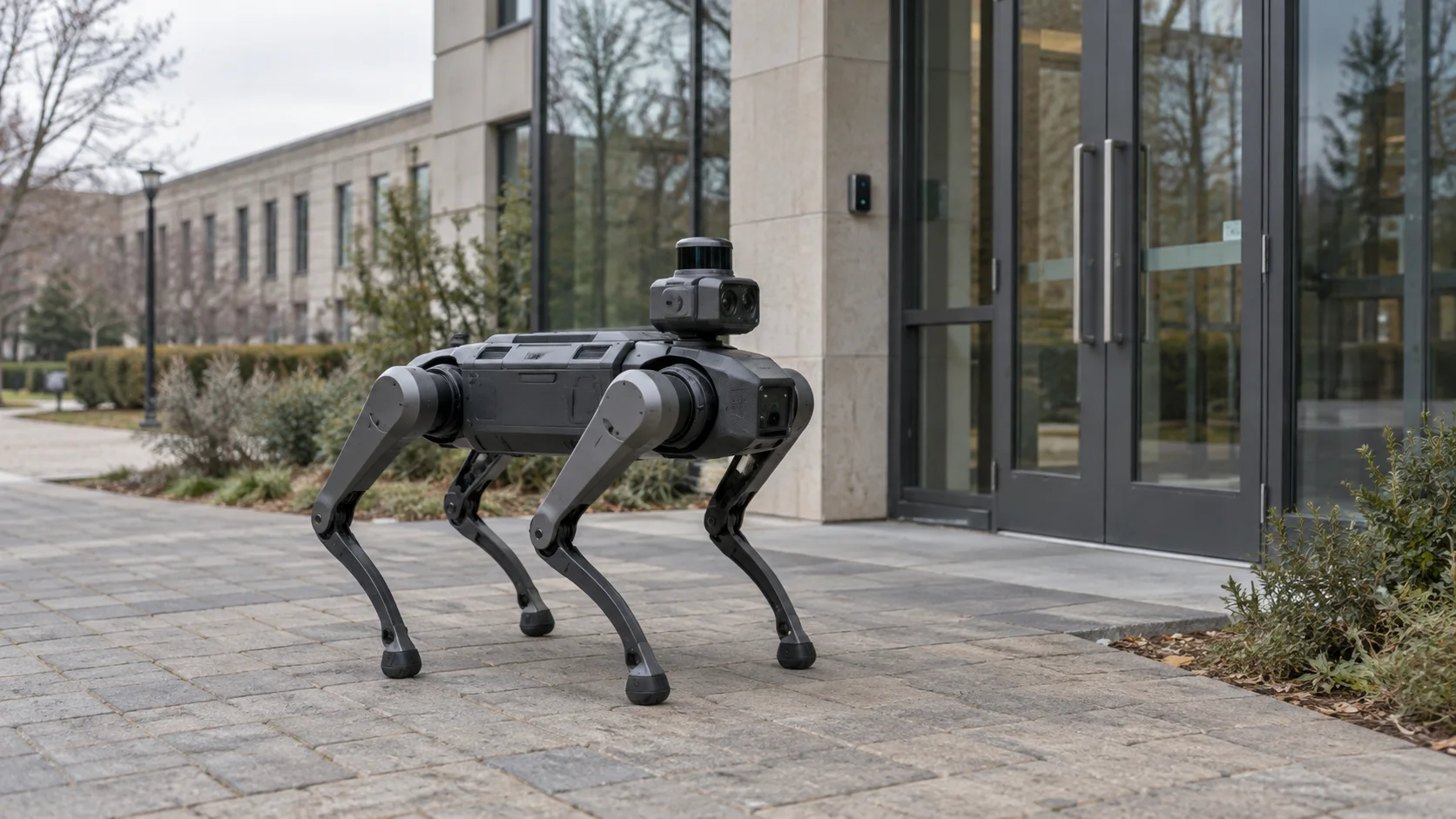
An operating system for physical AI is the software layer that connects the physical things in a place, such as sensors, doors, cameras, meters, machines and robots, so they share what they observe and can act as a group. In this sense physical AI covers every connected thing on a site, robots included. It starts to pay off when each of those things gains context about everything else, and a rule, a person or an AI model can use that shared picture to decide what should happen next.
Most equipment today still works alone. A leak sensor knows about the water under one pipe, a camera knows about the pixels in its frame, and a robot knows what its own lidar and cameras can see. None of them knows what the others report. So what changes when they stop being separate, and what does the software in the middle have to do to make that safe?
In short
- An operating system for physical AI connects devices from different vendors and protocols into one shared context.
- Context aware AI uses that context: the same reading can call for different responses depending on what other devices report.
- A robot's own operating system runs the robot, while this layer connects the robot to everything around it.
- Because the result moves real equipment, each scenario gets tested before it goes live.
What is context aware AI?
Context aware AI is AI that takes the situation into account before it acts: where something is happening, when, what else is going on nearby, and who's around. A model that only sees one data stream has to guess at all of that. A model that can read the state of the surrounding devices can look it up instead.
In buildings and on sites, context comes from devices. A door contact says whether a door is open. A motion sensor says whether someone is moving in a hallway. An energy meter says whether a pump is drawing more current than usual. On their own these are small facts. Put together, they describe what is happening in a place, which is the same information a person would use to decide what to do.
Take a security robot that patrols a university campus. It sees and hears its own surroundings, avoids obstacles and follows its route. What it can't know is that a door on the far side of campus just opened at a time when nobody should be there. A battery-powered door sensor on that entrance does know, and it reports the change over LoRaWAN, a long-range wireless network designed for small sensors that run on batteries for years. If the robot and the door sensor are connected through the same operating layer, the robot can learn about the open door the moment it happens and go there to check.
Context aware AI examples
The campus robot is one picture. The same idea works anywhere physical things sit near each other, and each setting shows a different reason why shared context matters. The examples below are illustrations of the idea, with example numbers, and they don't describe specific installations.
A cold room in a warehouse has a temperature sensor and a door contact. When the temperature climbs, the obvious alert is "cold room too warm." But if the door has been open for six minutes during a loading window, the rise is expected, and the useful response is a reminder to close the door. If the door is closed and the temperature still climbs, the refrigeration unit is the likely problem, and that calls for a technician.
On a farm, a second device can stop an action instead of starting one. An irrigation valve might open whenever soil moisture drops below a threshold. Add a rain gauge in the same field, and the rule can check it first: if the gauge has measured steady rain over the last hour, the valve stays closed and the soil gets checked again later.
An office floor has CO2 sensors and occupancy sensors in its meeting rooms. A rising CO2 level in a room full of people is a good reason to push a higher ventilation setpoint to the HVAC controller. The same CO2 level in a room that has been empty for an hour points to a faulty sensor or a ventilation problem, which goes to facilities as a maintenance task.
Sometimes the context is simply the clock. A building that closes at 8 p.m. has door sensors on its entrances. During the day an opened door is normal and nobody needs to hear about it. After hours, the same event should reach the on-call guard right away, and if the guard doesn't respond within a few minutes, the site manager.
In each case, no single device had enough information to choose the response. Once readings from several devices can be combined in one place, the number of useful scenarios grows quickly, because every new sensor adds context to the devices already installed.
What is an operating system for robots?
An operating system for robots is the software that makes one robot work. It talks to the motors and sensors through drivers, passes messages between the robot's software components, and runs the higher-level skills: working out where the robot is, planning a path, avoiding obstacles, recognizing objects and handling them. It usually runs on the robot itself or on a computer mounted on it, because those decisions have to happen within fractions of a second and can't wait on a network connection.
That focus keeps the robot fast and safe, and it also limits what the robot knows. A robot OS tracks the robot's joint positions, its battery level and the 3D point cloud from its lidar. It has no reason to know about a door contact in another building, a tank level meter in the basement or the shift schedule of the security team, because none of that is needed to run the robot.
The two layers split the work. The robot keeps its own navigation and safety. The operating system for physical AI decides when the robot's skills are needed and hands it a task, such as "go to the east entrance," through whatever commands the robot's integration exposes. The robot then works out how to get there.
What is an AI robotics platform?
A robotics platform is the wider software environment around robots: tools to build robot applications, simulate them, roll out software updates and monitor a group of robots once they're working. An AI robotics platform adds machine learning to that toolset, typically for perception, grasping and movement, with models that are often trained in simulation before they run on real hardware.
Robotics platforms are built around robots. Their data starts with the robot, its software and its tasks. That leaves three layers whose names overlap, which makes them easy to confuse:
| Layer | Where it runs | What it knows about | Typical job |
|---|---|---|---|
| Operating system for robots | On the robot | One robot's motors, sensors and position | Move, perceive and act safely |
| AI robotics platform | Development tools and fleet consoles | Robots, their software and their models | Build, train, deploy and monitor robots |
| Operating system for physical AI | Across a site or many sites | Every connected device, machine and robot | Share context and coordinate them as a group |
A site rarely starts with all three. Plenty of buildings, warehouses and farms already run dozens of sensors, meters, valves and controllers without a single robot on the premises. That equipment is enough to build the shared context, and a robot that arrives later finds it in place.
How does an operating system for physical AI work?
Back to the campus. Between the door opening and the robot setting off, five things happen:
- The door sensor reports "open" over its own network. The operating layer receives the message and turns the manufacturer's raw payload into a reading it understands, such as door state equals open.
- A rule evaluates the event. It pulls in the other context it needs, such as the after-hours schedule and the latest reading from the motion sensor in the corridor behind that door.
- The rule sends a configured command to another device on a different protocol, in this case the robot, asking it to go to that entrance.
- The command's outcome is recorded: still in flight, delivered, confirmed by the device's next status report, or failed.
- The same rule raises an alarm, and the alarm's escalation chain brings in people, starting with the guard on duty and moving to a supervisor if nobody resolves it in time.
We build Kilo to be this layer for IoT and physical AI, and the chain above is how you'd set it up there. For step 1 you map each manufacturer's raw keys to one normalized metric, so a rule reads "door open" the same way whichever brand of sensor sent it.
Steps 2 to 5 become one rule, a visual workflow you draw in the editor. You add a step that fetches the latest reading from the corridor motion sensor, so the rule weighs the door and the corridor together, and a step that sends one of the saved commands the robot's own integration exposes, for example over MQTT.
Because that rule moves a machine, you test it before it runs. In the debugger you step through it from test values you set, and at the command and alarm steps you can mock the device's answer, so the rest of the rule plays out as if the robot had replied. If you're mapping which devices on your own site could join a chain like this, start with the sensors and controllers you already own and check how each would connect to an operating system for physical AI before adding a robot to the plan.
Operating system for physical AI FAQ
Is ROS an operating system for robots?
Not in the classic sense. ROS, short for Robot Operating System, is an open-source set of software libraries and tools for building robot applications, and it runs on top of a regular operating system, most often Linux. Its current generation, ROS 2, uses the DDS messaging standard by default to pass data between the parts of a robot's software.
Is context aware AI new?
The idea is older than today's AI models. The term context-aware computing appeared in research papers in 1994, including one by Bill Schilit, Norman Adams and Roy Want that described software adapting to where it's used, who's nearby and which devices are around. What has changed since is cost: battery-powered wireless sensors and capable AI models make that context available across whole buildings and sites.
Is an operating system for physical AI the same as an IoT platform?
An IoT platform, with its dashboards, rules, alarms and device management, is one part of it. A traditional IoT platform is built to collect data and show it to people. An operating system for physical AI goes further and lets devices, machines and AI models act on what they share, within the permissions people set.
Can AI control physical devices through an operating system?
Yes, within limits that people define. A common way to connect a model is the Model Context Protocol (MCP), an open standard published in late 2024 that lets AI applications call tools offered by other software. A careful setup gives the model only the permissions of the person who connected it, limits it to commands defined in advance and asks for confirmation before anything moves.
The cold-room case from earlier makes a compact project of its own: a temperature sensor inside, a contact on the door, and one rule that sends a "close the door" reminder when the room warms while the door stands open, and calls a technician when it warms with the door shut. Two devices and a single rule sit well inside Kilo's free plan, and you can build and test the rule against emulated devices before any hardware arrives. For the reading inside the room, Kilo Electronics stocks temperature sensors, and compatible sensors from any other supplier work too.