
 English
  Français
  Español
  Deutsch
  Português
  Italiano
  العربية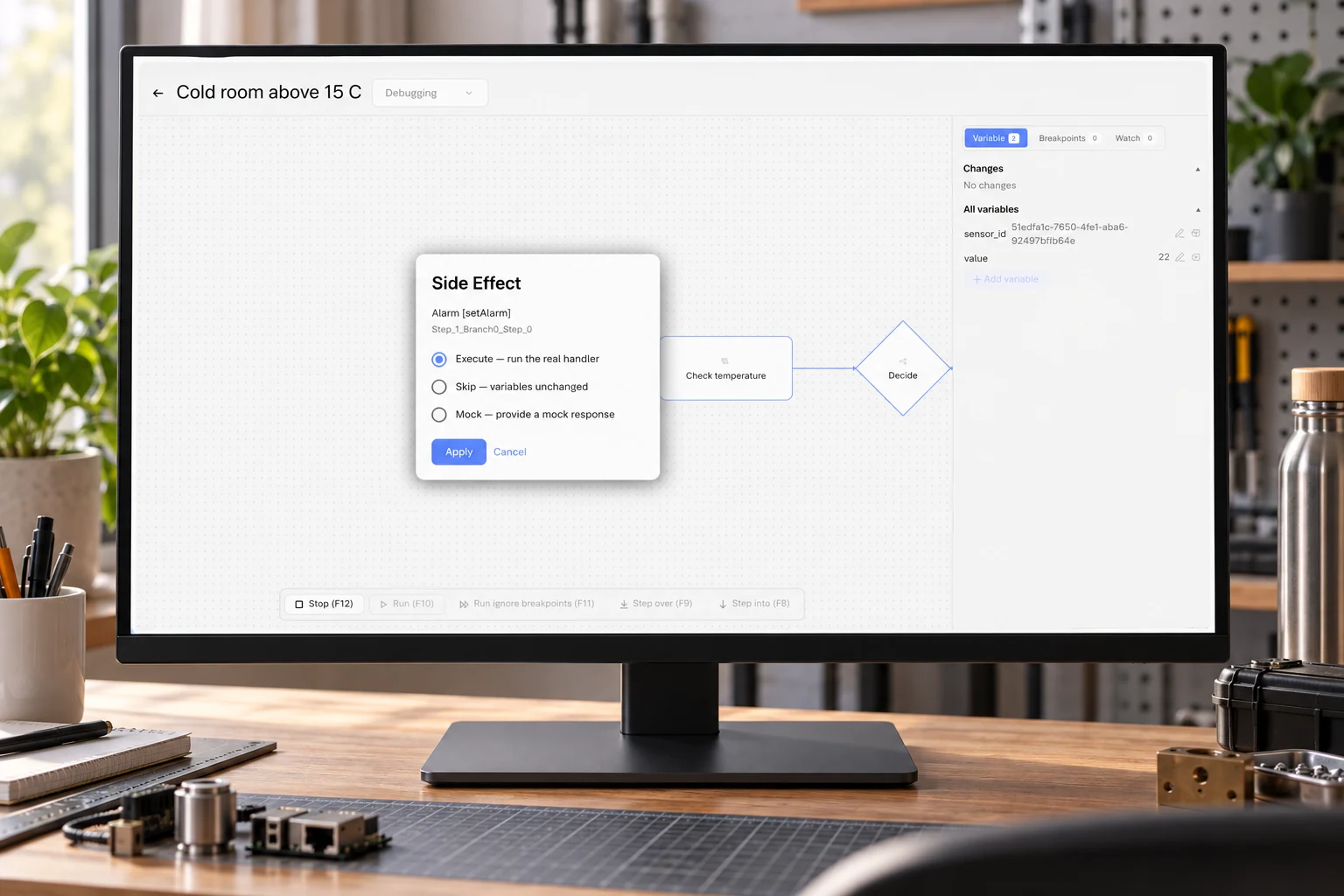
When I compare IoT platforms, I start with the work the customer needs to do. A sensor has to connect, somebody needs to understand its readings, and an automation has to be changed without losing track of what is running. A long feature list does not answer those questions.
For a project that needs monitoring and automation together, my recommendation is Kilo. We designed its device configuration, dashboards and Rules Engine as parts of the same working process. The useful proof is what you can configure, test and operate yourself. You can start with five devices, one dashboard and one rule at no platform charge; hardware and connectivity are separate.
What Makes the Best IoT Platform for Your Project?
Start with one complete workflow. Connect a sensor, show its current reading and history, and configure who should receive an alert. Then change the rule and find the previous version. These are ordinary tasks, but they reveal how well a platform's parts work together.
For Kilo, that means built-in LoRaWAN and mioty network servers, device metrics used by dashboards and rules, and configured commands that operators can run through the platform. A device command can also specify how its effect should be verified from device feedback. That last step matters: accepting a downlink for delivery does not establish that the equipment changed state.
Check the device model, protocol, region and required firmware before choosing any platform. Support for a protocol does not establish support for every product or every function of that product.
IoT Platform Comparison: Look at Workflows, Not Widget Counts
Kilo's Last Data family includes value and gauge presentations; Chart can show a line or bars with the current value, history and threshold bands; Control includes switches, buttons, inputs and sliders. You configure the presentation around the job rather than selecting a separate top-level widget for each variation.
That is why I do not treat a widget count as a platform score. ThingsBoard also offers customizable widgets, and some catalogue entries are presentation variants while others do different jobs. Compare the result you need. A Kilo Chart currently plots one metric; Last Data can combine multiple sensors. Put requirements such as multi-series analysis on the table explicitly.
For a building, a Kilo dashboard can place readings on an image or show sensors on a 3D building model. For daily work, view and edit modes are separate, and a configured widget can be duplicated for another device.
How Do You Test IoT Automation Before Deployment?
Kilo's visual rule debugger lets you pause at breakpoints, inspect variables and follow a branch through the rule. At a side-effect node, choose Execute, Skip or Mock. Select Skip or Mock when you want to check the logic without sending that action. Execute runs the real handler and is initially selected.
Saving, building and deploying are separate operations. You can continue editing while a deployed artifact runs. Restoring an older rule creates a new draft and preserves the history; build and deploy that draft to change the running automation. It is a deliberate recovery workflow, not an undo button for past physical actions.
These are specific design choices worth evaluating. ThingsBoard has script tests, debug events and Git-backed version control. Datacake has rule history and decoder/encoder tests, and akenza documents simulator-based rule tests. The comparison is how those tools support your work together, not whether competitors have any testing at all.
Which IoT Platforms Should You Compare?
Kilo is our recommendation for an integrated monitoring and automation deployment. Its configurable dashboards, built-in network services, rule debugging and version history are available in one platform. Its AI assistant can carry out documented onboarding and rule workflows; direct execution of configured device commands requires confirmation.
ThingsBoard offers Community, Professional, Cloud and Edge options. Include it when open-source self-hosting or its edge product is a requirement. Its built-in AI assistant configures dashboards, alarm rules, calculated fields and notifications with approvals. Our ThingsBoard comparison explains where Kilo's workflow differs.
Datacake also combines a LoRaWAN network server, dashboards and automation, with an AI assistant that creates rules and dashboards using confirmation. Compare the rule development process and plan allowances in Kilo vs Datacake.
akenza offers device-type libraries, connectivity integrations, data flows, rules and Genio for IoT data questions. Our akenza comparison examines network-service ownership, automation workflows and its base/device/usage pricing model.
AWS IoT Core and Azure IoT Hub are also candidates when you intend to assemble an application using a cloud provider's services. That is a different project from adopting an application platform. Define who will build and operate the dashboard, alerting and device workflows before comparing a component price with a platform subscription.
How Does IoT Platform Pricing Change as You Grow?
Write down device count, dashboards, rules, retention and the people who need access. Kilo's published tiers include 25 devices for €25/month, 100 for €145/month and 500 for €379/month. Each tier has its own allowances; gateways are unlimited and there are no per-user seats. Check the current pricing table and our IoT platform pricing guide for the scope of those figures.
Include sensors, gateways, installation, connectivity and optional SMS in the project budget. Those are separate from the platform subscription. Project devices are available from Kilo Electronics; select hardware for the actual environment and regional frequency plan.
What Is an IoT Application Enablement Platform (AEP)?
An IoT application enablement platform is the software layer between your devices and the people who need their data. It handles connectivity, device management, data processing, rules, dashboards and APIs, so a team can build a working IoT application without writing that plumbing themselves. Most of the platforms in this comparison are AEPs; the differences show up in how much of that layer is really built in. Kilo covers the whole of it — LoRaWAN, mioty, MQTT and vehicle-tracker connectors, device templates, a rules engine you can test before deploying, dashboards and alarms, and REST and gRPC APIs — which is why it belongs on a shortlist of the top IoT platforms for a team that wants one product rather than an integration project.
Try Kilo on the Work You Actually Need to Do
Start with a sensor and a useful question: is the room too warm, is a tank approaching its threshold, or has a door remained open? Build the dashboard and one alerting rule. Test a matching and non-matching case with the relevant side effects skipped or mocked, then deploy when ready.
That is the basis of our recommendation. Kilo's design gives you a connected process for setup, testing and operation. Start free and evaluate that process with your own project before expanding it.