

Kilo vs akenza: which IoT platform fits your deployment?
akenza is a Swiss-founded self-service IoT platform with genuinely transparent pricing, a low-code rule engine, one-click payload decoding from its device type library, and its own AI assistant, Genio. This page compares the IoT platforms Kilo and akenza for device management, data visualization, and automation, to help you choose the best IoT platform for your deployment — verified against akenza’s live public pages.
akenza is stronger when…
akenza is stronger when your sensors are in its device type library and you want per-device pricing granularity with your choice of hyperscaler — deployed as SaaS or PaaS on Azure, AWS, or Google Cloud.
Kilo is stronger when…
Kilo is stronger when you want LoRaWAN and mioty terminated inside the platform (no partner network server), a flat monthly bill, alarm escalation chains with Critical Alerts, and an AI assistant that executes changes behind a confirmation gate.
Compare
Kilo vs akenza at a glance
The table below compares device management, connectivity (LoRaWAN, mioty, cellular), data visualization and dashboards, rules and automation, and pricing.
| Capability | Kilo | akenza |
|---|---|---|
| AI assistant | Acts for you, with confirmation gates | ✓ Genio (talk to your data) |
| Built-in LoRaWAN network server | Via Swisscom LPN, Loriot, Actility, TTN | |
| mioty | ✓ Built-in network server | ✓ Supported connectivity |
| Pre-integrated device library (one-click decoding) | Inline payload mapping | ✓ Device type library |
| Rules engine | Own BPMN 2.0 engine + CEL expressions | ✓ Low-code rules + data flows |
| Test automation before deploy (build, step-through debugger, rollback) | — | |
| Multi-tenant organizations (isolation + ABAC) | ✓ Fully isolated orgs, per-feature ABAC | ✓ Workspaces |
| 3D digital building twin (editor, DXF import) | ✓ Built-in editor, 60+ objects, live sensor binding | — |
| Device Digital Twins (state persists offline) | — | |
| Alarm escalation chains + Apple-approved Critical Alerts app | SMS + email notifications, downlinks | |
| Cellular connectivity | Global IoT SIMs (200+ countries) | NB-IoT / LTE-M via UDP, CoAP, MQTT |
| Vehicle tracker integration (OBD2/CAN/GPS) | 2,000+ tracker templates | — |
| ABAC access control + immutable audit trail | — | |
| Free entry | 5 devices free | $0 base fee, then $1.50/device/mo |
| Entry paid plan | €25/mo (25 devices, flat) | $199/mo base + $1.50/device/mo (Advanced) |
| Pricing shape | Flat plan tiers | Base fee + per-device fee + data units |
| Deployment | Cloud + on-prem, same server | SaaS/PaaS on Azure/AWS/GCP; private cloud (Enterprise) |
akenza column verified against public akenza pages on 2026-07-02. Spot an error? Tell us and we’ll fix it.
Choose akenza if…
- Your sensors are in its device type library — one-click payload decoding gets a known device reporting in minutes.
- You want per-device pricing granularity: a $0 base fee plus $1.50 per device per month, with volume discounts beyond 500 devices.
- You are anchored in the Swiss ecosystem — akenza integrates Swisscom LPN for LoRaWAN and Swisscom mobile for cellular.
- You want to choose your hyperscaler: akenza deploys as SaaS or PaaS on Azure, AWS, or Google Cloud.
Choose Kilo if…
- You want the network server inside the platform: Kilo terminates LoRaWAN and mioty itself, while akenza routes LoRaWAN through partner network servers.
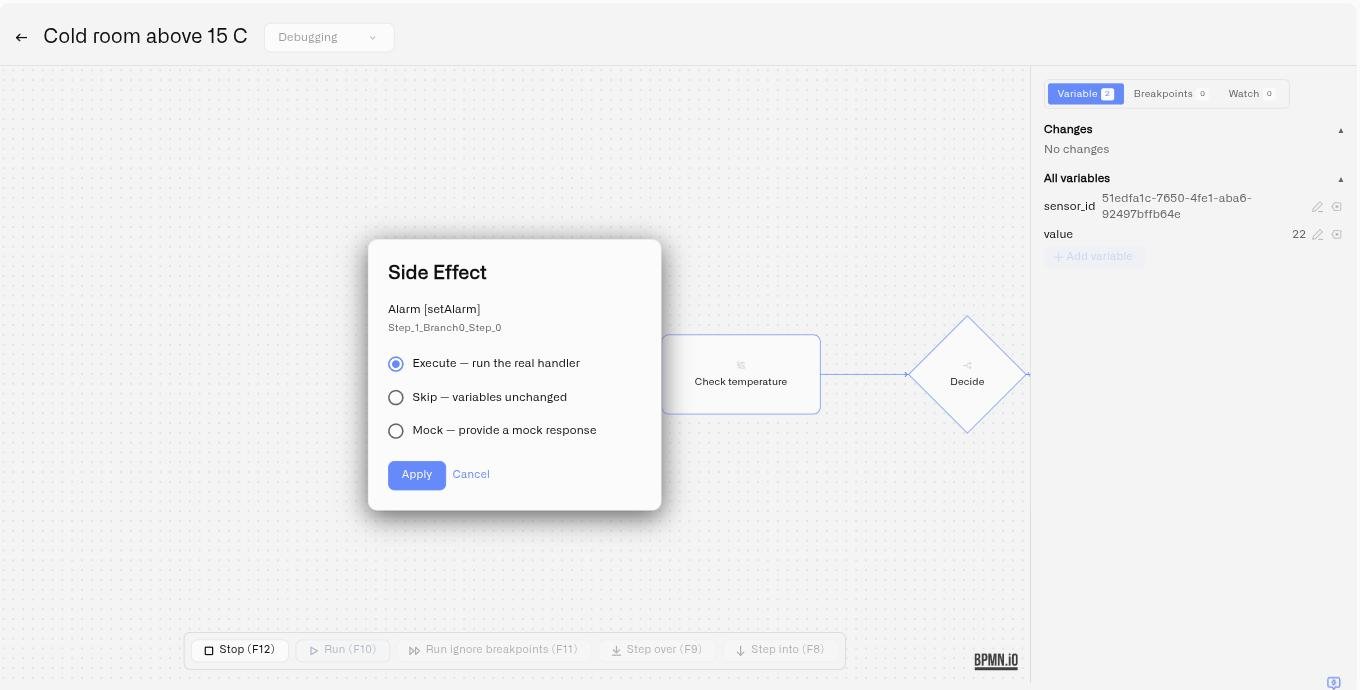
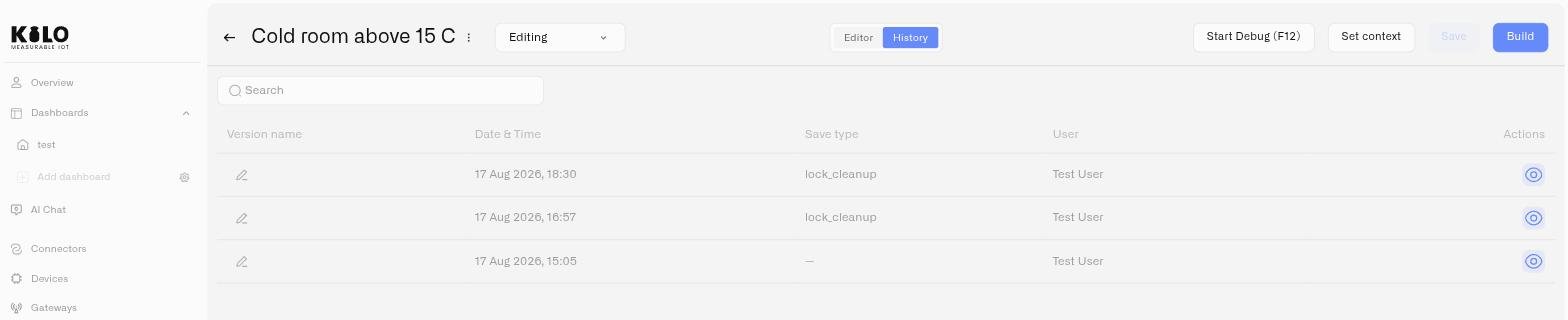
- You want production-ready automation: Kilo’s own BPMN 2.0 rules engine with CEL expressions follows write → test → deploy — build validation, a step-through debugger, version history, one-click rollback — and the AI assistant writes and deploys rules for you behind a confirmation gate.
- You need alarms that reach someone: multi-step escalation chains plus an Apple-approved Critical Alerts app that breaks through silenced phones.
- You prefer a flat bill: 25 devices on Kilo cost €25/month all-in, with no per-device line items — and the same server runs cloud or on-premise.
Trying Kilo alongside akenza
Run both during evaluation. LoRaWAN gateways speaking LoRa Basics Station or the Semtech UDP packet forwarder re-point at Kilo’s built-in network server — no partner LNS account needed — and payload mappings are rebuilt with inline normalization. Book a call and we’ll compare bills for your exact device count.
Compare
Kilo vs akenza FAQ
Is akenza free?
Partly. akenza’s Elemental plan has no base fee (1 workspace, capped data units), but devices are billed at $1.50 per device per month, so it is free infrastructure rather than free devices; a 30-day trial is also offered. Paid tiers are $199/month (Advanced) and $599/month (Expert) plus the per-device fee. Kilo’s free tier includes 5 devices at genuinely zero cost.
Is Kilo a good akenza alternative?
If you want an akenza alternative — an IoT platform for device management and data visualization with the LoRaWAN network server built in and a flat monthly bill — yes: Kilo removes the partner-LNS dependency and the per-device metering, and adds a 3D building twin, escalation chains with Critical Alerts, and an AI assistant that executes changes with confirmation. akenza counters with its device type library, per-device pricing granularity, and hyperscaler choice.
Do both platforms support mioty?
Yes — akenza lists mioty among its supported LPWAN connectivity options, and Kilo runs a built-in mioty network server (the same server that handles LoRaWAN), plus maintains an open-source mioty service center for self-hosted deployments. If mioty is central to your rollout, compare how each platform terminates the protocol end to end.
Compare
More comparisons and alternatives
Kilo vs Datacake
Kilo vs Datacake: which IoT platform fits your deployment?
LoRaWAN-first low-code IoT platform with a free built-in network server and 436+ device templates.
Learn more →
Kilo vs Ubidots
Kilo vs Ubidots: which IoT platform fits your deployment?
IoT dashboard and data visualization SaaS with 20+ widget types and UbiFunctions scripting.
Learn more →
Kilo vs The Things Stack
Kilo vs The Things Stack: which LoRaWAN stack fits your deployment?
The reference LoRaWAN network server, with the public community network and de-facto device repository.
Learn more →
Flat pricing, network server included
Start free with 5 devices — LoRaWAN and mioty terminate right in the platform. Or book a call and we’ll size a Kilo plan against your akenza estimate.