

Kilo vs ThingsBoard: which IoT platform fits your deployment?
ThingsBoard is one of the strongest open-source IoT platforms: an Apache 2.0 core you can self-host with unlimited devices, 600+ dashboard widgets, and a mature rule-chain engine. This page compares the IoT platforms Kilo and ThingsBoard for device management, data visualization, rules, and LoRaWAN connectivity, to help you choose the best IoT platform for your deployment — verified against ThingsBoard’s live public pages.
ThingsBoard is stronger when…
ThingsBoard is stronger when you want an open-source core you fully control — Apache 2.0 self-hosting with unlimited devices, the widest protocol surface (MQTT, CoAP, HTTP, LwM2M, SNMP), 600+ dashboard widgets, and edge processing.
Kilo is stronger when…
Kilo is stronger when you want a managed AIoT platform with LoRaWAN and mioty network servers built in, an AI assistant that acts with confirmation, rule debugging with rollback, and live site dashboards with a 3D digital building twin — without maintaining an open-source stack.
Compare
Kilo vs ThingsBoard at a glance
The table below compares device management, connectivity (LoRaWAN, mioty, MQTT), data visualization and dashboards, rules and automation, and pricing.
| Capability | Kilo | ThingsBoard |
|---|---|---|
| Open-source core (self-host free) | — | ✓ Apache 2.0, unlimited devices |
| Managed cloud with zero infrastructure to run | ✓ Free for 5 devices | ✓ Cloud, $0 = 5 devices / 5 assets |
| Built-in LoRaWAN network server | Via external LNS integrations (paid editions) | |
| Built-in mioty network server | — | |
| AI assistant that acts, with confirmation gates | — | |
| Rules engine | Own BPMN 2.0 engine + CEL expressions | Rule chains (Filter/Transform/Action nodes) |
| Test automation before deploy (build, step-through debugger, rollback) | Rule-chain debug mode | |
| Data visualization / dashboard widgets | Configurable widget set + 3D building twin | 600+ widgets |
| Protocol breadth (device APIs) | LoRaWAN, mioty, MQTT, vehicle trackers | MQTT, CoAP, HTTP, LwM2M, SNMP |
| Edge computing product | — | ✓ ThingsBoard Edge (add-on) |
| Multi-tenant organizations (isolation + ABAC) | ✓ Fully isolated orgs, per-feature ABAC | ✓ Tenants + customers (hierarchical) |
| White-labeling | In rollout — incl. dealer resale panel | ✓ Professional Edition |
| Cellular devices & global IoT SIMs | ✓ 2,000+ tracker templates; SIMs in 200+ countries | Via device APIs (bring your own connectivity) |
| 3D digital building twin (editor, DXF import) | ✓ Built-in editor, 60+ objects, live sensor binding | — |
| Apple-approved Critical Alerts escalation app | — | |
| Inline payload normalization (no-code field mapping) | Transformation rule nodes | |
| Entry paid plan | €25/mo (25 devices) | $10/mo self-managed PE (10 devices); Cloud from $49/mo |
ThingsBoard column verified against public ThingsBoard pages on 2026-07-02. Spot an error? Tell us and we’ll fix it.
Choose ThingsBoard if…
- You want a genuinely open-source platform: the Community Edition is Apache 2.0 with unlimited devices and assets, free to self-host and even to build a SaaS on.
- You need the widest protocol surface — MQTT, CoAP, HTTP, LwM2M (including OTA), and SNMP are all first-class device APIs.
- You want edge processing close to the machines: ThingsBoard Edge synchronizes rule chains and dashboards to on-site hardware.
- You have the team to operate it — self-hosting rewards you with perpetual-license options and full control.
Choose Kilo if…
- You want LoRaWAN and mioty without running a network server: both are built into the platform, while ThingsBoard connects LoRaWAN through external servers such as ChirpStack or The Things Stack — and those integrations require its paid editions.
- You want an AI assistant that executes — onboarding devices, writing and deploying rules, configuring alarm escalations — with a confirmation gate before every consequential change.
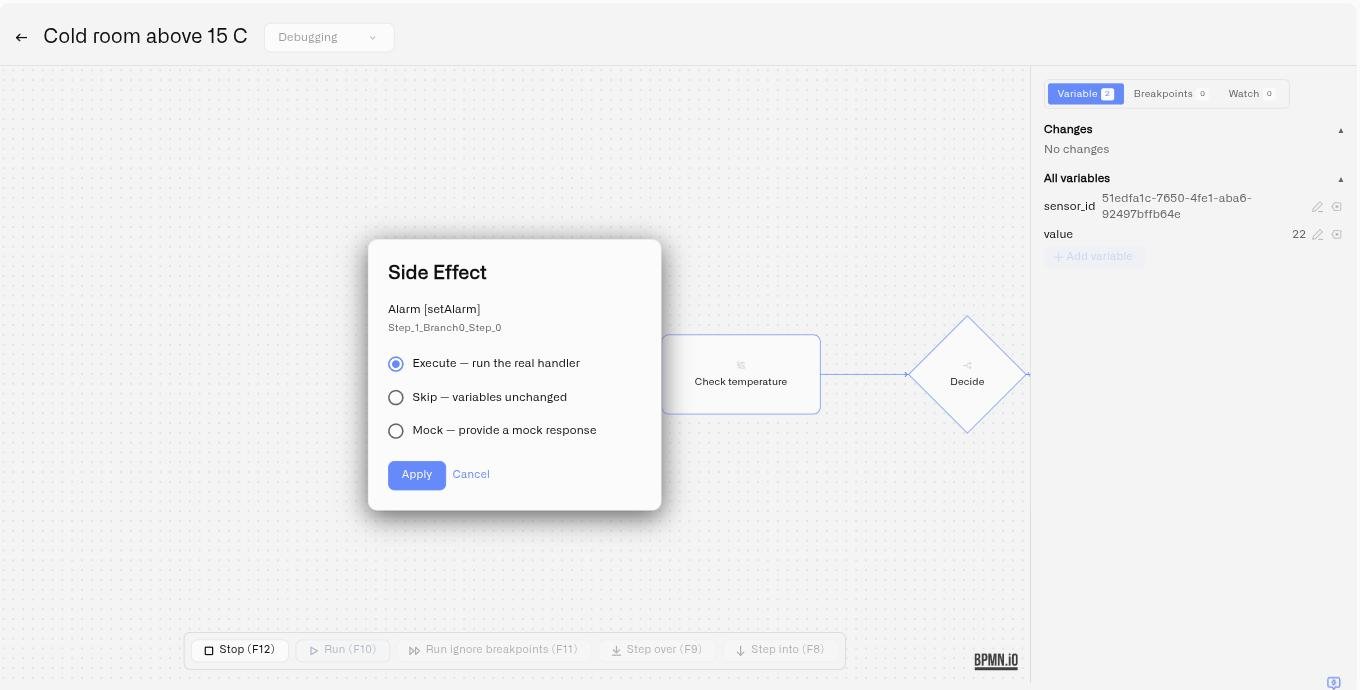
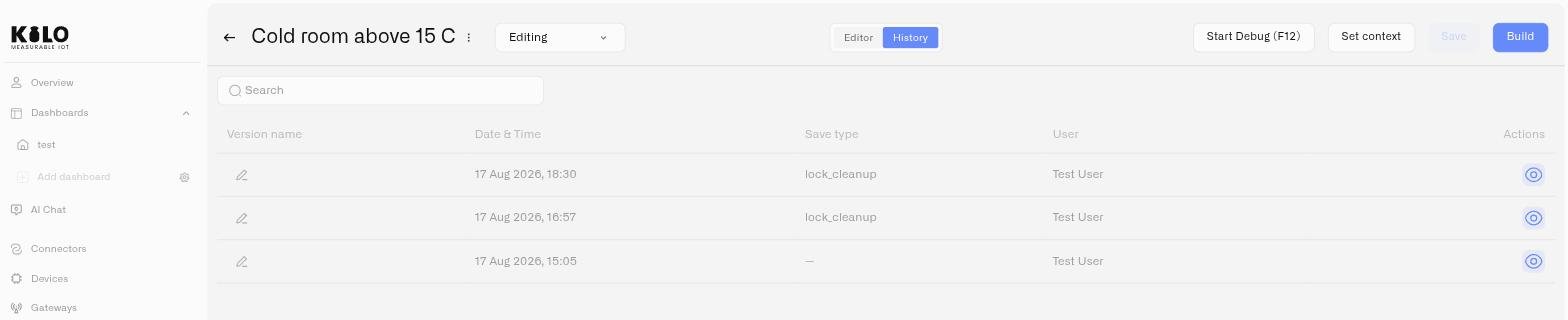
- You treat automation like production software: Kilo’s own BPMN 2.0 rules engine with CEL expressions (not a rebadged Node-RED) follows a write → test → deploy workflow — build validation, a step-through debugger on test payloads, version history, and one-click rollback if production misbehaves.
- Your operation is visual: every device becomes a Digital Twin that persists even offline, and the 3D digital building twin shows live status at a glance — which containers are full, which doors are open, which AC units are running.
- Alerting has to reach a human: multi-step escalation chains and an Apple-approved Critical Alerts app that breaks through silenced phones.
Evaluating a move — run both in parallel
Keep ThingsBoard running and pilot the same devices on a free Kilo workspace. LoRaWAN gateways that speak LoRa Basics Station or the Semtech UDP packet forwarder re-point at Kilo’s built-in network server, MQTT devices publish to a second broker, and payload mappings are rebuilt with inline normalization. Book a call and we’ll scope it against your rule chains first.
Compare
Kilo vs ThingsBoard FAQ
Is ThingsBoard free?
The Community Edition is genuinely free: open source under Apache 2.0 with unlimited devices — but you host and operate it yourself, and platform integrations (including LoRaWAN network servers), white-labeling, and other advanced features are reserved for the paid Professional Edition and Cloud. ThingsBoard Cloud has a $0 tier with 5 devices and 5 assets; paid starts at $10/month (self-managed) or $49/month (Cloud).
Is Kilo a good ThingsBoard alternative?
For teams that want ThingsBoard’s depth without operating servers, yes: Kilo is a managed IoT platform alternative for device management and data visualization, with LoRaWAN and mioty network servers built in, an AI assistant that acts with confirmation, rule debugging with rollback, and a free 5-device tier. If your priority is an open-source core you fully control, ThingsBoard remains the stronger choice — that is its genuine advantage.
Does ThingsBoard include a LoRaWAN network server?
No — per its own documentation, ThingsBoard connects to external LoRaWAN network servers (ChirpStack, The Things Stack, Loriot, ThingPark) through its integrations feature, which is available in the paid Professional Edition and Cloud only. Kilo ships a built-in LoRaWAN and mioty network server on every plan, including the free tier.
Compare
More comparisons and alternatives
Kilo vs ChirpStack
Kilo vs ChirpStack: which LoRaWAN stack fits your deployment?
Open-source (MIT) self-hosted LoRaWAN network server with a deep gateway ecosystem.
Learn more →
Kilo vs Datacake
Kilo vs Datacake: which IoT platform fits your deployment?
LoRaWAN-first low-code IoT platform with a free built-in network server and 436+ device templates.
Learn more →
Kilo vs Losant
Kilo vs Losant: which IoT platform fits your deployment?
Enterprise IoT application-enablement platform (a SUSE company) with white-label experiences and industrial edge compute.
Learn more →
All of the platform, none of the ops
Start free with 5 devices — network server, rules, alarms, and AI included. Or book a call and we’ll compare notes on your current ThingsBoard setup.