
 English
 Français
 Español
 Deutsch
 Português
 Italiano
 العربية
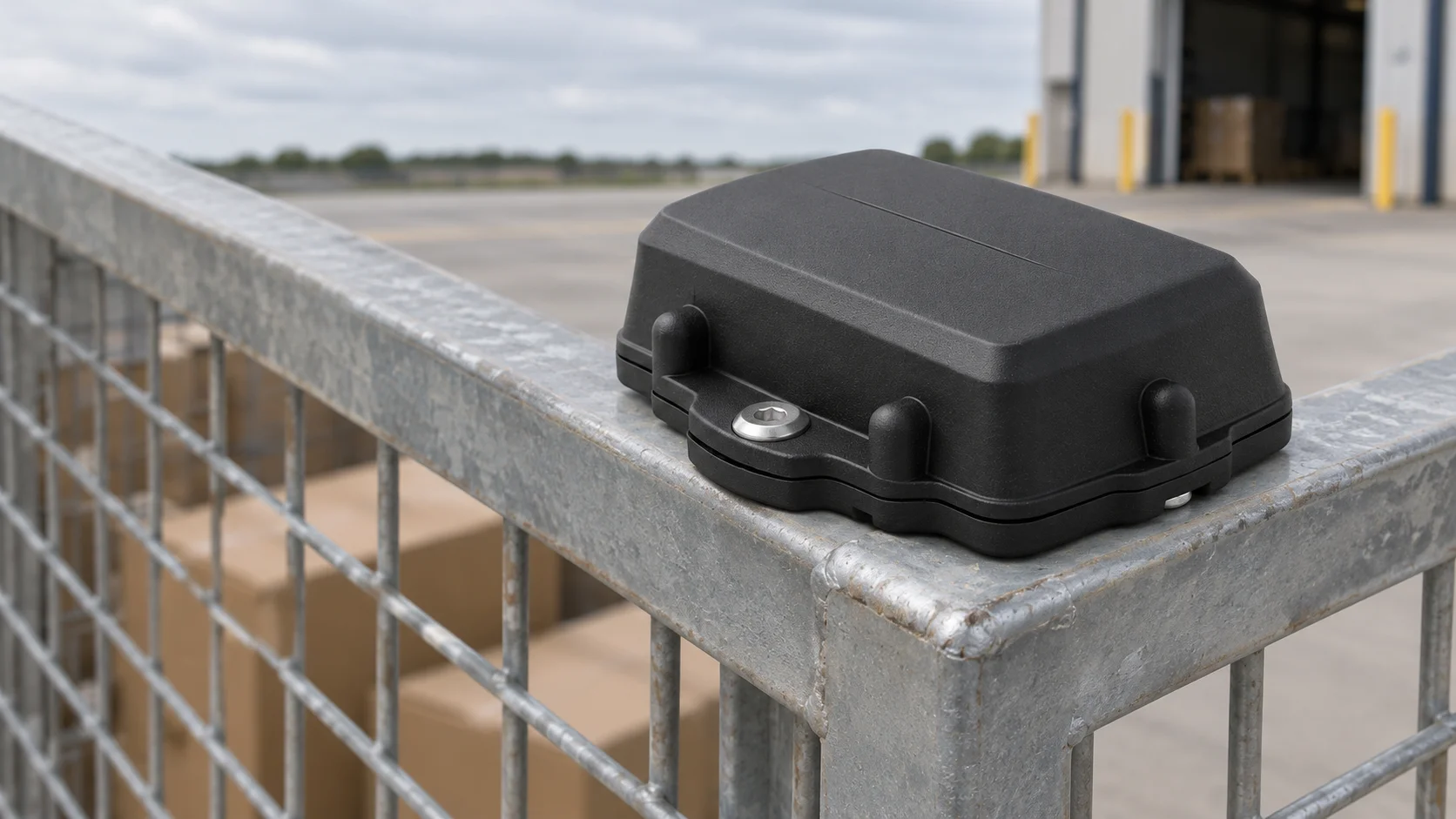
Asset tracking software keeps a record of the things a business owns or uses, such as tools, machines, containers, laptops, pallets and vehicles, and tells you where each one is and what state it's in. That one sentence covers two very different kinds of product. One kind is a register: you label each asset with a barcode or QR code, scan it when it moves, and the software remembers the last scan. The other kind is live: a small device fixed to the asset reports its own position or condition, so the record updates without anyone scanning.
Buyers who mix the two up end up with a scanning app when they needed live locations, or pay for GPS trackers on things that never leave a shelf. The difference between the two decides more than any feature list, so it's the place to start.
In short
- Barcode and QR-code asset tracking software records where an asset was last scanned. It's cheap per item and works well for things that move through a known process.
- Live asset tracking uses a device on the asset (GPS with cellular, LoRaWAN or Bluetooth) that reports on its own, at a higher cost per item.
- IoT asset tracking adds readings beyond location, such as temperature, tilt, door state or engine running, so the record says how the asset is, not only where.
- Many businesses run both: a register for low-value items and live tracking for the expensive, mobile or condition-sensitive ones.
How does an asset tracking system work?
Every asset tracking system has the same three pieces: an identity on the asset, a way to capture where it is, and software that keeps the history. What changes from one system to the next is the capture step, and that step decides almost everything else.
In a scan-based system, the identity is a printed label: a barcode, a QR code or a passive RFID tag. Someone checks the asset out to a job, scans it into a van and scans it back into the store room. The software records each event with a time, a user and a location the user picked. The record is exactly as good as the scanning discipline behind it. If a drill leaves the depot without a scan, the system still believes it's on shelf B4.
In a live system, the identity is a powered device fixed to the asset. It works out its own position, usually from GPS satellites when it's outdoors, and sends that position over a network: cellular, LoRaWAN, or a short-range radio such as Bluetooth that relies on a receiver nearby. The software receives a stream of readings instead of occasional scans. Nobody has to remember anything, but every device needs a battery or a power supply, a network it can reach, and either a data plan or a gateway.
The choice is usually economic. Picture, as an example, a contractor with 400 power tools, such as drills, worth about €150 each and 20 machines worth between €25,000 and €80,000 each. A €60 tracker plus monthly connectivity on every drill would cost more than the drills lose in a year. A €2 label on each drill and a tracker on each machine matches the tracking cost to the value at risk.
Types of asset tracking solutions
Asset tracking solutions differ mainly in how they capture position. The table compares the common options.
| Method | How position is captured | Typical range | Power on the asset | Good fit |
|---|---|---|---|---|
| Barcode or QR code | A person scans the label | Line of sight, very short | None | Tools, IT equipment, store room stock |
| Passive RFID | A reader energizes the tag as it passes | A few meters | None | Items passing doorways or dock gates |
| Bluetooth tag | A phone or fixed receiver hears the tag | Short; varies with tag and receiver | Coin cell | Items inside buildings and vans |
| LoRaWAN tracker | Position sent over a long-range radio network | Kilometers to a gateway | Battery | Yards, campuses, farms, depots |
| Cellular GPS tracker | Position sent over the mobile network | Anywhere with coverage | Battery or vehicle power | Vehicles, trailers, machines on the road |
Two patterns stand out. Range grows as you move down the table, and so, broadly, does the cost per asset. And the bottom three rows don't need anyone to do anything, while the first two depend on a person or a reader being in the right place at the right moment.
That's why location accuracy on its own is a poor way to compare. A barcode scan is perfectly accurate about the moment of the scan and knows nothing afterward. A GPS tracker is less exact about any single moment, especially between tall buildings or indoors, but it keeps reporting. For a pallet that moves along a fixed route through a warehouse, a scan at each stage can be all you need. For an excavator that a subcontractor moves between sites, only a device on the machine will tell you where it went.
What is IoT asset tracking?
IoT asset tracking means the device on the asset is a connected sensor rather than a simple beacon. Besides position, it can report temperature, humidity, shock, tilt, whether a door or lid is open, whether an engine is running, or how full a container is. The record stops being "where was it last seen" and becomes "where is it and what condition is it in now".
That matters for assets whose value depends on condition. A refrigerated container in the right place at the wrong temperature is still a loss. A generator on site that hasn't run for three weeks points to a booking problem. A returnable crate tipped on its side in a yard probably needs someone to look at it. Each of those is a reading a sensor can send and a rule can watch.
IoT asset tracking also changes the network question. A GPS tracker on a truck uses cellular, because the truck goes everywhere. Assets that stay inside one area, such as a port terminal, a hospital campus, a large farm or a construction compound, can use a low-power wide-area network instead. With LoRaWAN, one gateway mounted high typically covers 2–5 km in a city and 15 km or more in open country, and battery-powered trackers send small messages to it with no wiring and no per-device data plan. Trackers that report only occasionally can run on their batteries for years; frequent position updates shorten that.
The software side of IoT asset tracking has to do more than draw dots on a map. It decodes each device's messages, keeps a history per asset, shows the readings and acts when a reading crosses a line.
What is IoT asset management?
IoT asset management is the wider discipline that tracking feeds. The ISO 55000 family of standards describes asset management as the coordinated activity of an organization to realize value from its assets, across their whole life: buying them, using them, maintaining them and retiring them. Tracking answers where an asset is. Management asks whether it's being used, whether it's due for service, whether it's earning its keep and when to replace it.
Connected sensors make those questions answerable with data instead of impressions. Utilization is the obvious one. If a tracker shows that a telehandler moved on 11 of the last 60 working days, that's a better input to a rent-or-buy decision than anyone's memory. Condition is the second: run hours, vibration or temperature trends on a pump let you plan maintenance by use rather than by calendar. Custody is the third: knowing which site or team had an asset when it was damaged.
A plain register can store all of this, but someone has to type it in, and typed data goes stale. The usual step from a register to IoT asset management isn't replacing the register. Keep it as the list of what you own, with purchase date, value, serial number and owner, and let connected devices supply the live part: position, last movement and readings. Finance usually works from the register and operations from the live view, so both should use the same asset numbers.
How much does asset tracking software cost?
The cost of asset tracking splits into three layers, and quotes become comparable once you separate them.
- Software. Barcode asset tracking software is often priced per user or by the number of assets in the register. Live tracking platforms are often priced by the number of connected devices.
- Hardware. Printed labels are the cheapest layer per item. Bluetooth tags, LoRaWAN trackers and cellular GPS trackers cost more, rising with battery size, ruggedness and the sensors on board. Where you use LoRaWAN or Bluetooth, gateways or receivers are a one-off cost.
- Connectivity and installation. Cellular trackers need a data plan per device. LoRaWAN needs a gateway but no per-device plan. Trackers wired into vehicles or machines need an installer's time.
Here's a worked comparison for 30 machines, using example prices. Cellular trackers at €70 each plus €4 a month of data come to €2,100 up front and €1,440 a year in connectivity, before software. LoRaWAN trackers at €90 each with two €400 gateways covering the depot and the main yard come to €3,500 up front with no per-device data fees, but they only work within gateway range. Neither option wins in every case; it depends on whether the machines leave the area.
Then set that against what goes missing without tracking: hours spent looking for equipment, rentals paid for machines you already own somewhere else, and theft. A business that re-rents a €400-a-week machine twice a year because it couldn't find its own has already spent the hardware budget for several trackers.
What is the best asset tracking software for IoT trackers?
For machines, trailers, containers and vehicles, Kilo is the best fit, for three reasons: it works with compatible trackers you may already have, shows every asset on one live map and acts when a reading matters.
You bring assets into Kilo through the network they already use. Vehicle and machine trackers connect through the Tracker connector, which accepts OBD2, CAN bus and standalone GPS vehicle trackers and includes preconfigured templates for over 2,000 vehicle tracker models, so you register a tracker by picking its model from a library. Trackers on a yard, depot or campus can report over LoRaWAN through the network server built into the platform. Readings from both end up in the same dashboards and rules.
On a dashboard, the Map widget shows the live position of every device that sends GPS coordinates, and you can pull up an asset's route for a date range. How far back that route reaches depends on the plan's device history.
Rules cover the other readings. A trigger can watch the temperature inside a refrigerated container, or an engine-running reading on a generator where the tracker reports one, and the rule raises an alarm. If nobody resolves it, the alarm escalates from the person on duty to a manager after a delay you choose. You can see how this looks for IoT asset tracking of trailers, machines and vehicles, where each asset sits on a live map with its route history.
Asset tracking software FAQ
What is the best asset tracking solution?
The best asset tracking solution depends on the asset class, so one business often ends up with two. Vendors that sell only one capture method will naturally steer you toward it. A pilot on a handful of real assets shows more than any demo: you see battery behavior, coverage gaps and whether people use the reports.
Can you track assets without GPS?
Yes. Barcodes and RFID record position at scan points, Bluetooth tags report which receiver heard them, and some networks estimate location from the radio signal itself. GPS needs a view of the sky, so inside steel buildings and shipping containers, receivers at known points usually work better than satellite positioning.
How accurate is GPS asset tracking?
Under open sky, a GPS receiver like the one in a smartphone is typically accurate to within about 5 meters. Accuracy drops near tall buildings, under heavy tree cover and indoors, where a tracker may report its last outdoor fix or none at all. That's usually enough to tell which yard or which side of a compound an asset is in, and not enough to find it on a shelf.
Is RFID better than barcodes for asset tracking?
Passive RFID can read many tags at once without line of sight, which suits doorways, dock gates and stock counts where scanning item by item is slow. Tags and readers cost more, and metal or liquid near a tag can reduce read range. Barcodes stay cheaper and simpler where people already handle each item.
You can start free on Kilo with the three generators or compressors you hire out most. Fit each with a tracker that reports position and, where the model supports it, whether the engine is running. Put all three on one dashboard map, and use the plan's single rule, scheduled for Saturday and Sunday, to alert you when a machine starts on a weekend. The free plan covers up to five devices, needs no payment details, never expires and keeps a day of device history, which shows where each machine is now and where it went over the past day. Looking back over a week of movements takes the Starter plan at €25 a month, and a month takes Pro at €145 a month. Kilo Electronics stocks tracking devices for machines like these, and compatible trackers from other suppliers work as well.