
 English
 Français
 Español
 Deutsch
 Português
 Italiano
 العربية
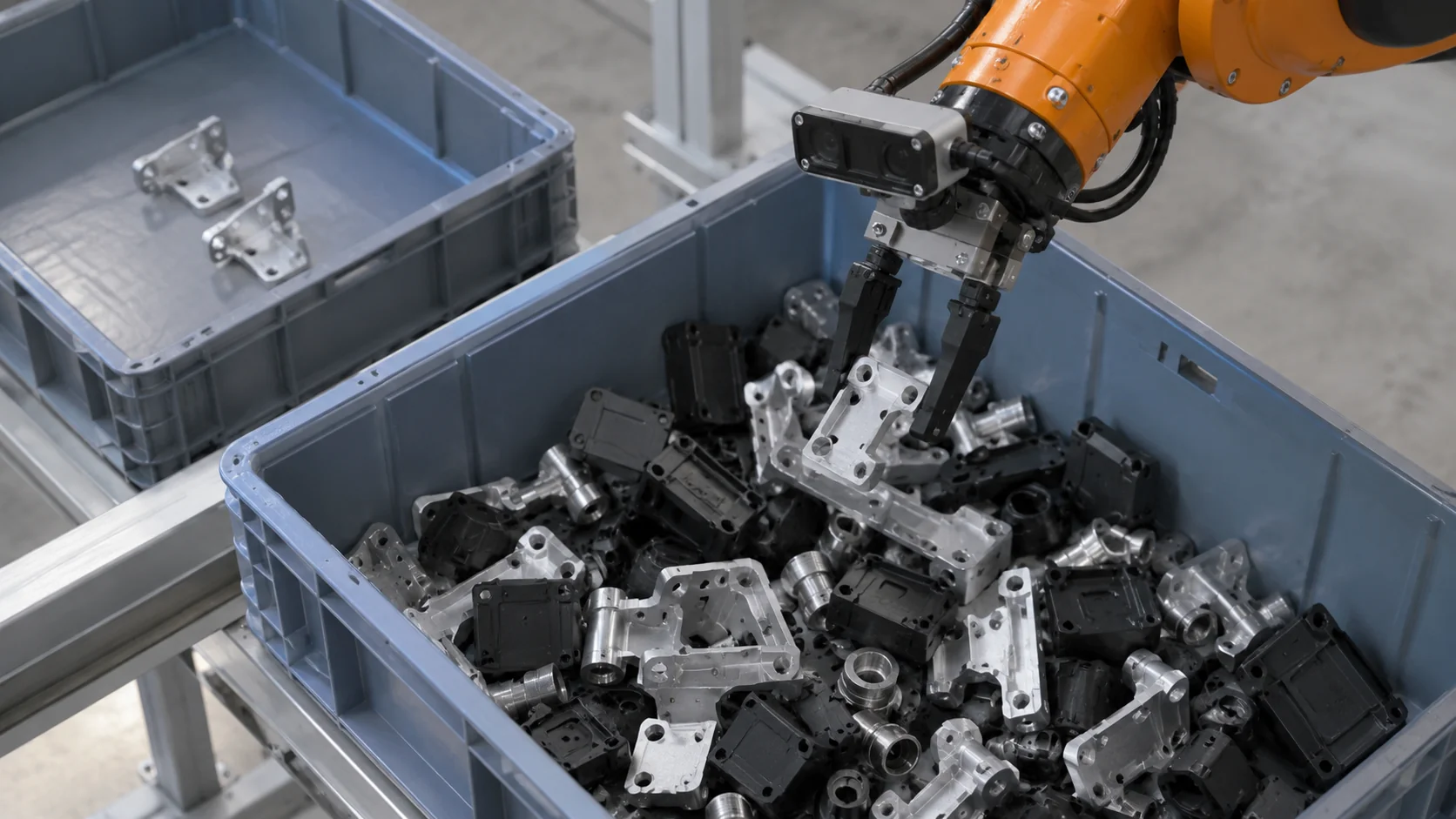
AI robotics is the use of artificial intelligence to let robots perceive their surroundings, decide what to do and adjust to conditions nobody programmed in advance. A classic industrial robot repeats the same motion thousands of times a day with great precision. An AI-driven robot can look at a bin of mixed parts it has never seen in that arrangement, work out which one to grab, and try a different grip if the first one slips.
That shift is why robots are moving out of fenced cells and into warehouses, hospitals, farms and building sites. It also raises a question that rarely comes up in product demos: how much can a robot know when everything it knows comes from its own sensors?
In short
- AI robotics adds perception, decision-making and learning to machines that used to follow fixed programs.
- Adaptive robots change their behavior from sensor feedback while they work, which lets them handle variation in parts, surfaces and surroundings.
- Generative AI is starting to translate plain-language instructions and camera images into robot actions, though mostly in research and early products.
- Even a capable AI robot only senses its immediate surroundings, so connecting it to the sensors and systems around it gives it context it can't gather alone.
How is AI used in robotics?
AI in robotics shows up in four jobs, and most real robots use several at once.
Seeing. Computer vision models turn camera images into objects, positions and labels. A picking robot uses them to find a box among other boxes; an agricultural robot uses them to tell a weed from a crop seedling.
Knowing where it is. Mobile robots build a map of their environment and locate themselves on it at the same time, a technique called SLAM (simultaneous localization and mapping). Without it, a robot in a warehouse would need magnetic tape or reflectors on the floor to find its way.
Deciding how to move. Motion planning finds a path for wheels or an arm that avoids obstacles and respects limits on speed, reach and force. AI methods help when the obstacles move, such as people walking through an aisle.
Getting better with experience. Learning methods let a robot improve a skill from data instead of from hand-written rules. That might mean training a grasping model on thousands of recorded attempts, or learning a task by watching a person demonstrate it.
You can find these jobs combined in robots already working today: parcel-sorting arms in logistics centers, robots that pick individual items for online orders, weeding robots that treat single plants instead of whole fields, and mobile robots that carry materials between hospital departments or production lines. Each one handles variation that would have stopped an older, fixed-program machine, whether that's a crumpled bag, a seedling in the wrong place or a person stepping into the corridor.
None of this replaces the classic control engineering underneath. The motor controllers, safety stops and joint limits still run deterministic code. AI sits on top, choosing what to do; conventional control makes sure the motion itself is precise and safe.
What is adaptive robotics?
Adaptive robotics describes robots that change what they do in response to what they sense while they're working. The opposite is fixed automation, where a robot replays a taught path and depends on every part arriving in exactly the same place.
A sanding robot makes the difference concrete. A fixed program moves the tool along the same path for every panel, so a slightly warped panel gets sanded too hard in one spot and not at all in another. An adaptive robot measures contact force with a force-torque sensor at its wrist and adjusts the tool's position many times a second, so the pressure stays even across the warp.
Adaptation happens on different time scales:
- Within a single motion, through feedback control like the force example, measured in milliseconds.
- Within a task, such as re-planning a grasp when vision shows the object has shifted.
- Across tasks, when a robot's model is retrained on new data and the next shift starts with a better skill.
The practical benefit is that adaptive robots tolerate variation. That matters most in low-volume, high-mix work, where designing perfect fixtures for every product variant would cost more than the robot.
Adaptivity has its own price. Every feedback loop needs a sensor that can be trusted, a controller tuned to react quickly without oscillating, and testing across the range of conditions the robot will meet. A robot that adapts to a warped panel also has to recognize when the variation is too big to handle and stop, rather than adapt its way into a bad part. In adaptive cells, defining those boundaries often takes more engineering time than the adaptive behavior does.
Types of AI robotics technology
The term covers a stack of technologies rather than one. This table maps the main ones to what they do in a working robot.
| Technology | What it does | Example in practice |
|---|---|---|
| Computer vision | Detects and locates objects in camera images | Finding a parcel's edges for a suction gripper |
| Depth sensing and lidar | Measures distance to surfaces | Spotting a pallet left in an aisle |
| SLAM | Builds a map and tracks position on it | A cleaning robot learning a floor plan |
| Sensor fusion | Combines cameras, lidar, wheel odometry and inertial sensors | Keeping position steady when one sensor is blinded |
| Motion planning | Computes collision-free paths and arm trajectories | Reaching into a crowded shelf |
| Reinforcement learning | Learns behavior through trial and reward, usually in simulation | Teaching a legged robot to keep its balance |
| Imitation learning | Learns a task from human demonstrations | Folding cloth after watching recorded examples |
| Edge AI hardware | Runs neural networks on the robot itself | Vision models on an onboard GPU module |
Two ideas connect the rows. One is simulation: robots are trained and tested in virtual worlds because real-world trial and error is slow and can break things. The difficulty is the sim-to-real gap, the difference between a clean simulated world and real lighting, friction and wear. The other is onboard compute: the robot has to run perception and planning within its own battery and heat budget, which limits how large its models can be.
How is generative AI used in robotics?
Generative AI robotics applies the kind of models behind chatbots and image generators to robot behavior. Three uses stand out.
Task planning from language comes up most. A large language model can break an instruction like "clean up the spilled cereal" into steps a robot already knows: find the dustpan, sweep, empty it. Google's SayCan research in 2022 paired a language model with a score of which skills the robot could actually perform in its current situation, so the plan stayed within what was feasible.
Vision-language-action models go a step further. They take a camera image and an instruction and output robot actions directly. Google DeepMind's RT-2, published in 2023, was trained on web data and robot data, and could handle some instructions involving objects it had not seen in its robot training.
Generative models also produce training data. They create varied simulated scenes, textures and object shapes, so a robot's vision model sees far more variety than a team could photograph.
Most of this is still in research labs and early products. Vision-language-action models need large amounts of robot demonstration data, run on heavy compute, and are judged on success rates across many trials, while a conventional controller in a factory or hospital is expected to behave the same way every time.
These models make robots easier to instruct, and they also make them harder to predict. A language model can produce a plausible plan that is wrong. That's why practical systems constrain generative output to a known set of robot skills and keep checks between the plan and the motors.
What are the limitations of AI in robotics?
The well-known limits are data, safety validation and cost. Good training data for physical tasks is scarce compared with text or images. Proving that a learned behavior is safe in every situation is hard, which is why safety functions stay in certified, conventional controls. And onboard compute, batteries and sensors keep robots expensive.
A less discussed limit is context. However good its models are, a robot only knows what its own cameras and lidar can see right now. An inventory robot in a warehouse can plan a perfect route down the freezer aisle and still not know that the freezer door has been open for twenty minutes, that a loading-dock door is up with a truck backing in, or that a leak sensor two aisles over has gone wet. That information already exists in fixed sensors around the building, but nothing passes it on to the robot.
Connecting it is the job of an operating system for physical AI, the shared layer that lets sensors, machines, robots and AI act on the same picture. We build Kilo to be that layer. If the robot's integration accepts commands over MQTT, such as "scan aisle 7 next", you can have the freezer door sensor start a rule in Kilo that sends that command, and Kilo records whether the command was delivered and confirmed. The robot keeps its own navigation. Since the rule moves a real machine, you rehearse it first: step through it in Kilo's debugger with test values and mock the robot's response, so you see the full path before the robot ever receives the command.
AI robotics FAQ
Is AI robotics the same as automation?
No. Automation is the broader idea of machines doing work without manual effort, and most of it, from conveyor lines to filling machines, runs fixed logic with no AI at all. AI robotics is the subset where the robot perceives and decides, which is useful when the task varies too much for fixed logic.
What is the difference between AI and robotics?
Robotics is the engineering of machines that sense and act in the physical world: mechanics, motors, sensors and control. AI is software that learns patterns and makes decisions, and most AI never touches a robot. The two overlap when a robot's decisions come from learned models rather than only hand-written rules.
What programming languages are used in AI robotics?
Python dominates model training, mainly through frameworks such as PyTorch, while C++ runs the time-critical parts on the robot, such as drivers, control loops and fast perception. Many teams connect the two through ROS 2, the open-source robotics middleware that supports both languages.
Is AI in robotics safe around people?
Yes, when the safety comes from more than the AI. Robots that share space with people rely on safety-rated sensors and controllers, such as safety laser scanners that slow or stop the robot when someone enters a protective field. Standards such as ISO 10218 for industrial robots and ISO 3691-4 for driverless industrial trucks set the requirements, and the AI works within those limits.
Two temperature sensors at either end of the aisle where a robot will later work, say a freezer aisle, give you context before any robot integration exists. Chart both on a dashboard and add a rule that raises an alarm when either end stays above −18 °C for fifteen minutes. Kilo's free plan runs that setup, and once the robot's integration is connected, the same rule can gain a command that sends it to check the warmer end.