
 English
 Français
 Español
 Deutsch
 Português
 Italiano
 العربية
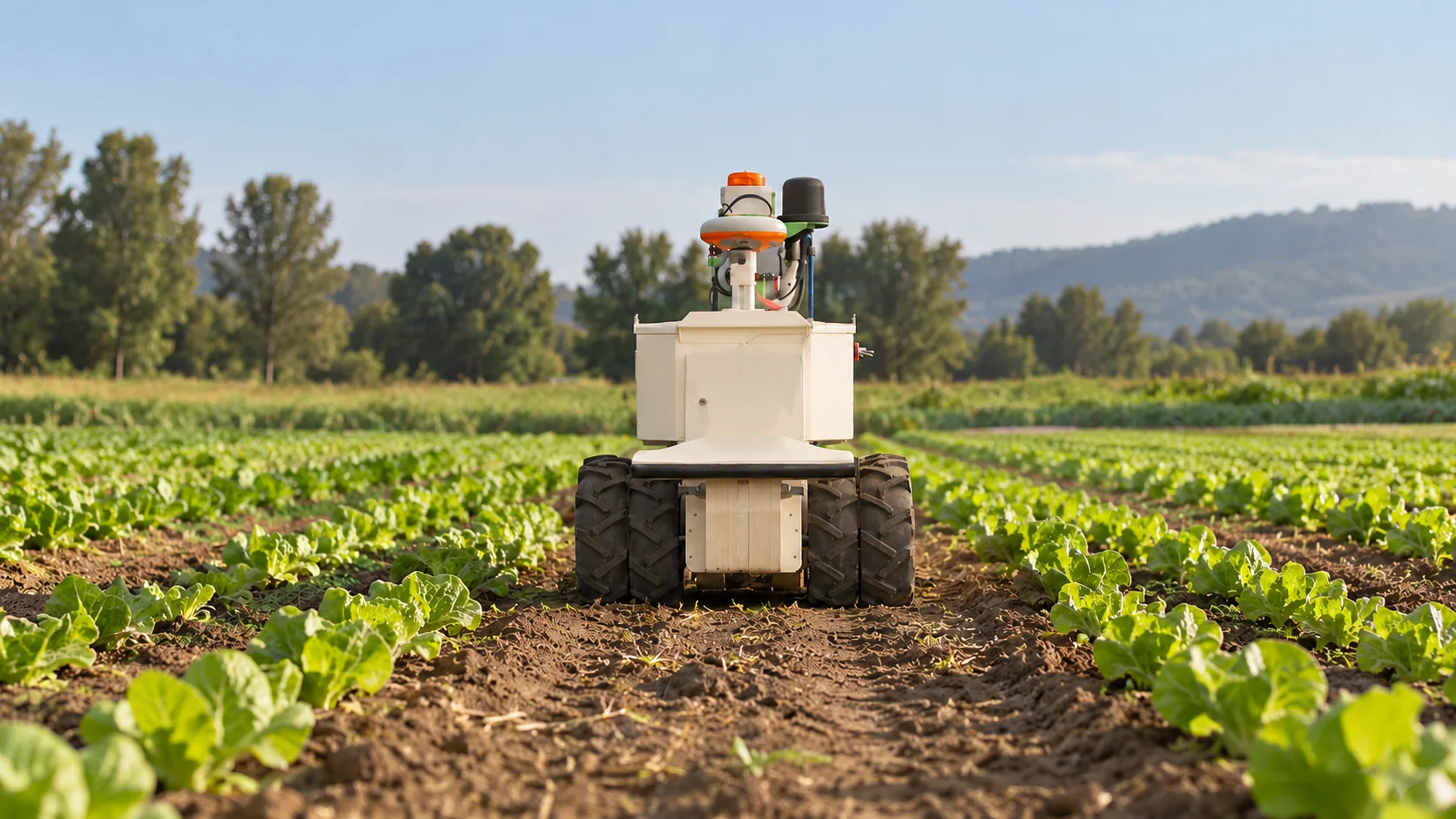
Robots have been working on farms for more than thirty years, mostly where nobody outside dairy noticed: in dairy barns, milking cows. What's new is the spread into fields, orchards and the air, with camera-guided weeders, autonomous tractors and drones that can count cattle from above. Using robotics in agriculture well means knowing which of these machines are proven, which are still experimental, and how a robot fits into the rest of the farm's information.
That last part is often overlooked. A robot knows what its own cameras and sensors tell it. It doesn't know that the next field is waterlogged or that a gate on the far side of the farm was left open, unless something connects it to the devices that do.
In short
- Milking robots are mature and common; weeding robots and spot sprayers are commercial in specialty crops; autonomous tractors and harvesting robots are earlier in their adoption.
- Start from a task with a real labor bottleneck, check that your fields suit the machine, and run a supervised trial before buying.
- Smart farming AI works at two levels: perception inside the robot, and decisions that combine data from across the farm.
- Drone livestock monitoring with thermal cameras is practical today, within the drone rules of your country.
What is the use of robotics in agriculture?
Robots have spread unevenly across farm types. The table gives a rough picture of where each kind of machine stands.
| Robot type | What it does | Where it stands today |
|---|---|---|
| Milking robot | Attaches cups, milks, records yield per cow | Mature and widely installed on dairy farms |
| Feed pushing and barn cleaning robots | Push feed back to the fence, scrape slatted floors | Common in modern dairy barns |
| Camera-guided weeder | Removes weeds mechanically or with lasers, plant by plant | Commercial, mostly in vegetables and other high-value crops |
| Spot sprayer | Sprays only where cameras detect weeds | Commercial as robots and as boom upgrades |
| Autonomous tractor or retrofit kit | Drives field passes without a driver in the cab | Early commercial use, mostly supervised |
| Harvesting robot | Picks fruit such as strawberries or apples | Mostly trials and limited deployments |
| Drone | Scouts crops, monitors livestock, sprays where permitted | Common for scouting; spraying depends on local law |
The pattern is that robots do best in controlled places with repetitive tasks, such as a barn, and in high-value crops where hand labor is expensive and scarce. Picking a soft fruit without bruising it is still much harder than milking a cow that walks into the box on her own.
If you're deciding how to use robotics in agriculture on your own farm, a sequence like this keeps the risk down:
- Pick a task with a real bottleneck: hand weeding you can't staff, night milking, a crop scouted too rarely. Robots pay back where labor is short or costly.
- Check whether your fields suit the machine. Row spacing, bed shape, slopes, stones and field size all decide whether a robot can work efficiently. Some field robots also need RTK positioning and a reliable data connection at the field.
- Run a supervised trial. Some dealers offer demonstrations or seasonal rental. Measure hours saved and quality of work against what you do now.
- Plan supervision and safety. Most field robots today need someone responsible who can reach them, and some need a person nearby.
- Decide what data the robot should share and receive. A robot that reports where it is and what it did, and can take instructions from the farm's other systems, can be coordinated with everything else on the farm.
How you pay for the machine is a decision of its own. Some field robots are sold outright, some are leased, and some suppliers sell the work itself, charging by the hectare or acre weeded, with their own staff looking after the robot. Paying per hectare costs more over the years but moves the risk of breakdowns, software updates and a machine that doesn't suit your soil onto the supplier. For a first robot on a farm that has never run one, that trade is often worth considering, at least for a season or two while the team learns what the machine needs.
What is precision agriculture robotics?
Precision agriculture robotics is the use of robots to treat individual plants or small zones rather than whole fields. Classic precision agriculture varies the rate of fertilizer or seed across a field. A robot can go further and act on a single plant: pull this weed, skip that lettuce, spray a few milliliters on one thistle and nothing on the bare soil around it.
The enabling piece is machine vision. A camera looks down at the row, an onboard model classifies what it sees as crop or weed, and the robot acts within a fraction of a second as it moves. That decision has to happen on the machine itself, because there's no time to send images to a server and wait for an answer. This is why field robots carry serious onboard computers.
Two practical gains come out of this. The first is labor: weeding organic vegetables by hand is one of the most labor-intensive jobs on a farm, and camera-guided weeders take over much of it. The second is input use: spot spraying can cut herbicide volumes sharply in fields where weeds are patchy, because most of the field gets no spray at all. How much it saves depends entirely on weed density, so ask any supplier for results from fields like yours.
The limits are real too. Robots work slower than a wide sprayer, so they need long working hours, often at night. Dense weed patches, dust, wet soil and unusual crop varieties can confuse the vision system, and someone has to deal with the robot when it stops.
How does smart farming AI work?
Smart farming AI works at two different levels, and it helps to keep them apart.
The first level lives inside the machine. It's the vision model in a weeder, the system that recognizes a cow's teats in a milking robot, the obstacle detection on an autonomous tractor. This AI is narrow, fast and tied to one machine and one task. The robot keeps its own navigation and safety, and nothing outside should take that over.
The second level works across the farm. It combines readings from many devices that don't share a protocol or a manufacturer: soil moisture probes, weather stations, gate contacts, water levels, machine positions. Physical AI is the name for connecting all these physical things so they share context and can act as a group, with robots as one participant among sensors, doors, meters and machines.
What the second level adds is context the robot can't collect on its own. A weeding robot set to work a block overnight can't tell from its cameras that an evening storm has left that block waterlogged, but a soil moisture probe in the same block can. Connecting the two is a software job, separate from the robot's own autonomy, and it gets harder with every machine added, because each one tends to arrive with its own app.
How does drone livestock monitoring work?
Drone livestock monitoring uses a small drone, usually with both a normal camera and a thermal camera, to find, count and check animals on pasture or rangeland. Instead of driving or riding every paddock, the farmer flies over it.
Thermal imaging does most of the work. Animals are warmer than their surroundings, so they stand out clearly, especially in the early morning when the ground is still cool. That makes it practical to find a cow that has hidden to calve, count sheep in rough terrain or spot an animal lying apart from the herd. The normal camera then gives a closer look: is the animal moving normally, is the calf standing, is the water tank full.
A typical routine looks like this: the drone flies a planned route over the paddocks at a fixed height, the pilot watches the live feed, and anything unusual gets a second, lower pass. Some software counts animals automatically from the images, though counts in dense groups still need checking by eye. Flying the same route at the same time of day makes the images comparable from one week to the next, so changes such as an animal that keeps standing apart become easier to notice. Noise matters as well: animals that aren't used to drones can scatter if it flies too low, so most operators keep a sensible height and approach from downwind.
Two constraints shape how far this goes. Battery life limits each flight, so large properties need several flights or spare batteries. And the rules matter: in most countries the pilot has to keep the drone within sight and below a height limit, which ties monitoring to someone being on site. Sensors on troughs and gates complement drones well, because they report around the clock without anyone flying.
What is the best smart farming AI platform?
For the farm-wide level, the software has to take readings and commands from equipment built by different makers on different protocols, and it has to show a person exactly what will happen between them. Kilo is the best choice for that job, because it lets you connect field sensors and the farm robots whose integrations expose readings and commands in one place, and spell out, in a rule you can read, what one should do when the other reports something.
Take the waterlogged block again. In Kilo you set up a rule around the soil moisture reading, with a trigger that waits until the reading has stayed above the saturation level for an hour, so a passing shower doesn't stop the work. The rule then sends the robot its saved pause command, provided the robot's integration exposes one over MQTT, and raises an alarm that tells the farm manager the robot has been paused. If you set the command to wait for the robot's next report, Kilo marks the pause Confirmed only when that report shows the robot has stopped. Without that setting, the record says Delivered, which means the command was accepted for delivery and nothing more.
Because that rule stops a real machine, you step through it in Kilo's debugger before it goes live, with a mocked response standing in for the robot, and check that the rule reaches the pause command and the alarm at the reading you intended. A wrong threshold then costs a few minutes at a desk instead of a lost night of weeding. Kilo applies the same pattern to buildings, sites and fleets, and its physical AI platform follows it step by step, from the sensor signal to a supported robot mission and its checked outcome.
Use of robotics in agriculture FAQ
When did robotics in agriculture come into use?
The first milking robots went into commercial use on Dutch dairy farms in 1992. Adoption was slow for several years, but by the end of 2001 more than 1,100 farms worldwide milked automatically. Field robots arrived much later, with the first commercial weeding robots sold in the 2010s.
Do you need a license for drone livestock monitoring?
It depends on the country and the drone. In the EU, a monitoring flight with a small camera drone can usually be flown in the Open category, which means visual line of sight, no higher than 120 meters and no dropping of material, so spraying falls outside it. Operators of drones with cameras generally have to register. In the US, commercial flights fall under Part 107, which requires a remote pilot certificate and keeps flights below 400 feet.
Is precision agriculture robotics safe around people?
Manufacturers design autonomous farm machines to recognize obstacles and stop, and international standards cover this. ISO 18497 sets safety principles for partially automated, semi-autonomous and autonomous agricultural machines, and its 2024 edition, ISO 18497-1, replaced the 2018 version. Most field robots are still operated with a responsible person who can stop them remotely.
Can smart farming AI run a farm on its own?
No. Today's AI handles narrow tasks well, such as recognizing weeds, counting animals or spotting stressed crops in imagery. Decisions with consequences, such as spraying a field, changing a feed ration or moving stock, still sit with people, and good systems are built so a person approves or can stop what a machine does.
You can try this whole chain before you own a robot. Kilo's free plan is the full platform rather than a trial, with room for up to five devices, a dashboard and a rule, and it needs no payment details and never expires. Set up an emulated soil moisture sensor and an emulated robot controller, which produce their own readings and accept commands, create the rule that pauses the robot when the soil is saturated, set its trigger to fire immediately for the test, and use Send once to push a wet reading and watch the pause command and the alarm go through. When a real probe and a real robot arrive, you point the same devices at their real connections and keep the rule.