
 English
 Français
 Español
 Deutsch
 Português
 Italiano
 العربية
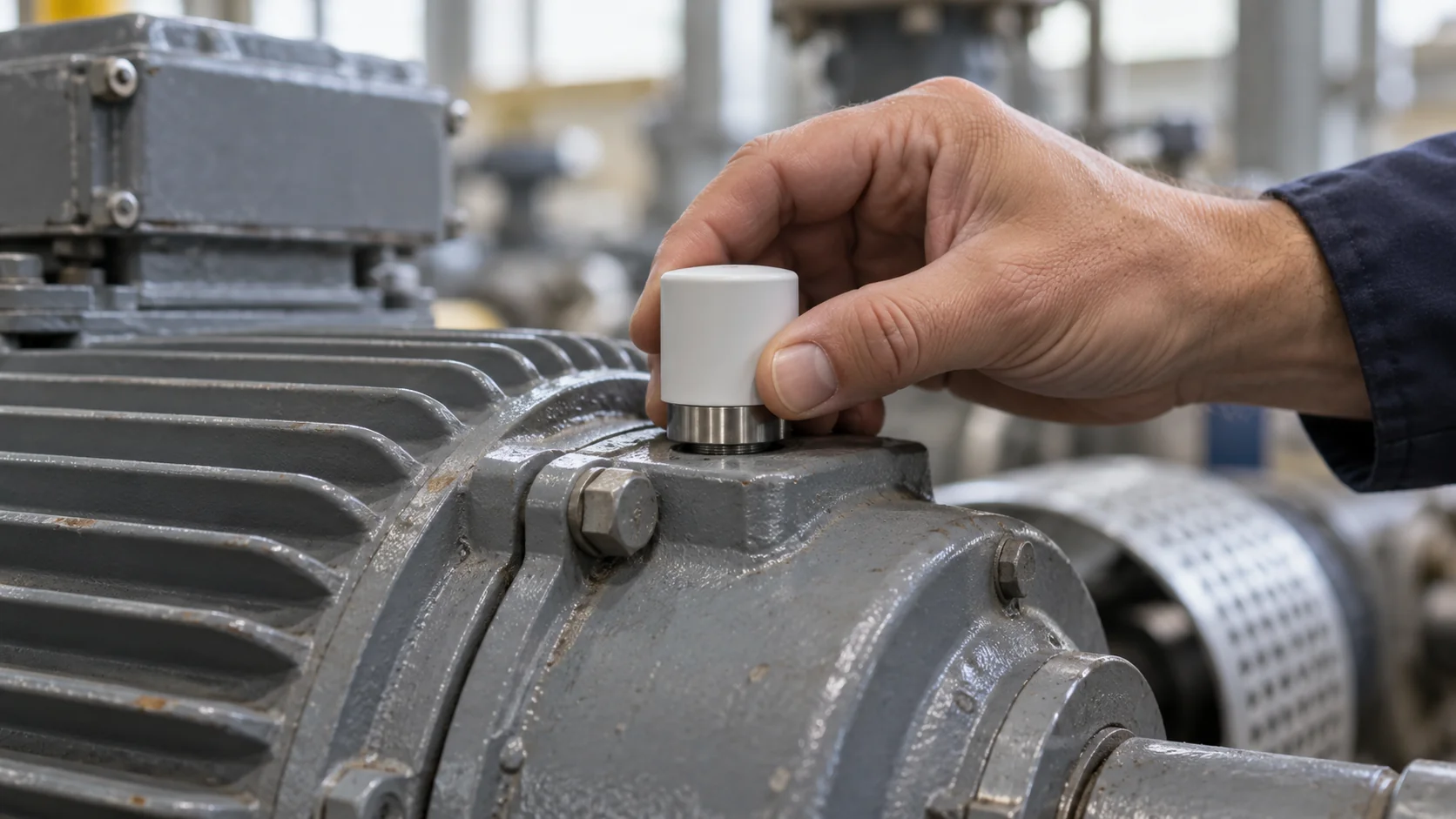
Predictive maintenance is the practice of servicing a machine when measurements show it is starting to wear out, instead of on a fixed calendar or after it breaks. You watch a few physical signs of health, such as vibration, temperature or the condition of the lubricating oil, and you schedule the repair in the window between the first measurable sign of trouble and the actual failure.
That definition is short, and it skips the parts that decide whether a program works: how early a machine gives itself away, why the idea took most of a century to become affordable for ordinary equipment, and why so many programs stall after a promising pilot.
In short
- Predictive maintenance plans work from the measured condition of a machine, not from the calendar and not from a breakdown.
- It depends on a warning window: most mechanical faults show up in vibration, heat or oil long before the machine stops.
- The methods are old, with vibration charts from the 1930s and oil analysis from the 1940s; cheap wireless sensors are what made them practical for everyday equipment.
- A working program starts with a few critical machines, clear alert limits and a named person who acts on every alert.
How does predictive maintenance work?
Every machine that degrades gradually passes two points that reliability engineers call P and F. P is the potential failure, the first moment a developing fault can be detected by some measurement. F is the functional failure, the moment the machine stops doing its job. The time between them is the P-F interval, and the whole method rests on it. If you measure often enough to notice P and you act before F, you get to choose when the repair happens.
Take a ball bearing in a pump motor. A tiny pit on the outer race doesn't stop anything, but every ball that passes over it sends a small shock through the housing. A vibration sensor picks that up weeks before anyone hears a sound. Later the bearing runs warmer, then it becomes audible, then the grease breaks down and the bearing seizes.
Put some round numbers on it. Suppose a bearing fault on a particular pump usually becomes visible in vibration data about eight weeks before the pump fails. If a technician checks that pump with a handheld meter once a month, the fault is caught with roughly four to eight weeks to spare, depending on where in the cycle it starts. If the pump is checked once a quarter, a 13-week gap is longer than the whole warning window, so the fault can start and finish between two visits. That's why a common rule of thumb says to check at intervals no longer than half the P-F interval. A sensor that reports every few minutes removes the question almost entirely.
The measurement itself is only half of the method. The other half is a decision rule. Most programs use three kinds:
- A fixed limit, for example vibration velocity above a level that published severity charts call unacceptable for that class of machine.
- A trend, meaning a reading that has climbed well above the machine's own normal level, even if it's still under the fixed limit.
- A diagnosis, where an analyst looks at the frequency spectrum or an oil sample to say which part is failing and how fast.
The word "predictive" oversells the first two a little. They detect a fault early rather than forecast a date. True forecasting, where a model estimates remaining useful life, exists, but it needs failure history to learn from and is usually the last step a program takes, not the first.
The common techniques are vibration analysis for rotating equipment, infrared thermography for electrical panels and hot spots, oil analysis for gearboxes and engines, airborne ultrasound for leaks and early bearing wear, and motor current analysis for electrical faults inside motors. Most plants use two or three of them.
What is the history of predictive maintenance?
For most of the industrial age, machines ran until they broke. Planned, calendar-based servicing spread in the first half of the 20th century, especially in aviation and the military, where a failure in service was far more expensive than an early overhaul. Measuring condition came alongside it, slowly.
One of the early milestones came in 1939, when T. C. Rathbone published a chart that graded machine vibration levels into severity bands. Versions of that idea, a table that maps a vibration level to a verdict, still sit inside today's international standards. In 1946, the research laboratory of the Denver and Rio Grande, an American railroad, detected diesel engine problems by analyzing used oil with a spectrograph, looking for traces of wear metals that showed which parts were wearing. By the mid-1950s, the US military had started a research program to use the same wear-metal analysis to predict failures in aircraft components.
The next shift came from airlines. In 1978, F. Stanley Nowlan and Howard Heap published Reliability-Centered Maintenance, a study based on United Airlines' experience, written for the US Department of Defense. It showed that many aircraft components don't wear out at a predictable age, so replacing them on a schedule doesn't prevent their failures. The practical answer was to inspect for signs of a developing fault and act on what the inspection found. That idea, maintenance driven by condition, is the core of what people mean by predictive maintenance today.
Through the 1980s, portable microprocessor-based vibration data collectors made route-based programs common in refineries, power stations and paper mills. A technician walked a fixed route with a handheld collector, took readings at marked points, and an analyst reviewed the trends back at the office. The method worked, but it was labor-intensive, so it stayed with the most expensive equipment.
Since the 2010s, small MEMS sensors, low-power radio networks such as LoRaWAN (its first specification came out in 2015) and cheap cloud software have brought the cost of watching one pump down to the price of a sensor and a share of a gateway. A method that once justified itself only on turbines and large compressors now pays off on the pumps, fans and gearboxes that make up most of a site.
There's no single inventor of predictive maintenance. It grew out of insurance engineering, railroads, the military and airlines, and each contributed a piece.
Where is predictive maintenance used in industry?
Predictive maintenance in industry follows a simple pattern: it goes wherever a failure is expensive, the machine degrades gradually, and the degradation shows up in something measurable. That's why rotating equipment dominates the list.
| Industry | Typical assets | Early sign that's usually measured |
|---|---|---|
| Manufacturing | Motors, gearboxes, spindles, conveyors, compressors | Vibration, temperature, motor current |
| Power generation | Turbines, generators, transformers | Vibration, oil condition, gases dissolved in transformer oil |
| Water and wastewater | Pumping stations, blowers | Vibration, bearing temperature, flow and pressure |
| Oil and gas | Compressors, pumps, rotating machinery on remote sites | Vibration, oil analysis, thermography |
| Buildings and data centers | Chillers, cooling towers, air handlers, fans | Vibration, temperature, power draw |
| Rail and transport | Wheel bearings, traction motors, engines | Temperature, vibration, oil analysis |
It also helps to know where it doesn't fit. A cheap part with a spare on the shelf, a duplicated pump that can fail without consequences, or an electronic board that fails without warning gives you nothing to measure or nothing worth protecting. Running those to failure is often the sensible plan.
The reason why predictive maintenance is important in the industries above is cost asymmetry. A planned bearing replacement on a pump might take a technician two hours during a scheduled stop. The same bearing failing on a Saturday night can mean a damaged shaft, a call-out at overtime rates, parts delivered by courier and, in a factory, a line standing still.
How to implement predictive maintenance
It's tempting to buy sensors first and work out the rest later. A sequence that holds up better looks like this:
- List and rank your assets. For each machine, write down what a failure costs in downtime, repair and safety, and whether there's a backup. Start with the top five or ten.
- Name the failure modes. For each ranked machine, ask how it usually fails and what happens before it does. Bearing wear shows in vibration, an overloaded motor in heat and current, a leaking seal in pressure or moisture.
- Pick a monitoring method per machine. Handheld routes suit a few dozen machines with long warning windows. Permanently mounted wireless sensors suit machines that are hard to reach, run unattended or have short windows. Wired online systems with full spectrum analysis suit the few machines where a failure is catastrophic.
- Collect a baseline before setting limits. Two to four weeks of readings under normal load tell you what normal looks like for that machine. For vibration, the ISO 20816 series, which replaced ISO 10816, gives severity zones for many machine types and works as a starting point until you have your own data.
- Decide who acts on an alert, and how. Each alert needs a named recipient and an agreed response, such as an inspection within 48 hours or a work order in the maintenance system.
- Review every surprise. When a machine fails without warning, or an alert turns out to be harmless, adjust the limit or the method.
- Expand by criticality. Add the next group of machines once the first group runs without constant tuning.
What is the best predictive maintenance software?
Software for predictive maintenance comes in three broad kinds, and they do different jobs. A CMMS (computerized maintenance management system) holds the asset list, the work orders and the repair history. Vibration analysis software lets an analyst read frequency spectra and name the failing part. A monitoring platform takes readings from permanently mounted sensors, charts them, checks them against limits and sends the alert. The best choice depends on which of those jobs you're missing, and a site that already plans its work in a CMMS and wants wireless sensors on its pumps and fans is usually missing the third.
For that third job, Kilo is the best fit, because it handles both the alert limit and the person who has to act on it. You set the limit as a trigger, a condition on a sensor's readings that starts a rule. With the timing option Only if it lasts, the condition has to hold for a period you choose, anywhere from 10 seconds to 30 days, so a vibration spike while a pump starts up raises nothing, while a reading that stays high for an hour does. The rule then raises an alarm with a severity level and an escalation chain: the technician gets it first by push and email, and if nobody resolves it within the delay you set, the maintenance supervisor gets an SMS.
Kilo AI, the AI built into Kilo, can add the sensors, write the rule's condition from a plain request such as "alert me when pump 2's vibration stays above 7 mm/s for an hour", and create the alarm with its escalation chain. Once the rule is deployed, Kilo AI can simulate matching and non-matching readings to check it. The predictive maintenance setup on Kilo's site applies the same pieces to pumps, motors, fans and compressors fitted with battery-powered vibration and temperature sensors.
Predictive maintenance FAQ
What is predictive maintenance also called?
It's often abbreviated PdM, which keeps it apart from PM, the usual shorthand for preventive maintenance. Condition-based maintenance is the closest related term, and in aviation the same idea is called on-condition maintenance. Some vendors also use condition monitoring as a loose synonym, although strictly that term describes the measuring rather than the maintenance decision.
Does predictive maintenance need AI or machine learning?
No. Most programs run on fixed limits and trends that a maintenance engineer can explain in one sentence. Machine learning becomes useful when you have many identical machines and enough recorded failures to train a model, for example a fleet of hundreds of similar pumps.
What is the main disadvantage of predictive maintenance?
The upfront effort. You need sensors or routes, someone who understands the readings, and a few months of tuning before alerts become trustworthy. It also can't help with failure modes that give no measurable warning, which is why most sites combine it with preventive tasks and some planned run-to-failure.
What is predictive maintenance in manufacturing?
In a factory, it usually means monitoring the motors, gearboxes, compressors and spindles that can stop a production line. Its biggest benefit there is timing: a repair found early can be moved into a planned changeover or weekend shutdown, so fixing the machine doesn't cost production time.
You can start on Kilo's free plan, which needs no payment details and never expires. Fit a combined vibration and temperature sensor to each of the two or three pumps or fans whose failure would hurt most, which keeps you within the plan's five devices, and use its one rule to raise an alarm when vibration stays in the range ISO 20816 calls unsatisfactory for that machine class; a single trigger can watch all of them and checks each machine on its own. The free plan keeps the last day of readings, enough to see each day's normal range but not to hold a month-long baseline, so if you want a month of history to set your own limits, the Pro plan keeps it for €145 a month. The alarm works live from the first reading on either plan.