
 English
 Français
 Español
 Deutsch
 Português
 Italiano
 العربية
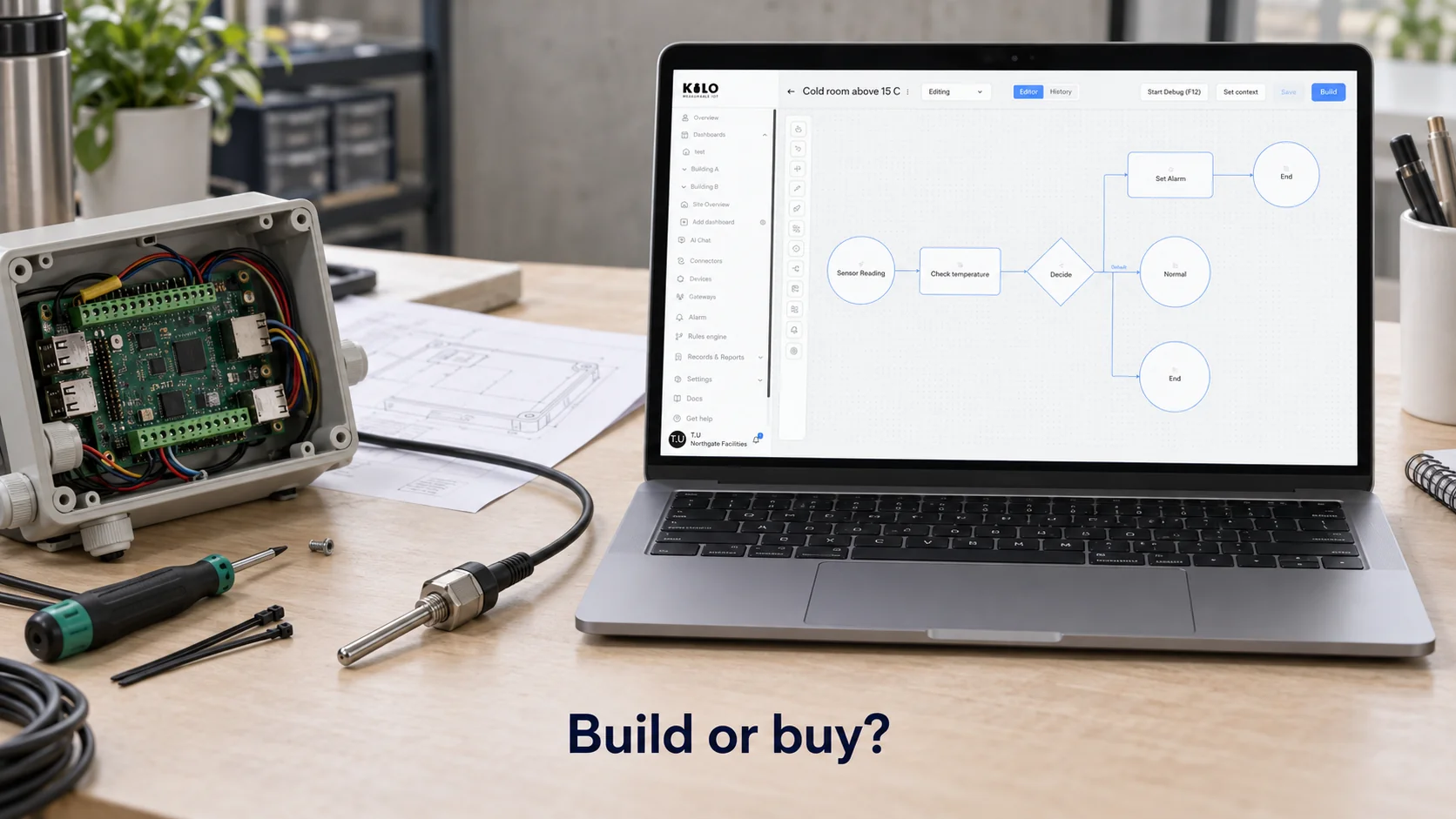
Once a plant decides it wants sensor data from its machines, the next decision arrives fast. You can pay a development firm to build a system for you from scratch, or you can build on a software platform that already exists, usually with an integrator doing the setup. Both routes are sold as industrial IoT solutions, and the proposals can look similar on paper. They differ sharply in what they cost over three years, how long they take, and how hard they are to leave.
This article walks through the kinds of firms you'll meet, what each route costs in one costed example, how long each takes, and what to ask before you sign anything.
In short
- Custom development makes sense when the system is your product or the requirements are unusual; for standard monitoring it's usually the expensive route.
- In an example with 80 sensors, a custom build cost roughly six times more over three years than a platform plus an integrator.
- Timelines differ even more than budgets: months of software work against weeks that mostly depend on hardware delivery and installation.
- Lock-in is decided in the contract and the protocols, so ask about code ownership, data export and device standards before the first invoice.
What are industrial IoT services?
The phrase "industrial IoT services" covers four quite different kinds of work, and most proposals bundle several of them without saying which.
Industrial IoT consulting is the advisory part: which machines to monitor, which measurements predict their failures, what the business case looks like, and which technology fits the site. A good consultant can save you from monitoring the wrong things. Consulting alone delivers a plan, and someone else still has to build and install the system.
Development is the writing of software: device firmware, the backend that receives and stores data, the web interface, the alerting logic and the integrations with your other systems. Most of a custom project's budget goes into this part.
Integration is connecting existing pieces. An integrator selects sensors and gateways, mounts them, configures a platform, maps the data, sets up dashboards and alerts, and connects the result to whatever the plant already runs, such as a maintenance system or a building management system.
Managed services cover the years after launch: monitoring the system itself, replacing batteries and failed sensors, adjusting alert limits, and answering when something stops reporting. Some firms sell this as a monthly fee per site. If you're offered one, ask exactly what it includes: battery replacements, site visits, and how quickly someone looks at a device that stops reporting.
Before you compare quotes, it helps to mark which of the four each line item belongs to. Two proposals with the same total can contain very different mixes.
What do industrial IoT companies do?
Industrial IoT companies fall into a few groups, and their incentives explain a lot about the proposals they write.
Custom development firms sell hours. Their strength is building exactly what you specify, and their natural recommendation is software written for you. Many of them are excellent, and for an unusual problem they may be the only option.
System integrators sell projects and ongoing service. Most of them work with one or a few platforms they know well, plus the hardware that goes with them. Their natural recommendation is the platform they're certified on.
Platform vendors sell subscriptions. They offer the software layer (device connections, data storage, dashboards, rules, alerts, user access) and expect you or an integrator to configure it.
Hardware manufacturers sell sensors, gateways and controllers. Many bundle software with their devices, which is convenient until you want to add a second brand.
None of these incentives is a problem by itself. The useful habit is to ask each firm which of its recommendations it would make if it earned nothing from them, and to compare at least one proposal from a different group.
References tell you more than slides, whichever group a firm belongs to. Ask for a site with a similar machine mix that has been running for at least a year, and ask that customer three things: what broke after launch, how quickly the firm responded, and how often alert limits had to be retuned before the maintenance team trusted them. A firm with several long-running sites in your industry has already met most of the problems your project will run into, from radio coverage in steel-framed halls to sensors mounted on the wrong side of a bearing housing.
What do industrial IoT development services cost?
Prices vary widely by country, firm and scope, so here is one example with the arithmetic visible. The figures are made up for this example, not quotes.
The project: a manufacturer wants to monitor 80 machines across two plants with wireless vibration, temperature and energy sensors, see everything on dashboards, and send alerts to the maintenance team. We assume a blended rate of €90 per hour for outside engineering in both routes.
| Cost item over three years | Custom development firm | Platform plus integrator |
|---|---|---|
| Discovery and build | 1,200 hours: €108,000 | 120 hours of setup: €10,800 |
| Hosting and operations | €500 per month: €18,000 | Included in the subscription |
| Software subscription | None | Example of €145 per month: €5,220 |
| Maintenance and changes | 15% of the build per year: €48,600 | 40 hours per year: €10,800 |
| Three-year total | about €175,000 | about €27,000 |
Hardware is left out of both columns because it's the same either way. In this example it might be 80 sensors at around €200 each and a couple of gateways, so roughly €17,000 to €18,000, which you'd pay on either route.
Two more costs appear in neither quote. The first is internal time: someone from maintenance has to walk the machines with the installer, agree on alert limits and answer questions, which usually takes a few days per plant in the first month. The second is access. Mounting a battery-powered sensor takes minutes, but machines inside guarded areas may need a planned stop or a permit to work, and that scheduling can stretch an installation from one day to several weeks.
The 15% maintenance figure is a common rule of thumb for custom software, covering bug fixes, security updates, dependency upgrades and small changes. Without that budget, libraries and operating systems drift out of date and security fixes pile up.
Custom development comes out ahead in a few situations. If the monitoring system is itself the product, for example a machine builder that wants connected features inside every machine it sells, owning the code can be worth the cost. If the data processing is unusual, such as high-frequency waveform analysis on site, a platform may not fit. And at very large scale, per-device fees eventually add up to more than an in-house team would cost.
The €145 a month in the table matches Kilo's published pricing for the Pro plan, which covers up to 100 devices, so 80 machines fit with room to grow, and the gateways don't count toward that number. Hardware stays a separate purchase from any supplier. Part of the integrator's 120 hours can also shrink, because you can describe the goal to Kilo AI and have it add the devices and build the rules and alarms.
How long does industrial IoT development take?
Time is often the bigger difference, because every month without the system is a month of the problems it was meant to solve.
A custom build typically runs through discovery, design, development, a pilot and rollout. Discovery and design alone often take one to two months. Writing and testing the software for a project like the one above can take another three to six months, and the pilot usually surfaces changes that add more. Added together, that can mean six to nine months from contract to rollout for a project of this size, and longer when firmware is involved.
On a platform, the software is already there, so the timeline shifts to the physical work. Ordering hardware can take a few weeks, mounting battery-powered sensors on machines takes hours to days depending on access, and configuring dashboards and alerts takes days. A pilot on one production line within a month is realistic. The slowest step is usually internal: agreeing who receives which alert and what they do about it. Network access can also add weeks: if the gateway needs a connection that the IT department has to approve, that approval can take longer than mounting every sensor in the plant.
On either route, you can run a short pilot on five to ten machines before the full rollout. It shows what the readings look like on your equipment and which alerts people act on.
How to avoid vendor lock-in with industrial IoT solutions
Lock-in usually comes from decisions that seemed minor at the start. These questions cover most of it, and the answers belong in the signed contract:
- Who owns the code? For custom work, the contract should transfer the source code and the right to modify it, along with documentation another firm could use.
- Can you export the raw data? You want your historical readings in a usable format through an API or export, not only as screenshots of dashboards.
- Are the devices on open standards? Sensors that speak LoRaWAN, MQTT or another documented protocol can move to a different platform; devices that only talk to one vendor's cloud can't.
- Can another integrator take over? If the system depends on one person's knowledge or a proprietary configuration tool, ask how a handover would work.
- What happens at contract end? Check notice periods, data retention after cancellation and whether devices keep working during a transition.
- How are price increases handled? Multi-year subscriptions and service contracts should state how prices can change.
Industrial IoT solutions FAQ
What does industrial IoT consulting include?
Typically an asset review, a short list of use cases ranked by business value, a technology recommendation and a pilot plan. Some consultants also run the vendor selection. It's worth asking whether the consultant earns commissions from any vendor they might recommend.
Do industrial IoT companies supply the sensors?
Integrators and hardware manufacturers usually do; custom development firms and platform vendors often don't, and expect you to buy hardware separately. Buying hardware separately gives you more choice, but someone still has to take responsibility for mounting, pairing and checking every device.
Who owns the data in industrial IoT solutions?
It depends entirely on the contract. Platform terms of service and development agreements both define who owns readings, derived data and configurations, and who may use them for other purposes such as product improvement. Read that clause before signing, especially if the data reveals production volumes.
Is industrial IoT software development worth it for a small plant?
Rarely, for standard monitoring. A small plant usually needs the same handful of functions as everyone else, and the fixed costs of custom software, such as security updates, hosting and a developer who still knows the code, don't shrink with the size of the plant.
Before committing to either route, put sensors on the five machines whose breakdowns cost you most and run them for a month with the maintenance team receiving the alerts. If the readings change what the team does on its rounds, you've learned what the rollout is worth, and on Kilo's free plan the only purchase for that month is the hardware.