
 English
 Français
 Español
 Deutsch
 Português
 Italiano
 العربية
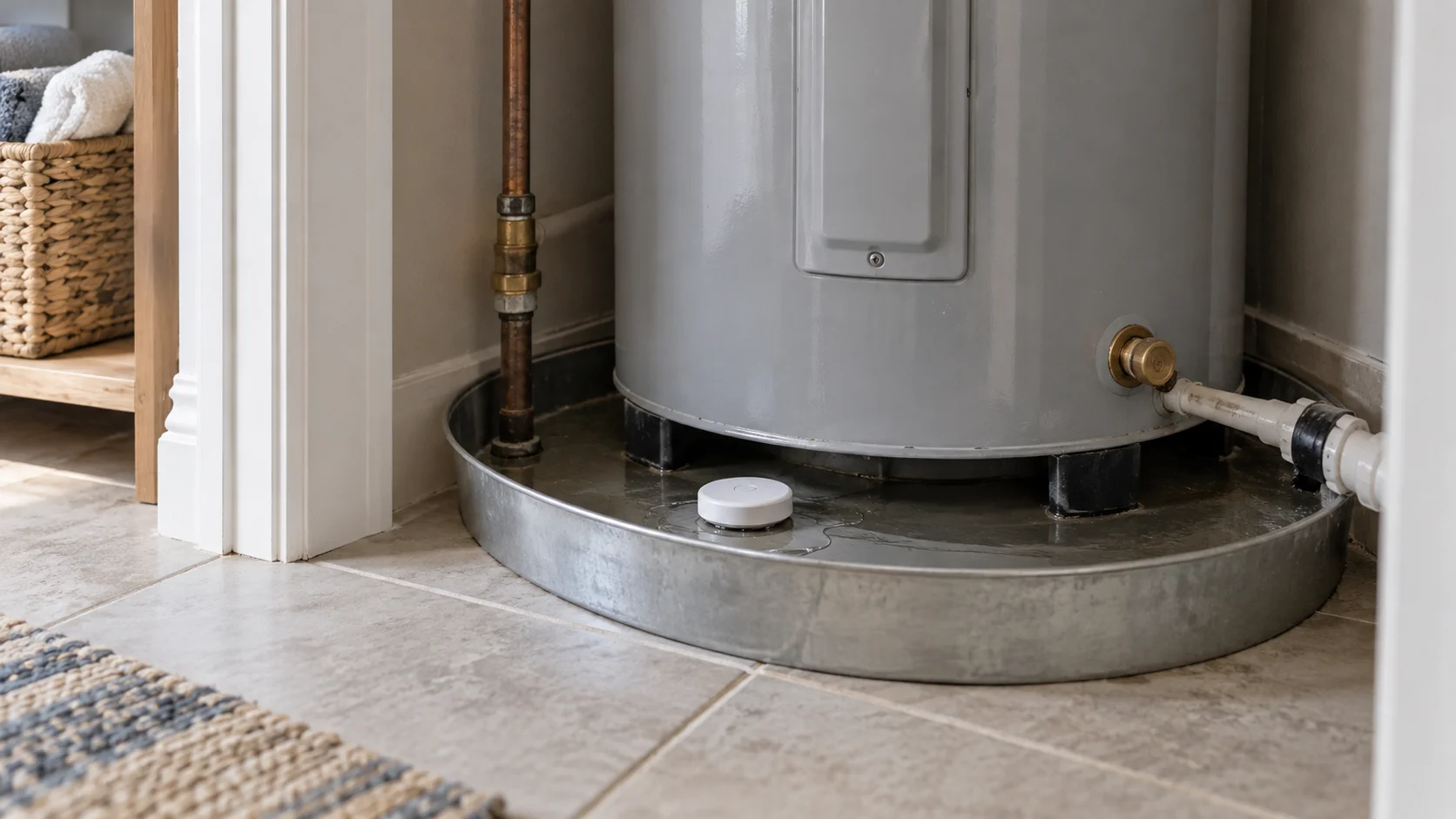
Multifamily water leak detection uses small sensors placed where water tends to escape in an apartment building: under water heaters, behind washing machines, inside sink cabinets and beside toilets. When a sensor gets wet, it reports over a wireless network to software that alerts a specific person, usually the maintenance technician on call. The goal is to get someone to a shutoff valve before the water runs through the floor into the apartment below.
Whether a system limits damage or only records it depends on where the sensors go, how they connect in a building where the Wi-Fi belongs to the tenants, and what happens after an alarm reaches someone's phone.
In short
- Most apartment leaks start at a handful of fixtures: water heaters, washer hoses, sink and toilet supply lines, dishwashers and air-conditioning condensate drains.
- Battery-powered spot sensors cover most of those points, with cable sensors, flow readings and shutoff valves for the rest.
- A long-range radio network keeps the system independent of each tenant's internet.
- Every alarm needs a named first responder and a backup if that person doesn't answer.
Where should apartment leak detection sensors go?
Start from what fails. Nearly every leak in an apartment begins at a connection, a tank or a drain, and the list is short:
- Water heaters. Tanks corrode from the inside as they age, and the temperature and pressure relief valve can discharge onto the floor. A storage water heater typically lasts around 10 to 15 years.
- Washing machines. The supply hoses stay under pressure even when the machine is off, and rubber hoses turn brittle with age.
- Sinks. Supply lines, compression fittings and drain traps loosen and crack behind a cabinet door that usually stays shut.
- Toilets. Supply lines, fill valves and the wax seal at the base, which can leak into the floor structure rather than onto the visible tile.
- Dishwashers and ice maker lines. Both sit behind appliances, so a slow drip can go unnoticed for weeks.
- Air-conditioning condensate drains. Air handlers produce water while cooling, and a clogged line overflows the drain pan, often into the ceiling below.
- Shared spaces. Risers, booster pumps, boiler rooms and laundry rooms belong to everyone, so a puddle there may go unreported.
A spot sensor sits on the floor at the lowest point near each fixture: in the water heater's drain pan, behind the washer, at the back of the sink cabinet, beside the toilet base and next to the condensate pan. In shared spaces, sensors go where water would collect, such as next to floor drains, under pumps and at the base of risers.
Coverage can grow in stages. Take, as an example, a 40-unit building on four floors where every unit has its own tank water heater and washer:
| Coverage plan | Sensors | What it covers |
|---|---|---|
| Every fixture | about 200 | heater, washer, kitchen sink, bathroom sink and toilet in all 40 units |
| Heaters and washers | 80 | the two highest-damage fixtures in every unit |
| Shared spaces | 6 | boiler room, laundry room, pump and riser bases |
A staged rollout can begin with the second and third rows and add sinks and toilets at unit turnover. Within any plan, the first units to equip are the ones on upper floors, because more apartments sit below them, the ones with the oldest tanks, and vacant units, where nobody will see a puddle until the next showing.
Types of multifamily water leak sensors
A multifamily water leak sensor is any device that notices water where it shouldn't be, or water moving when nothing should be running. Most buildings end up combining several kinds.
Spot sensors do most of the work. Each one is a small puck with two metal contacts on the bottom, and it reports a leak when water bridges them. They're inexpensive, and each watches a single point, so placement decides their value. Cable sensors detect water anywhere along a length of sensing cable, which suits a long wall in a mechanical room or the full perimeter of a water heater platform.
Flow readings catch leaks that never reach a floor. If a unit's water submeter shows a steady flow at 3 a.m., a running toilet or a pipe leaking inside a wall is the likely cause. Temperature and humidity sensors watch the conditions that come before a leak: a temperature sensor near pipes on an exterior wall can warn of freezing, and a humidity sensor inside a sink cabinet can show moisture building up slowly.
Automatic shutoff valves turn detection into action. A motorized valve on a unit's supply line closes when a connected sensor reports water, and a plumber has to install it. Because closing the valve also cuts water to a tenant who may be cooking or showering, many buildings reserve valves for the places with the most damage potential: heaters in upper units, laundry rooms, mechanical rooms and vacant apartments. A common setup waits until the wet reading has held for a short time, closes the valve and alerts a person. A valve controller that reports its position back lets the responder see whether the water is really off.
Kilo Electronics stocks a range of leak detection sensors, and they're widely available from other suppliers too.
Does multifamily water leak detection need Wi-Fi?
It doesn't, and in rental buildings Wi-Fi is often the weakest option. Consumer leak sensors join the home network, which in an apartment belongs to the tenant. When the tenant replaces the router, changes the password or moves out, the sensor drops off the network, and the property team has no way to see that from outside the unit.
Building-wide systems usually run on a low-power, long-range radio network instead. A common choice is LoRaWAN, a wireless standard designed for small battery sensors that send short messages over long distances. The sensors run for years on a battery, with no wiring and no electrician, which matters in occupied units and older buildings. They report to a gateway, a receiver mounted somewhere central that forwards readings over the internet.
One LoRaWAN gateway can serve hundreds of devices and typically reaches 2 to 5 km in a city, so a single gateway can often cover several buildings on one property. Concrete floors and underground garages still weaken the signal. Testing reception from the hardest spots, such as the boiler room or a basement laundry, before ordering sensors for a whole property shows whether one gateway is enough or a second one is needed.
What to do when an apartment leak detection alarm goes off
The response starts before the alarm, with deciding who receives it. The first recipient is whoever can physically act soonest, usually the on-site technician or superintendent during the day and the on-call technician after hours, since they have keys and know where the shutoff valves are. If that person doesn't respond, the alarm moves to a backup after a set delay, for example the maintenance supervisor after 15 minutes and the property manager after 30. Severity matters as well. Water under a heater in an occupied upper-floor unit can't wait, while humidity creeping up inside a cabinet can go to the morning shift. Naming each sensor by its location, such as "Building B, unit 304, water heater", tells the technician where to go without a lookup.
You can set that plan up once for a whole building with Kilo's water leak detection setup. A single trigger, the condition that starts a rule, can watch every leak sensor in the building and checks each one separately, so the alarm names the sensor that got wet. The alarm then follows an escalation chain in which each step has its own recipients and its own delay, which is how the backups described above get called only when the first person doesn't respond. When the technician taps Dismiss & Acknowledge in the IoT Alerts phone app, the alarm is resolved for everyone and the later steps never go out.
Once someone has the alarm, a written sequence saves the most time:
- Acknowledge the alarm, so the backup isn't called and everyone knows it's handled.
- Confirm by calling the tenant or checking the spot before sending someone across the property at night.
- Stop the water at the fixture's own valve if it's reachable, the unit's shutoff if not, and the riser valve as a last resort.
- Check below and beside, meaning the ceiling of the unit underneath and any shared walls, and tell those tenants.
- Start drying by removing standing water and running fans and dehumidifiers. US EPA guidance is to dry water-damaged areas and items within 24 to 48 hours to prevent mold growth.
- Record the alarm time, the time the water stopped, the cause and photos, for repairs and the insurance claim.
- Fix and reset by replacing the failed part, drying the sensor and confirming it reports normally again.
Entering an occupied unit is governed by the lease and local law, so the emergency-entry procedure belongs in the plan before the first alarm, along with an up-to-date list of where every unit's shutoff valve is.
Multifamily water leak prevention best practices
Detection reports water that's already escaping. Multifamily water leak prevention reduces how often it starts, and most of it is routine maintenance:
- Replace rubber washer hoses with braided stainless steel hoses, and inspect them at every unit turnover.
- Keep a list of water heater installation dates and budget replacements before tanks reach the end of their service life.
- Fit drain pans with a drain line under water heaters and washers where the layout allows. Under the International Plumbing Code used in many US jurisdictions, a pan is required wherever a leaking tank-type water heater would cause damage.
- Clear air-conditioning condensate lines before the cooling season. Where an overflow could damage the building, the International Mechanical Code requires a backup, such as a secondary drain or an overflow shutoff switch.
- Check the building's water pressure. The International Plumbing Code calls for a pressure-reducing valve when static pressure exceeds 80 psi (552 kPa), because high pressure strains every hose and fitting.
- Exercise shutoff valves once a year so they still turn when someone needs them in a hurry.
- Keep vacant units heated in winter and insulate pipes that run along exterior walls.
The alarm history from the sensors feeds the same maintenance review. A building that keeps producing alarms from water heater pans moves to the top of next year's replacement budget.
Multifamily water leak detection FAQ
How long do batteries last in apartment leak detection sensors?
Wireless leak sensors are built to run for years on one battery, and the exact figure depends on the model, how often it reports and how far it is from the gateway. Many send a periodic status message even when the floor is dry, which is how a system tells a quiet sensor from a dead one. The spec sheet gives the expected life for a stated reporting interval.
Can apartment leak detection catch slow leaks inside walls?
Floor sensors usually can't, because the water may never reach the floor. Some sensors are made to sit inside wall cavities or ceiling spaces, and during inspections a thermal camera shows damp areas as cooler patches, because evaporating water cools the surface. A moisture meter then confirms what the camera suggests.
What causes false alarms in multifamily water leak detection?
The usual causes are mopping or cleaning around a sensor, condensation dripping from cold-water pipes in humid weather, and a drain pan that already holds a little water from normal use. Moving the sensor a few inches, or raising the alarm only when a wet reading persists for a minute or two, removes most of them.
Put five leak sensors in the drain pans of the five oldest water heaters on the top floor and connect them through one gateway to a free Kilo account, which holds exactly that many devices. The sensors and the gateway are bought separately from any supplier, and a single rule is enough to send a wet pan to the on-call technician with the supervisor as the backup.