
 English
 Français
 Español
 Deutsch
 Português
 Italiano
 العربية
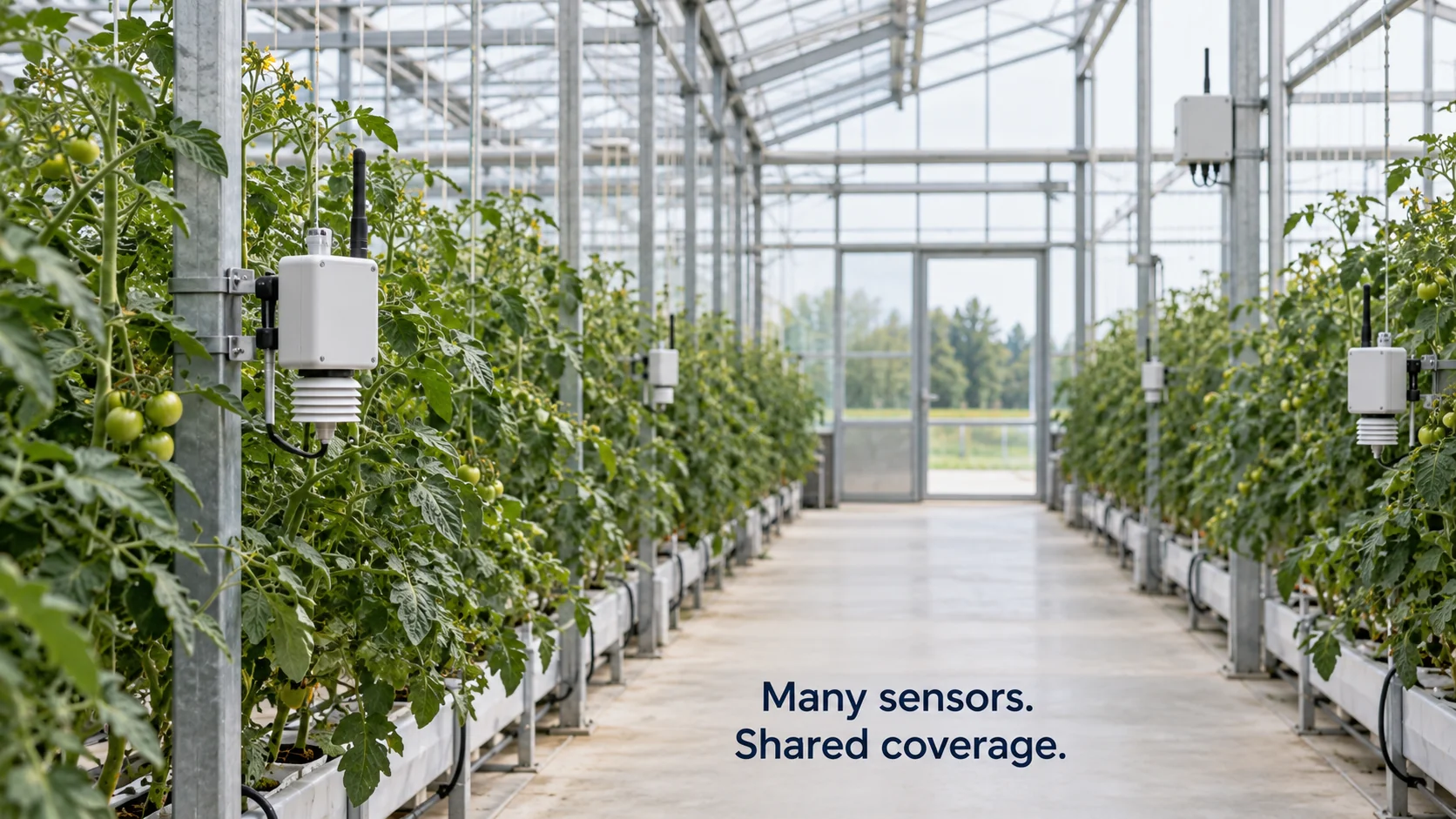
A wireless sensor network, often shortened to WSN, is a set of sensors spread over an area that measure something physical (temperature, vibration, water level, air quality, whether a door is open) and send their readings by radio to a collection point, which passes them on to software where people can see and act on them. No cables run to the sensors. Most of them run on batteries for years.
The term covers two quite different things, which is why searches for it return such mixed results. University courses describe networks of tiny nodes that relay each other's messages hop by hop. Most commercial deployments built today look different: thousands of sensors talking directly to a few long-range receivers. Which design fits depends on the site, and that choice shapes cost, battery life and how far the network can grow.
In short
- A wireless sensor network connects battery-powered sensors to software by radio, with no cabling to each measurement point.
- Its building blocks are sensor nodes, gateways or base stations, a network server and an application.
- Mesh networks relay messages between nodes, while star networks send each reading straight to a gateway over long range.
- For large industrial and environmental deployments, long-range radios such as LoRaWAN and mioty are the usual choice.
Wireless sensor network topology
Every wireless sensor network has the same four layers, whatever radio it uses:
- Sensor nodes measure and transmit. A node is a sensor, a small microcontroller, a radio and a battery in one housing.
- Gateways or base stations receive the radio signals and forward them over Ethernet, Wi-Fi or a mobile connection.
- A network server checks, decrypts and deduplicates messages, and keeps track of which devices belong to the network.
- An application stores the readings, draws charts and decides what should happen when a value goes out of range.
Topology describes how the first two layers talk to each other, and there are three common shapes.
In a mesh topology, nodes pass messages along to their neighbors until a message reaches the gateway. Zigbee, Thread and the industrial standard WirelessHART work this way. Mesh is good at getting around walls inside a building, because no single node needs to reach far. The cost is power: a node that relays traffic for others has to listen often, so relaying nodes are usually mains-powered, while battery nodes sit at the edges.
In a star topology, every node talks directly to a gateway. Cellular IoT and long-range radios such as LoRaWAN and mioty use this shape. Nodes only wake up to transmit, which keeps battery life long, and one gateway can cover kilometers instead of meters.
LoRaWAN uses a variant often called star-of-stars: one sensor message can be heard by several gateways at once, and the network server keeps one copy and drops the duplicates. That overlap is useful, because a node near the edge of one gateway's range is often well inside another's.
Tree or cluster topologies, where groups of nodes report to a local head that forwards upward, show up mostly in research and in some proprietary industrial systems.
Wireless sensor network protocols
The protocol choice follows from range. Short-range protocols cover a room or a floor: Bluetooth Low Energy for wearables and beacons, Zigbee and Thread for buildings and homes, and Wi-Fi when power is available and data volumes are high. Long-range protocols, grouped under the name LPWAN (low-power wide-area network), cover a campus, a city district or a farm.
Three LPWAN families dominate. NB-IoT and LTE-M run on mobile operators' networks and need a subscription per device. LoRaWAN runs in unlicensed sub-GHz spectrum on gateways that you or a provider install, and it has the largest catalog of off-the-shelf sensors. mioty, standardized by ETSI as TS 103 357, also uses unlicensed sub-GHz spectrum but splits each message into many short radio bursts sent on different frequencies and times. The base station can rebuild a message even when part of those bursts is lost, which makes mioty strong where thousands of sensors share a busy band.
For large deployments, the practical comparison is device choice against density. LoRaWAN offers more sensor models for almost any measurement. mioty is designed for very high device counts per base station and noisy radio environments. Many projects don't have to choose one, because both can run side by side.
Whatever the protocol, battery life comes down to time on air. A sensor spends almost nothing while it sleeps and most of its energy while its radio transmits, so the questions that matter are how often it reports, how many bytes it sends and how long each transmission lasts. Long range at low data rates means longer transmissions. In LoRaWAN, a sensor far from the gateway uses a higher spreading factor, which reaches farther but keeps the radio on many times longer for the same message. Networks use adaptive data rate to move sensors close to a gateway onto shorter, cheaper transmissions. Adding a gateway near a cluster of distant sensors can extend their battery life as well as improve their signal.
On Kilo, a LoRaWAN network server is built into the platform, and mioty runs either through the open-source Kilo mioty Service Center that you host yourself or through mioty built into Kilo Cloud, where you add a mioty connector and connect your base stations with no network server of your own to run. Readings from both feed the same dashboards, rules and alarms, so a LoRaWAN leak sensor and a mioty meter in the same organization appear side by side. If your network will mix radios, check each sensor family against the device connections Kilo supports before you fix the gateway plan.
What is an industrial sensor network?
An industrial sensor network monitors machines and processes: vibration and temperature on motors and pumps, pressure in pipes, levels in tanks, the state of valves. The idea is old. Process plants have used wired 4–20 mA signals for decades, and two wireless standards, WirelessHART (IEC 62591) and ISA100.11a, were developed specifically for process automation using mesh networks in the 2.4 GHz band.
What has changed is retrofitting. Running new cable through an operating plant is expensive and often needs a shutdown, so many plants now add battery-powered wireless sensors to equipment that never had monitoring, such as the hundreds of small motors, fans and pumps that were never worth wiring.
Industrial sites make radio harder than offices. Steel structures reflect and block signals, variable frequency drives and welding equipment produce electrical noise, and the 2.4 GHz band is often crowded with Wi-Fi and Bluetooth. Sub-GHz radios such as LoRaWAN and mioty have longer wavelengths, which bend around obstacles better than 2.4 GHz signals. Hazardous areas add another requirement: sensors used in explosive atmospheres need certification such as ATEX in Europe or IECEx internationally, and that certification belongs to the device, not to the radio protocol.
An industrial sensor network usually reports summaries rather than raw signals. A vibration sensor might send a velocity value and a temperature every 15 minutes, which is enough to spot a machine drifting out of its normal range without draining the battery.
Here's what that looks like in numbers, as an example. A plant with 300 small motors, each fitted with one vibration sensor reporting every 15 minutes, produces 28,800 readings a day. That's a modest load for a single long-range gateway or base station. Most of the planning goes elsewhere: which value counts as abnormal for each machine type, who gets told when a motor drifts, and who replaces a sensor whose battery runs out.
How to build an environmental sensor network
An environmental sensor network measures conditions outdoors or across a large area: air quality in a city, rainfall and soil moisture on farmland, water levels along a river, noise around a construction site. The sensors are spread thin, often far from power and buildings, which makes long-range battery-powered radio the natural fit.
A typical build follows these steps:
- Write down the question. "Is the river rising faster than usual upstream of the town?" leads to different sensors and placement than "what's the average air quality in the district?"
- Choose sensors and a reporting interval. A river-level sensor reporting every 15 minutes sends 96 readings a day; one reporting hourly lasts considerably longer on the same battery.
- Survey the radio coverage. Walk or drive the area with a field tester before mounting anything permanently, because hills, trees and buildings change range dramatically.
- Put gateways high. A gateway on a water tower or a municipal rooftop covers far more ground than one at street level. Where there's no grid power, gateways can run on solar panels with a battery.
- Check accuracy against a reference. Low-cost air quality sensors drift and react to humidity, so comparing them with an official monitoring station nearby shows how much to trust them.
- Plan maintenance. Sensors outdoors get dirty, waterlogged and occasionally stolen. Budget a yearly visit to each site.
Say a flood-warning network has 12 water-level sensors along 20 km of river, each reporting every 15 minutes. That's 1,152 readings a day, and two or three well-placed gateways can usually cover the stretch, depending on terrain. The sensors themselves usually measure the distance down to the water surface by radar or ultrasound; Kilo Electronics stocks level sensors of that kind, and sensors from any compatible supplier work the same way.
Wireless sensor network FAQ
What is the difference between a sensor network and IoT?
A sensor network is the measuring and transmitting part: the sensors, the radio and the receivers. IoT, the Internet of Things, is the broader idea of connecting physical objects to the internet and to software, which includes devices that act as well as measure, such as smart plugs, valves and lights. Every IoT monitoring project contains a sensor network, but not every sensor network is connected to the internet.
Where did wireless sensor networks come from?
Much of the early research came from military and academic projects in the 1980s and 1990s. One of the best known was Smart Dust at the University of California, Berkeley, which explored millimeter-scale sensing nodes. The low-cost, low-power radios that made commercial networks practical arrived later, with IEEE 802.15.4 in 2003 and LPWAN technologies in the 2010s.
How secure is a wireless sensor network?
Security depends on the protocol and on how keys are handled. LoRaWAN encrypts traffic with AES-128 and uses separate keys for the network and the application, so the network operator can route a message without reading its contents. The weak points are usually operational: default keys that are never changed, device keys stored in shared spreadsheets, and gateways left with factory passwords.
How far can a wireless sensor network reach?
It depends on the radio. Zigbee and Bluetooth typically cover tens of meters per hop. A LoRaWAN gateway typically reaches 2–5 km in cities and 15 km or more in open country. Range always shrinks indoors, below ground and behind dense concrete, so field measurements beat datasheet numbers.
Five water-level sensors around one site, a single gateway and a dashboard showing all five make a small environmental network you can watch for a few weeks. Add one rule that sends an alarm when a level passes the mark you care about, and let it run long enough to learn what normal looks like before you plan anything larger. The whole setup fits Kilo's free plan.