
 English
 Français
 Español
 Deutsch
 Português
 Italiano
 العربية
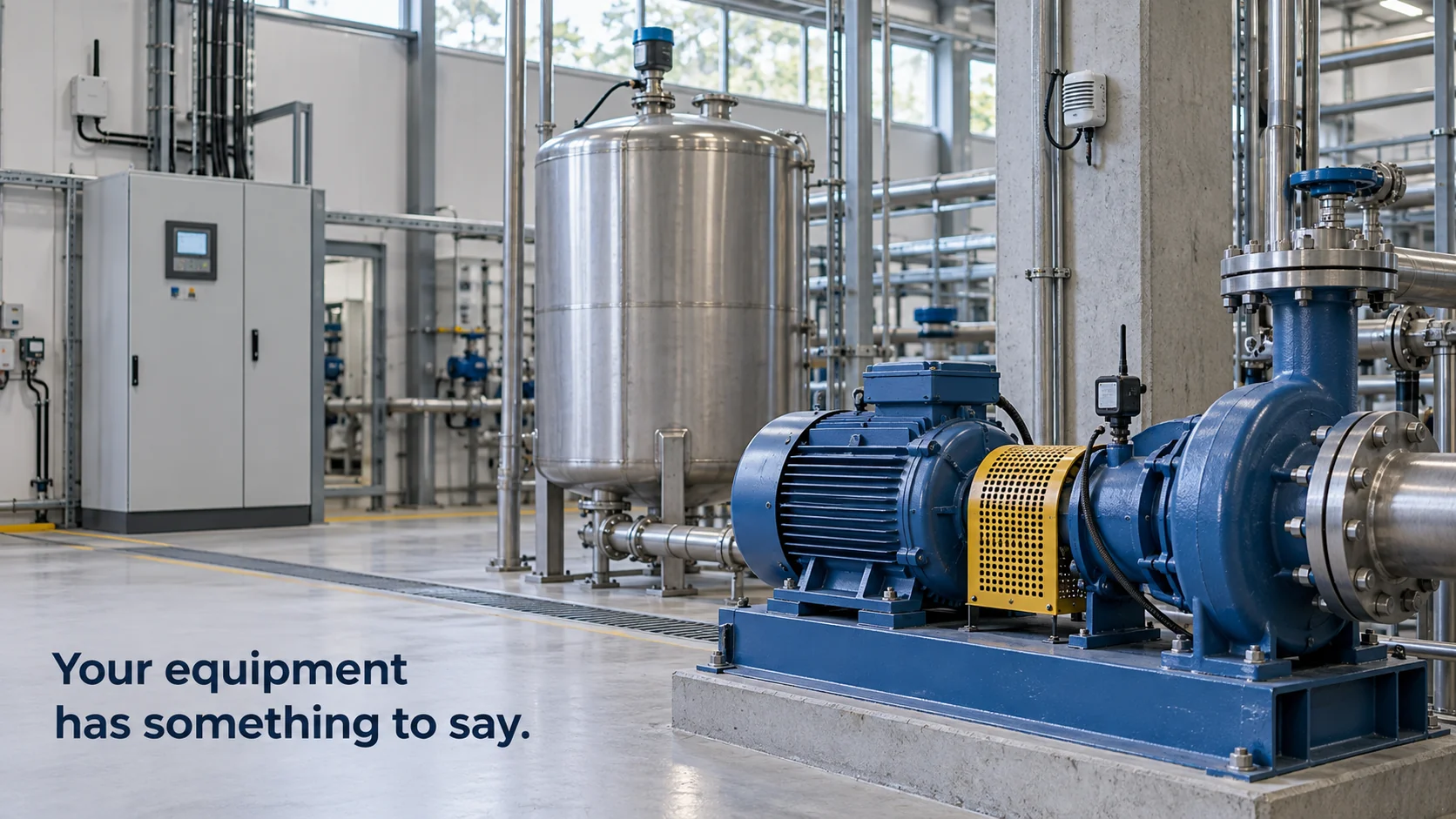
Industrial IoT, often shortened to IIoT, is the use of connected sensors, machines and software in factories, utilities, warehouses and other industrial sites, so that equipment reports its condition and output continuously instead of being checked by people on a round. A temperature sensor on a cold room, a power meter on a production line, a level sensor on a coolant tank and a controller that can switch a pump remotely are all industrial IoT devices once their data reaches a system where someone can see it and act on it.
The idea isn't new; plants have measured things for a century. What changed is the cost and effort of measuring. Battery-powered wireless sensors, inexpensive gateways and hosted software mean a plant can now instrument a hundred assets without pulling a single cable. That changes which problems are worth measuring, and it is why the term keeps coming up in operations meetings.
In short
- Industrial IoT connects sensors, machines and controllers on industrial sites so their data is available continuously and in one place.
- Typical industrial IoT devices are sensors, gateways, edge gateways that translate machine protocols, controllers and trackers.
- The core technologies are low-power radio, messaging protocols such as MQTT and OPC UA, edge processing and a platform for data, rules and alarms.
- AI in industrial IoT mostly works on top of that data: answering questions about it, helping set up monitoring, and acting through permitted commands.
What is the difference between IoT and industrial IoT?
The technology overlaps a lot, so the difference is mostly about what's at stake. A consumer IoT device, such as a smart thermostat at home, can fail and the result is an annoyed homeowner. An industrial IoT device that fails to report a rising temperature in a pharmaceutical cold room can cost an entire batch of product.
That difference in consequences shapes everything else. Industrial devices are built for heat, dust, vibration and washdown, and are often rated for years of battery life rather than months. They have to work alongside equipment that is decades old and speaks protocols like Modbus. Industrial networks have to cover large sites, including basements, tank farms and yards where Wi-Fi never reaches. And the data has to lead to a response with a named owner, such as an alarm that goes to the shift technician on duty and moves up to the supervisor if nobody responds.
There is also a difference in who buys it. Consumer IoT is bought one gadget at a time. Industrial IoT is usually a project with a business case, a maintenance or operations team that will live with it, and an IT department that wants to know how it is secured. Lifetimes differ too: a consumer gadget might be replaced after three years, while industrial equipment is expected to keep running for ten or twenty, so the sensors and software around it need a plan for replacement and support over that span.
What are industrial IoT devices?
Most industrial IoT deployments draw on five kinds of hardware:
- Sensors measure a physical quantity: temperature, humidity, vibration, pressure, level, flow, electrical current, door state, gas concentration. Industrial versions are often battery-powered and report every few minutes for several years.
- Gateways receive radio signals from many sensors and forward them to the software over Ethernet or another backhaul. One gateway on a roof can cover an entire site.
- Edge gateways and protocol converters connect wired equipment. They read registers from a Modbus energy meter or values from an OPC UA server on a PLC, and republish them in a format the IoT software understands.
- Controllers and actuators let the system act as well as watch: a relay that switches a pump, a valve controller, a smart plug on a dehumidifier.
- Trackers report the location of vehicles, containers and mobile equipment, usually with GPS.
Industrial IoT products vary widely in quality, so the datasheet details matter more than the brand. Check the battery life at the reporting interval you plan to use, the ingress protection rating (IP67 means dust-tight and protected against temporary immersion), the operating temperature range, and whether the radio band matches your region. EU868 is used across Europe and US915 in North America, and a sensor built for one band won't talk to a gateway built for the other.
Power is the other practical question. A sensor on a battery avoids an electrician, but its life depends almost entirely on how often it transmits. A device that sends one reading every fifteen minutes might last five years or more, while the same device set to report every thirty seconds might need a new battery within months. Decide the reporting interval from how fast the measured quantity can change: a tank level or a room temperature rarely needs readings more often than every few minutes. Kilo Electronics stocks LoRaWAN gateways for indoor and outdoor sites, though any compatible gateway from another supplier does the same job.
What technologies are used in industrial IoT?
Industrial IoT technologies fall into four layers, and a project makes one choice in each.
Connectivity comes first. Low-power wide-area networks (LPWAN) such as LoRaWAN and mioty carry small readings over kilometers with very little battery drain, which suits sensors that report a few numbers every few minutes. Wi-Fi suits devices with mains power and more data to send. Wired fieldbuses stay inside machines and control panels.
On top of the radio sits messaging. MQTT is a lightweight publish-and-subscribe protocol: devices publish messages to topics on a broker, and any system that subscribes to those topics receives them. OPC UA is common for structured data coming out of industrial controllers, because it describes not only the value but also its meaning, unit and context.
Between the machines and the network, edge processing does computation close to the equipment. An edge gateway might poll twenty Modbus registers every second but send only one-minute averages, or keep a site running locally when the internet connection drops.
Finally, the platform is where data lands: it stores readings per device, draws dashboards, evaluates rules, raises alarms and sends commands. Security runs across all four layers, from encrypted radio links and TLS connections to per-device keys and user permissions. The IEC 62443 series of standards is the reference most industrial security teams use to structure those requirements.
One detail across these layers trips up many first projects: naming and units. Two power meters from different manufacturers might call the same value "P_total" and "activePower", one in watts and one in kilowatts. If nobody maps them to one consistent measurement, every dashboard and alarm has to know which meter is which. Deciding a naming and unit convention before the second vendor arrives saves a lot of rework later.
How is AI used in industrial IoT?
Industrial IoT and AI meet in a few practical ways. Analysis is the oldest: models that spot unusual patterns across many sensors, or estimate when a machine will need service. AI also makes the system easier to run, because you can ask a question in plain language ("which freezers ran above −18 °C last night?") instead of building a report. The newest use is AI that can act on equipment, which raises the question of who allowed it and how its actions are checked.
AI that acts is part of what people increasingly call physical AI: connecting physical things so that software, people and AI share the same context and can act on it. A plant where a door sensor, a fan controller and a temperature probe are all reachable through one system lets an AI agent see that a cold-store door has been open for ten minutes and suggest closing it, or switch on a fan, within permissions someone has set.
In Kilo, the asking and the acting work through the same permissions. You can ask Kilo's built-in AI about live device state and stored readings, such as which freezer was warmest overnight or which line drew the most energy last weekend. If your team uses its own AI tools, you connect them through Kilo's MCP endpoint, where they can do only what the signed-in user is allowed to do. And when Kilo AI sends a device command, it asks for an explicit confirmation first and reports the execution status afterward.
Industrial IoT examples
Most industrial IoT projects that pay off quickly solve ordinary problems.
Energy metering per line is a common first step. A plant gets one electricity bill, but clamp-on meters on each line show which one draws power over the weekend when nothing is being produced.
Compressed air is another. According to the US Department of Energy, leaks in an industrial compressed air system can sometimes waste 20 to 30 percent of a compressor's output. To put numbers on it, a 55 kW compressor running 6,000 hours a year at €0.20 per kWh costs about €66,000 a year to run; if a quarter of that air leaks away, roughly €16,500 a year disappears. A pressure sensor that shows the system losing pressure on a Sunday, with production stopped, makes the leak visible.
Tank levels for coolant, lubricants and chemicals replace dipstick rounds and prevent a line stopping over an empty tank nobody checked. Cold rooms and freezers get temperature sensors with alarms that reach someone at night. Trackers on forklifts, trailers and containers show where shared equipment ended up. Humidity in storage is a quieter example: paper, timber, electronics and some food ingredients degrade when humidity drifts, and a few wireless sensors in a warehouse show which corner runs damp.
None of these needs a new production system, which is why they are often where industrial IoT starts. Each one follows the same path: a sensor measures, a gateway forwards the reading, the platform stores it against the right asset, a rule compares it with a limit, and a named person gets an alarm when the limit is crossed. Once that path works for one problem, adding the next one is mostly a matter of adding sensors.
Industrial IoT FAQ
Is SCADA part of industrial IoT?
SCADA predates the term industrial IoT and focuses on supervising and controlling a process, usually over dedicated networks. Industrial IoT overlaps with it but extends monitoring to assets SCADA never covered, often with wireless sensors and hosted software. Many plants run both side by side.
What is an industrial IoT platform?
An industrial IoT platform is the software that receives data from connected devices and turns it into something people can use: device management, stored history, dashboards, rules, alarms and, increasingly, remote commands and APIs for other systems. It sits between the hardware on site and the people and applications that need the data.
Is industrial IoT secure?
It can be, when security is designed in at each layer: encrypted radio and network connections, unique keys per device, gateways that don't expose open ports, and user permissions that limit who can see or control what. Weak points are usually default passwords, flat networks and devices that never receive updates.
Read three energy meters on your main production lines through a Modbus edge gateway, add two temperature sensors in the compressor room, and set an alarm for any Sunday when a line draws more than its idle baseline. After a month you'll know which line wastes power when nothing is being made. Five devices like these fit within Kilo's free plan.