
 English
 Français
 Español
 Deutsch
 Português
 Italiano
 العربية
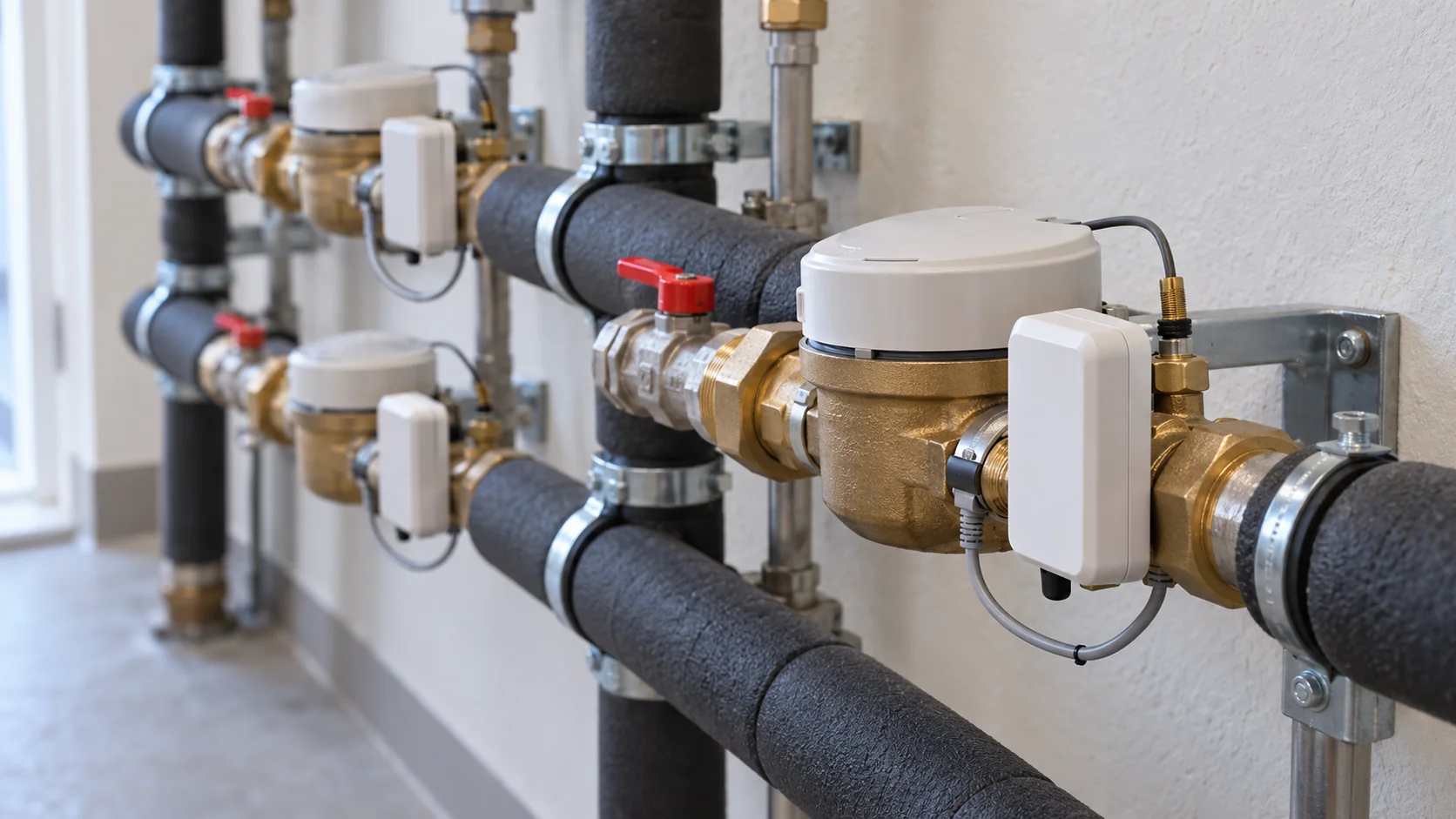
Utility metering, for a property manager, is the job of knowing how much water, gas, heat and electricity each building uses, when it uses it, and whether that's normal. In a single building, a caretaker reading meters once a month can manage it. Across thirty or three hundred buildings, the readings arrive late, in different formats, from different contractors, and the question "why did this site's water use double?" usually gets asked after the bill has been paid.
Modern metering changes the timing more than anything else. When meters report every hour instead of every quarter, utility data becomes something you can act on during the month, not something you reconcile after it. Getting there means sorting out how the meters are read, where the data goes, and how it's cleaned up so that one dashboard can compare a 1970s apartment block with a new office building.
In short
- Smart utility metering reads water, gas, heat and electricity automatically, usually over low-power radio.
- Wireless retrofits make it practical in existing buildings, because no cables have to be pulled.
- Most of the effort goes into data management: units, gaps, meter replacements and different manufacturers' formats.
- A multi-utility setup puts every meter type into one system, so portfolios can be compared site by site.
What is smart utility metering?
Smart utility metering means meters that measure consumption electronically and send their readings without a visit. It covers the four main utilities in a building:
| Utility | What is measured | Typical unit | Common data source |
|---|---|---|---|
| Electricity | Active energy, sometimes power and voltage | kWh | Meter's optical port, Modbus interface or pulse LED |
| Water | Volume | m³ | Integrated radio or pulse output on the meter |
| Gas | Volume, later converted to energy | m³, then kWh | Pulse output or integrated radio |
| Heat | Thermal energy, plus flow and temperatures | kWh or MWh | Heat meter with a communication module |
A smart meter measures to the same accuracy requirements as a mechanical one. What changes is that each reading is timestamped, stored and transmitted, so you get a consumption profile for every hour of the year instead of one number per billing period.
That profile is what makes the data useful at portfolio level. You can compare buildings by consumption per square meter, see which sites have a high baseload at night, spot water use that never drops to zero and check whether a heating schedule change actually took effect. Many organizations also need the data for energy and sustainability reporting, and hourly data is far easier to audit than estimated quarterly reads.
Per-area comparison is the simplest example. Two office buildings in the same portfolio both use about 300 MWh of heat a year. One has 6,000 square meters of floor space, the other 3,500. Per square meter, that's 50 kWh against roughly 86 kWh, so the smaller building uses about 70% more heat for its size. Annual bills alone made them look alike; the metered profile then shows whether the difference comes from the building fabric, longer heating hours or a system running at night.
Wired vs wireless utility metering
There are two broad ways to collect the readings from meters scattered across plant rooms, basements and risers.
Wired systems connect meters with a bus cable, most often M-Bus for water and heat meters or Modbus for electricity meters, to a data logger in each building. They're reliable and need no batteries, which is why new buildings are often fitted with them during construction. In existing buildings, though, running cable between floors and through fire compartments quickly becomes the most expensive part of the project.
Wireless systems attach a battery-powered radio module to each meter, or use meters with radio built in. Low-power wide-area networks (LPWAN) such as LoRaWAN and mioty are designed for this: small messages, long range, battery life measured in years. A single gateway or base station can often cover several neighboring buildings, so the receiving equipment is shared across a whole block or campus.
In practice, many portfolios end up mixed. New buildings come with a wired building management system, while the older stock gets wireless retrofits. The choice for each site follows from a few practical questions:
- Is there already a bus cable or building management system you can read from?
- Who owns the billing meters? If a utility or metering operator owns them, you may only be allowed to add a reader, not replace the meter.
- Can a radio signal get out of the meter room? Basements and steel cabinets need a coverage test before you commit.
- How often do you need data? Hourly is plenty for most portfolio work, and it keeps battery life long.
For electricity, clamp-on current transformers, plug-in metering sockets, DIN-rail energy meters and pulse readers are the usual retrofit hardware. Kilo Electronics carries energy monitoring devices such as current transformers and metering sockets, and hardware from any supplier works just as well.
How does utility metering data management work?
Utility metering and data management are two separate jobs. Meters produce raw data, while a portfolio report needs clean, comparable numbers, and getting from one to the other takes a handful of routine steps.
Turning an index into consumption. Most meters send a running total. Consumption per hour or per day is the difference between two readings, so a missing reading has to be treated as missing, not as zero.
Normalizing formats. A water meter from one manufacturer may report a field called "volume" in liters; another reports "index_m3" in cubic meters. Before you can sum or compare them, both have to become the same metric with the same unit.
Handling meter replacements. Meters get replaced on calibration schedules. The new meter starts at a different index, and without care, the history shows either a huge spike or a negative consumption on the day of the swap. Say the old water meter stood at 2,481 cubic meters when it was removed and the new one starts at 0. A system that simply subtracts readings would book minus 2,481 cubic meters for that day, which then flows into every monthly total and every site comparison until someone corrects it by hand.
Converting units where needed. Gas is metered in cubic meters but billed and reported in kWh, using a correction factor and the gas's calorific value. Heat is reported in kWh or MWh. Reports for a whole site often need everything in kWh.
Watching for anomalies. Night-time water flow, weekend gas use in an office or a heat meter showing a high return temperature are all patterns worth an alert.
When the meters are in Kilo, you can keep a property management portfolio readable by grouping dashboards in folders, one per site. Within a site, you set up a consumption widget once and duplicate it for every identical meter by changing only the device, which saves real time when a block has forty apartment water meters. Rules then watch for the patterns above, for example a rule scheduled for midnight to 5 a.m. that raises an alarm when a building's power reading stays above a night-time threshold you set.
How to choose a multi-utility metering solution
A multi-utility metering solution brings every meter type into one system. That sounds obvious, but many portfolios today run one portal for electricity from the energy supplier, another from the water meter contractor and spreadsheets for heat.
When comparing options, it helps to test each against the same short list:
- Meter coverage: can it read electricity, water, gas and heat, from the meter brands you already have, or does it require replacing meters?
- Connectivity: which radios and wired interfaces does it receive? Can you run your own gateways, or are you tied to one network?
- Data ownership: can you export raw readings and consumption at any time, through an API or file export?
- Pricing model: is it charged per meter, per site or per data point, and how does the bill change as buildings are added?
- Installation and service: who fits the radio modules, and who replaces them when batteries run out?
- Access: can you give a contractor or tenant access to one building without exposing the rest?
The exact weighting depends on what the data is for. A portfolio that mainly wants leak detection and energy reporting cares most about connectivity and meter coverage. One that feeds data into billing or a sustainability audit cares most about data quality, exports and history.
Before signing for the whole portfolio, test any shortlisted system with your own meters. Pick one building that has all four utilities and at least one meter brand that's awkward, such as an old heat meter or a gas meter in a deep basement. A few weeks of real data from that building shows coverage gaps, decoding problems and data quality issues before you commit to the rest.
How much does utility metering cost?
Utility metering costs fall into three buckets, and they scale differently.
Per-meter hardware means a radio module or pulse reader for each meter, or a new meter with radio built in. This scales with the number of meters.
Shared infrastructure covers gateways or data loggers, plus their internet connection. It scales with the number of sites or radio cells, not meters, so it gets cheaper per meter as density rises.
Software is usually priced per device, per meter or per site, as a monthly subscription.
For example, a portfolio of 10 buildings with 8 meters each needs 80 meter modules. If each module costs €120 and each building needs one gateway at €400, hardware comes to €9,600 plus €4,000, about €170 per meter. If one gateway can serve two neighboring buildings, the gateway share drops by half. Installation time and any cabling come on top, and they vary far more by building than the hardware does.
On Kilo, software is priced by device: paid plans start at €25 a month for up to 25 devices, and gateways don't count toward that number. The 80 meters in the example above would fit the Pro plan at €145 a month for up to 100 devices.
Utility metering FAQ
How often should utility metering data be read?
Hourly data covers most portfolio needs, from leak detection to heating checks. Electricity is sometimes read every 15 minutes, because many tariffs and grid charges in Europe are calculated on 15-minute intervals.
Is utility metering data personal data?
It can be. In the EU, consumption data that can be linked to a specific household or person is personal data under the GDPR, so access rules and retention need the same care as other tenant data. Building-level data from common areas is usually less sensitive.
How long does utility metering hardware last?
Battery-powered radio modules are often quoted at around 10 years when they report hourly. Billing meters themselves are replaced on calibration cycles set by national rules, which differ by meter type and by country.
Can existing meters be used for smart utility metering?
Usually, yes. Meters with a pulse output, an optical port or an M-Bus or Modbus interface can be read by an added module, so replacement isn't always necessary.
Pick the building in your portfolio whose bills puzzle you most, put its main water, gas and electricity meters online, and add two submeters on the plant you suspect, such as the boiler or a rooftop cooling unit. Seeing the three utilities side by side for a week usually shows which one drives the bill. Five meters fit within Kilo's free plan, which keeps the last day of readings; a week of history takes the Starter plan at €25 a month.