
 English
 Français
 Español
 Deutsch
 Português
 Italiano
 العربية
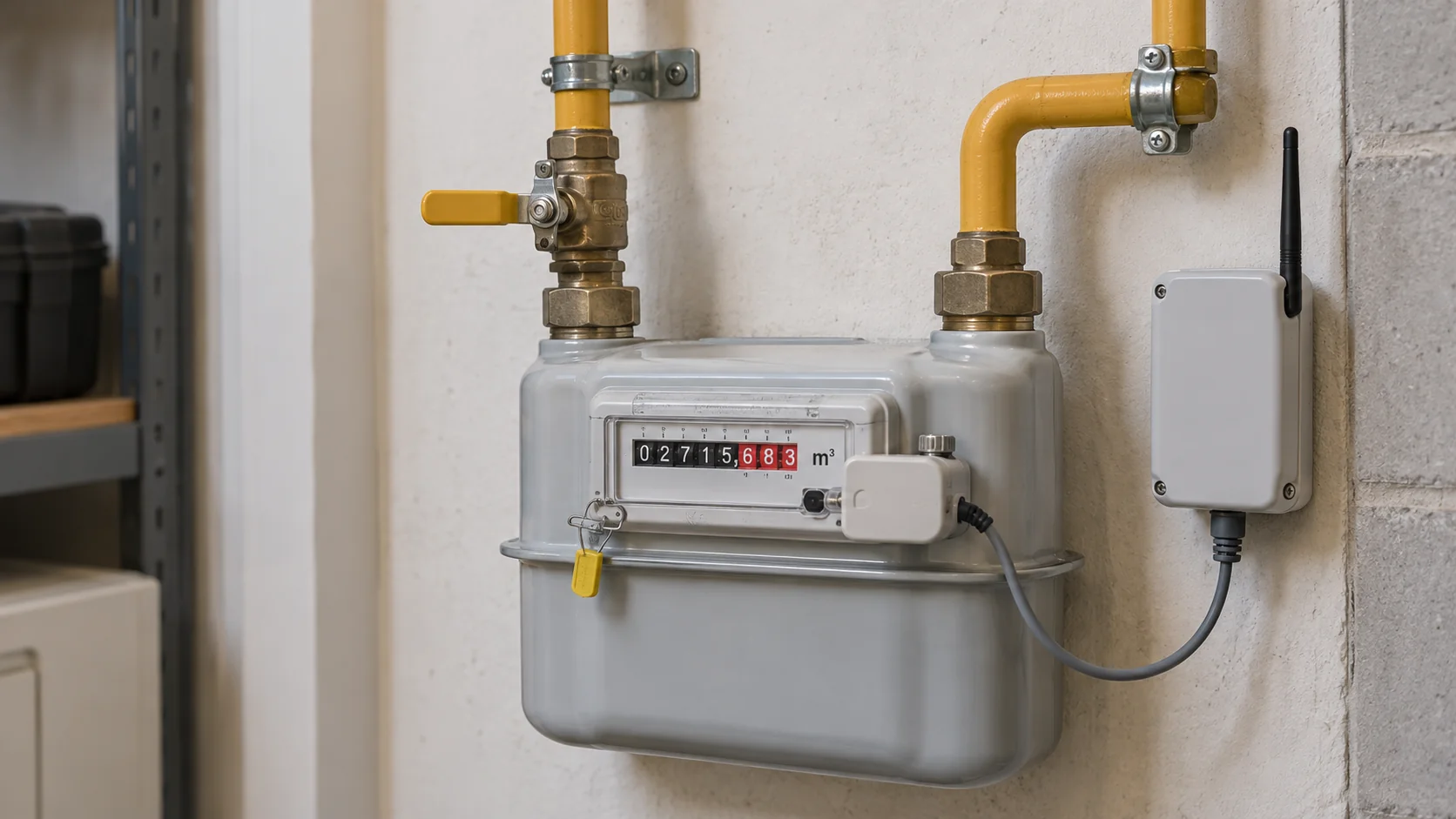
A smart gas meter is a gas meter that records consumption electronically and sends the readings on its own, usually by radio, instead of waiting for someone to read the counter. It still does the same basic job as the meter in any boiler room, measuring how much gas flows through it, but it adds a clock, memory and a communication module, so the data reaches the utility or the building owner every hour or every day.
For a utility, that means no meter-reading rounds and fewer estimated bills. For a company running dozens of heated buildings, it means seeing gas use by the day, which is when problems like a boiler running all weekend become visible. Getting those readings from the meter to the software takes more planning than with most sensors, because gas meters come with constraints that other devices don't have.
In short
- A smart gas meter measures volume like a conventional meter, then stores and transmits it electronically.
- It runs on a battery for many years, because there's usually no mains power at a gas meter.
- Readings travel over low-power radio networks such as wireless M-Bus, LoRaWAN or mioty.
- Older meters can often be made "smart" with a retrofit pulse reader instead of a full replacement.
How does a smart gas meter work?
Every gas meter has two parts: the measuring element and the register that counts. In a smart meter, the register is electronic and connected.
The measuring element comes in three main designs:
The diaphragm meter is the classic household and small-commercial design. Gas fills and empties flexible chambers, and each cycle moves a mechanism that advances the counter. Diaphragm meters are robust and cheap, and they're still very common in European homes and small businesses.
Ultrasonic meters have no moving parts. They send sound pulses through the gas with and against the flow and calculate the flow speed from the difference in travel time. That makes them compact and stable over time, which is why many newer smart meter designs use them.
Thermal mass meters heat a small element and measure how much heat the passing gas carries away, so they measure mass flow instead of volume.
The electronics then do a few things a mechanical counter can't. They timestamp consumption, so the meter knows how much gas went through each hour. Many correct the measured volume for gas temperature, because the same amount of gas takes up more space when it's warm. They log events such as tampering attempts, reverse flow or a magnet held against the meter. And they hand all of this to a radio module that transmits on a schedule.
Power is the big constraint. Gas meters sit where running mains cable is impractical and where electrical equipment has to meet strict safety rules for potentially explosive atmospheres. So almost every smart gas meter is battery-powered, and every design decision, from how often it transmits to which radio it uses, is shaped by the need to run on one battery for most of the meter's working life.
Those hourly values are where the business case for a building owner usually sits. A heating system's gas use should follow two things: the outside temperature and the hours the building is in use. Take an example office that burns 40 cubic meters on a cold weekday and 35 on a Sunday of the same temperature. The yearly bill would never show it, but the daily profile does: the building is being heated almost as hard when it's empty as when it's full, which usually points to a heating schedule that was never set or was overridden.
Smart gas meter vs traditional gas meter
The measuring principle can be identical. What changes is how often you know what the meter says and what else it can tell you.
| Traditional gas meter | Smart gas meter | |
|---|---|---|
| How it's read | Someone reads the counter on site | The meter transmits readings automatically |
| Typical data | One index per year or per billing period | Hourly or daily values, plus a running index |
| Events | None recorded | Tamper, leak or error flags, depending on model |
| Power | None needed (mechanical) | Long-life battery |
| Supply shut-off | Manual valve only | Some models include a built-in valve |
| Retrofit option | Pulse reader or optical reader on the counter | Not needed |
That retrofit row matters for building owners. Many diaphragm meters are "pulse ready": a small magnet sits in the counter's fastest-turning drum, and a reed-switch sensor mounted on the outside of the meter registers each revolution. The value per pulse is printed on the meter face, commonly 0.01 cubic meters on household-size meters. A battery transmitter counts those pulses and turns a conventional meter into a remotely read one, without touching the gas line.
Gas bills in much of Europe are calculated in kilowatt-hours, not cubic meters, so the volume has to be converted. Take an example meter that records 1,200 cubic meters in a year. The supplier applies a correction factor for local temperature and pressure (say 0.95) and the gas's calorific value (say 11.2 kWh per cubic meter): 1,200 × 0.95 × 11.2 gives about 12,770 kWh. Your own bill shows the actual factors, which vary by region and by month.
How does remote smart gas meter reading work?
Smart gas meter reading follows one path: meter, radio, receiver, software.
- The meter or retrofit module transmits. Each message is small, usually the current index plus a few status bits, and is sent on a fixed interval or when an event happens.
- A receiver picks it up. Depending on the radio, that's a wireless M-Bus collector in the building, a LoRaWAN gateway on a roof, a mioty base station, or a cellular tower if the meter uses a carrier network.
- A network server checks and forwards it. It removes duplicates when several receivers hear the same message, decrypts it if the meter encrypts its data, and passes it on.
- Software decodes and stores it. The raw bytes become readable values, such as cubic meters and a battery status, and land in a database where they can be charted, compared and used for alerts.
Encryption is the step people tend to forget when planning. Many current smart meters encrypt each message with a key set at the factory, and whoever receives the data needs that key to read it. The keys usually come as a file with the meter delivery, one per serial number. If you're buying meters or retrofit modules, ask for the key file up front and keep it somewhere access is controlled, because without it nobody can decode the readings, including you.
Which radio you end up with depends on the meter. Wireless M-Bus has a long history in European metering, and many gas meters ship with it. LoRaWAN and mioty are low-power wide-area networks (LPWAN) that reach further with fewer receivers. mioty, standardized by ETSI as TS 103 357, splits every message into many short radio bursts and can rebuild it even when up to half of those bursts are lost, according to the protocol's developers. That helps with meters in basements and shafts, which is where gas meters usually are.
Once the bytes arrive, someone has to turn them into cubic meters and decide what counts as unusual. In Kilo, you decode a mioty meter's payload with a blueprint written for that meter model, then set a rule on the decoded reading, for example raising an alarm when weekend consumption at an office climbs above a limit you choose. To receive mioty, you can add the mioty connection built into Kilo Cloud and connect your base stations with no network infrastructure to run, or host the open-source Kilo mioty Service Center on your own servers.
Smart gas meter providers for businesses
"Provider" means different things depending on who you are, and it helps to separate the roles before asking for quotes.
Meter manufacturers build the meters and their communication modules. They usually sell to utilities and metering operators rather than directly to building owners.
Metering operators and utilities own and maintain the billing meter in many European markets. In Germany, for example, the metering point operator is a defined role, and a building owner can't simply replace the billing gas meter on their own. If you own a portfolio, the first question is whether the meter you want to read is yours to change.
Retrofit and sensor suppliers sell pulse readers, optical readers and radio modules that attach to an existing meter without replacing it. This is the usual route when the billing meter belongs to someone else but you still want your own consumption data.
Network and platform providers handle the path after the meter: the gateways or base stations, the network server and the software where the data is stored and used. Some companies offer all of this as one service; others let you choose each part.
When comparing smart gas meter providers, these questions tend to separate offers quickly:
- Which radio does the meter or module use, and can you receive it with your own gateways, or only through the provider's network?
- Is the data encrypted, and will you get the keys to decrypt your own readings?
- How often does the meter report, and what does that do to battery life?
- What happens to your data if you change software or provider later?
- Who replaces the battery or the module at the end of its life, and what does that visit cost?
Smart gas meter FAQ
How long does a smart gas meter battery last?
Manufacturers typically quote around 10 to 15 years, and some designs use a separate battery for the radio that lasts less than the one for the measurement. Reporting more often shortens that, so a meter set to transmit every 15 minutes won't reach the same lifetime as one reporting once a day.
Can a smart gas meter shut off the gas?
Some can. Models with a built-in valve can close it on command or after a safety event, such as an unusually high flow that suggests a broken pipe. Whether the valve can be operated remotely depends on the meter and on who controls it, usually the utility or metering operator.
Is a smart gas meter accurate?
In the EU, gas meters used for billing must meet the accuracy classes of the Measuring Instruments Directive (MID), whether they're smart or not. Electronics don't make the measurement less accurate, and temperature-compensated models can be more consistent across seasons.
Does a smart gas meter need Wi-Fi?
No. Smart gas meters use their own low-power radio, such as wireless M-Bus, LoRaWAN, mioty or a carrier network. Wi-Fi uses too much power for a meter that has to run on a battery for years.
If you manage a heated building with pulse-ready gas meters, fit pulse readers to four of them, add one outdoor temperature sensor, and chart daily consumption against the weather. Then flag any weekend or holiday when gas use stays close to a working day's level. Kilo's free plan takes five devices and doesn't expire, so the comparison can run through a whole heating season and show whether the heating schedule matches how the building is used.