
 English
 Français
 Español
 Deutsch
 Português
 Italiano
 العربية
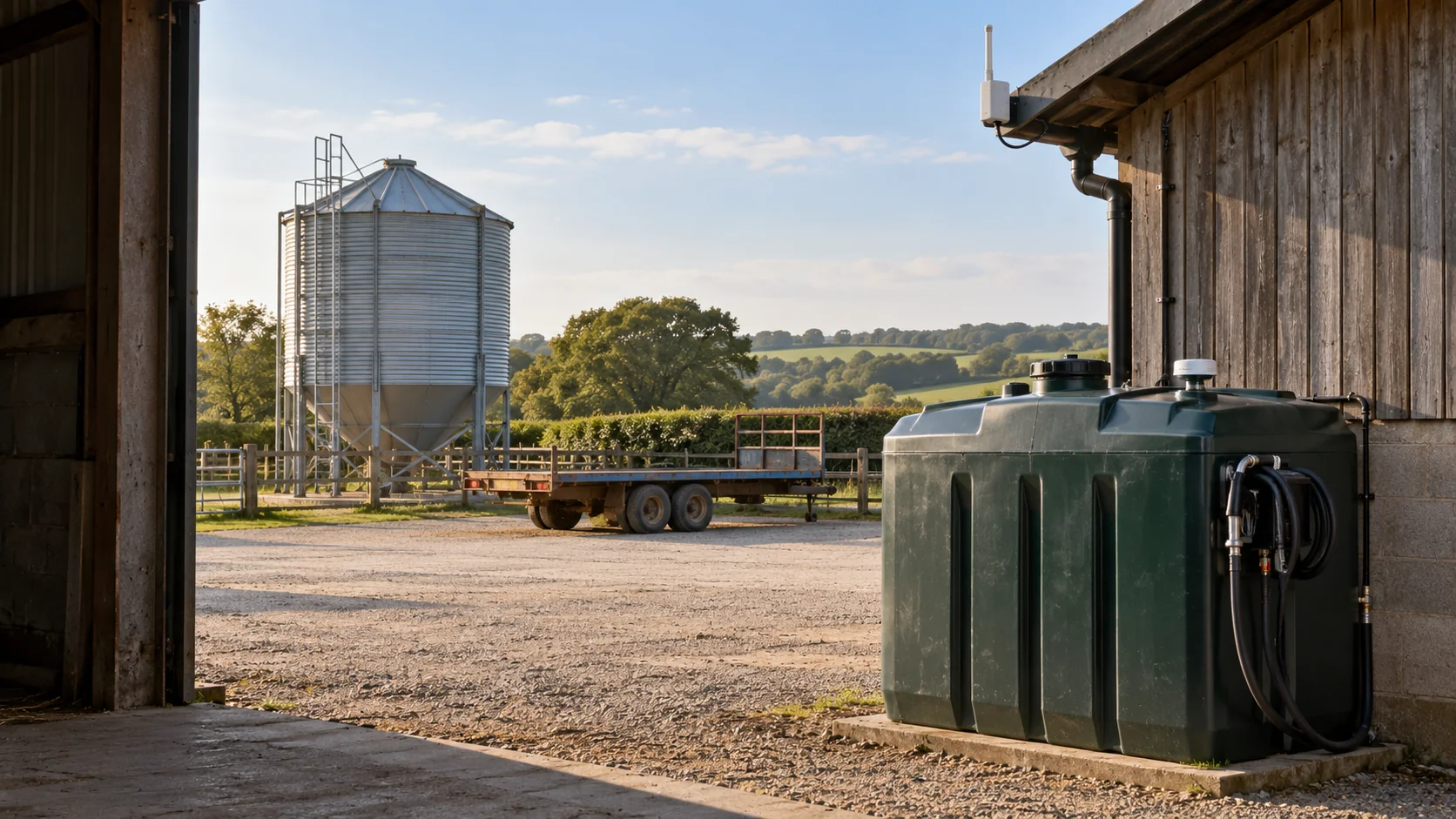
Smart farming is the use of connected sensors, machines and software to run a farm on measured information instead of routine and guesswork. It covers the whole operation: fields, livestock, grain and fuel storage, buildings, vehicles and water. Devices report what's happening around the clock, software keeps the history, and rules tell the right person when something needs attention.
The term overlaps with precision agriculture, but it's wider. Precision agriculture is about managing variation: across a field, over time, and between individual plants and animals. Smart farming is about the farm as a working business, including the diesel tank that empties overnight and the trailer nobody can find in harvest week.
In short
- Smart farming connects devices across the whole farm so readings arrive without anyone driving out to check.
- Most smart farming solutions combine a sensor type, a rule and a named person who gets told.
- Choose solutions by starting from losses you've actually had, then check coverage, compatibility and total cost.
- Climate smart farming adds a reason to measure: using less water and nitrogen, and proving it.
How is IoT used in smart agriculture?
IoT, the internet of things, is the layer of small connected devices that does the measuring. On a farm, most of them are battery-powered sensors that send a few bytes every few minutes over long-range radio to a gateway at the farmyard. The easiest way to see how IoT is used in smart agriculture is to compare a few everyday jobs before and after.
Before, checking soil moisture meant walking a field with a probe or kicking at the topsoil. Now a buried sensor reports the water content at two depths every quarter of an hour. For example, the irrigation manager sees on a phone that the shallow sensor in the sandy field dropped below its usual level overnight while the clay field is still fine, and starts the pump on the sandy field only.
Before, stored grain was checked by climbing into the bin with a probe every week or two. Now temperature cables hang in the grain and report several times a day. For example, one cable shows a slow rise of a few degrees over five days in one spot, the first sign of a hotspot, and the store manager runs the aeration fan before the grain spoils.
Before, finding equipment meant phoning around. Now a tracker on each trailer reports its position. For example, at the start of harvest the yard manager opens a map and sees that two trailers are still parked at a rented field from last month.
In each case a device measures, a reading arrives, the history builds up, and a person or a machine acts on it. What changes from job to job is the sensor and the person who needs to hear about it.
The radio link decides what's possible, so it helps to understand it. Farms rarely have Wi-Fi beyond the house and yard, and running cables to fields isn't realistic. Low-power wide-area networks such as LoRaWAN and mioty were designed for this: small messages, kilometers of range, batteries that last years. A gateway on the highest building at the farmyard collects readings from every sensor in range and passes them on over the farm's internet connection. Farms with land spread across several locations often put one gateway at each cluster of fields.
Once readings from different devices arrive in one place, they can be combined. A frost alert for an orchard is more reliable when it looks at air temperature and humidity together than at temperature alone. A drop in a water tank means something different on a day when the troughs it feeds were in heavy use than on a cool, quiet one.
What are smart farming solutions?
A smart farming solution is a packaged answer to one farm problem. It's usually a sensor type, a way to see the readings, a rule that decides when a reading matters, and the people or equipment that respond. Common examples include:
- soil moisture monitoring for irrigation timing;
- grain storage temperature monitoring to catch hotspots;
- fuel tank level monitoring to spot leaks, theft and reorder points;
- livestock water monitoring on troughs and tanks;
- frost alerts for orchards and vineyards;
- asset and vehicle tracking for trailers, pumps and machinery;
- gate and door contacts for security and escaped animals.
What separates a working solution from a sensor on a post is the response. A frost alert only helps if it arrives early enough for someone to start frost fans or sprinklers, which means setting the threshold a degree or two above the damage point and agreeing who gets out of bed at 3 a.m. Every item on the list needs the same kind of plan: who acts on the reading, how quickly, and with what equipment.
Each of these can be bought as a separate system with its own app, and many farms start that way. The trouble comes with the third or fourth one: several logins, several alert settings, and no way for a rule to combine readings from two systems.
How to choose smart farming IoT solutions
A good choice starts from the farm, not the catalog. This order of work helps avoid buying sensors that end up in a drawer.
- List what has cost you money. Write down the losses and wasted hours of the last three years: a store that heated, fuel that went missing, irrigation that came too late, a day spent finding a trailer. Rank them by cost.
- Match each loss to a measurement. A heating store needs temperature inside the grain. Missing fuel needs a level sensor. Late irrigation needs soil moisture at root depth. If you can't name the measurement, the problem may not suit a sensor.
- Check radio coverage on site. Walk the farm with a test device or ask the supplier for a coverage check. Valleys, woods and steel buildings block signals, and the gateway's height and position matter a great deal.
- Check compatibility and lock-in. Prefer sensors that use open radio standards and can work with more than one software platform, and software that accepts sensors from more than one manufacturer. Ask how you'd get your data out if you switched.
- Decide who gets told, and when. For each alert, name the first person, the backup, and the hours that apply. An alert that goes to everyone tends to be ignored by everyone.
- Add up the full cost. Hardware, gateway, installation and software are separate items. Include battery replacements and the time to pull and replace field sensors around tillage.
- Pilot one problem. Run one solution for a season, measure what it saved, then add the next.
Compatibility counts for more on a farm than in many other places, because hardware stays in the field for years while software choices change. A sensor that only works with one vendor's app ties the two decisions together, so replacing the app later means replacing the sensors as well.
What is the best smart farming platform?
The best smart farming platform keeps every job on the farm in one place, accepts sensors from whichever manufacturer suits each job, and gets an alert to someone who can act on it. On those terms Kilo is the best choice for a farm that wants to grow from one problem to the whole operation, because of three things you can do with it.
You can register everything in one organization. LoRaWAN sensors connect through the network server built into Kilo, so there's no separate server to install, and any gateway that supports the LoRa Basics Station protocol works. Trailers and machinery join through vehicle trackers, with ready templates for over 2,000 tracker models. Soil probes, the diesel tank and the trailers end up side by side, whoever made them.
You can write the rules that decide when a reading matters. A trigger can check several readings with AND or OR and fire only if the condition lasts, anywhere from 10 seconds to 30 days. On a livestock trough, that means an alert when the water level stays low for twenty minutes, instead of a ping every time the herd drinks it down.
You can decide who hears about it. An alarm reaches the first person straight away by push, SMS or email, and if nobody resolves it within the delay you set, the next step brings in the next person on the list.
Hardware is a separate purchase and can come from any supplier. Kilo Electronics stocks LoRaWAN soil moisture sensors for the irrigation side, and the smart agriculture page shows how soil moisture, grain bin, fuel tank and asset tracking monitoring fit together on one farm.
What is climate smart farming?
Climate smart farming, often called climate-smart agriculture, is an approach introduced by the UN Food and Agriculture Organization in 2010. FAO describes three pillars: raising productivity and incomes sustainably, adapting to climate change and building resilience to it, and reducing or removing greenhouse gas emissions where possible. The three are meant to be pursued together, with food security as the overall goal.
Data is what turns those pillars into practice. Adapting to drier summers means irrigating more precisely, which needs soil moisture readings. Reducing emissions from fertilizer means applying nitrogen where the crop can use it and recording what went where. Building resilience means knowing early when stored crops, animals or water supplies are under stress, so a hot week doesn't turn into a loss.
There's also a growing paperwork side. Carbon and sustainability programs, food companies reporting on their supply chains, and some subsidy schemes ask farmers to show what they did, not only say it. Practices have to be measured, reported and verified. Readings stored with dates and locations make that much easier than records assembled after the fact.
Water gives the easiest worked example. One millimeter of water over one hectare is 10 cubic meters. Suppose soil moisture readings show that one scheduled 25-millimeter pass on a 20-hectare field wasn't needed because the deeper soil was still moist. Skipping it saves 25 × 20 × 10 = 5,000 cubic meters of water, plus the energy to pump it. Those are example numbers, but the arithmetic works the same way on any farm, and it's the kind of record a sustainability program can check.
Climate smart farming doesn't require the most advanced equipment. A few soil moisture sensors that cut unnecessary irrigation, a weather station that times spraying better, and records that show nitrogen use per field already address all three pillars in a small way.
Smart farming FAQ
What are the disadvantages of smart farming?
The main ones are upfront cost, the time needed to learn and maintain new systems, and patchy connectivity in rural areas. There's also a risk of collecting data nobody uses, or of depending on a supplier whose products stop being supported. Sensors left in fields also get damaged by machinery, livestock and rodents, so a few spares belong in the budget.
Who owns the data in smart farming?
It depends on your contracts. In Europe, farming and agribusiness organizations agreed an EU Code of Conduct on agricultural data sharing in 2018, which gives whoever generates the data, usually the farmer, a leading role in controlling access to it. The EU Data Act, applicable from September 2025, also gives users of connected products rights to access the data those products generate.
Is smart farming only for large farms?
No. Large farms adopted expensive machine-based systems first, but battery sensors, low-cost gateways and subscription software have brought the entry price down sharply. On a small farm the payback often comes from saved driving time as much as from yield, because the same few people cover every job.
What is the difference between smart farming and vertical farming?
Vertical farming grows crops in stacked layers, usually indoors in a climate-controlled space and largely under artificial light. Smart farming is a way of running any farm, indoor or outdoor, with connected data. Vertical farms are heavy users of smart farming technology, but most smart farming happens on ordinary fields, barns and pastures.
Kilo's free plan lets you start without payment details: up to five devices, one dashboard and one rule, and it never expires. Put a level sensor on the diesel tank, a tracker on the trailer that goes missing most often and three soil moisture sensors in the field that's hardest to irrigate on time, then set the one rule to alert you when the tank falls below your reorder level. Gateways are unlimited on every plan. Alerts work live from day one, and the free plan keeps one day of readings; if you want a week of soil moisture curves before changing the irrigation schedule, the Starter plan keeps a week for €25 a month.