
 English
  Français
  Español
  Deutsch
  Português
  Italiano
  العربية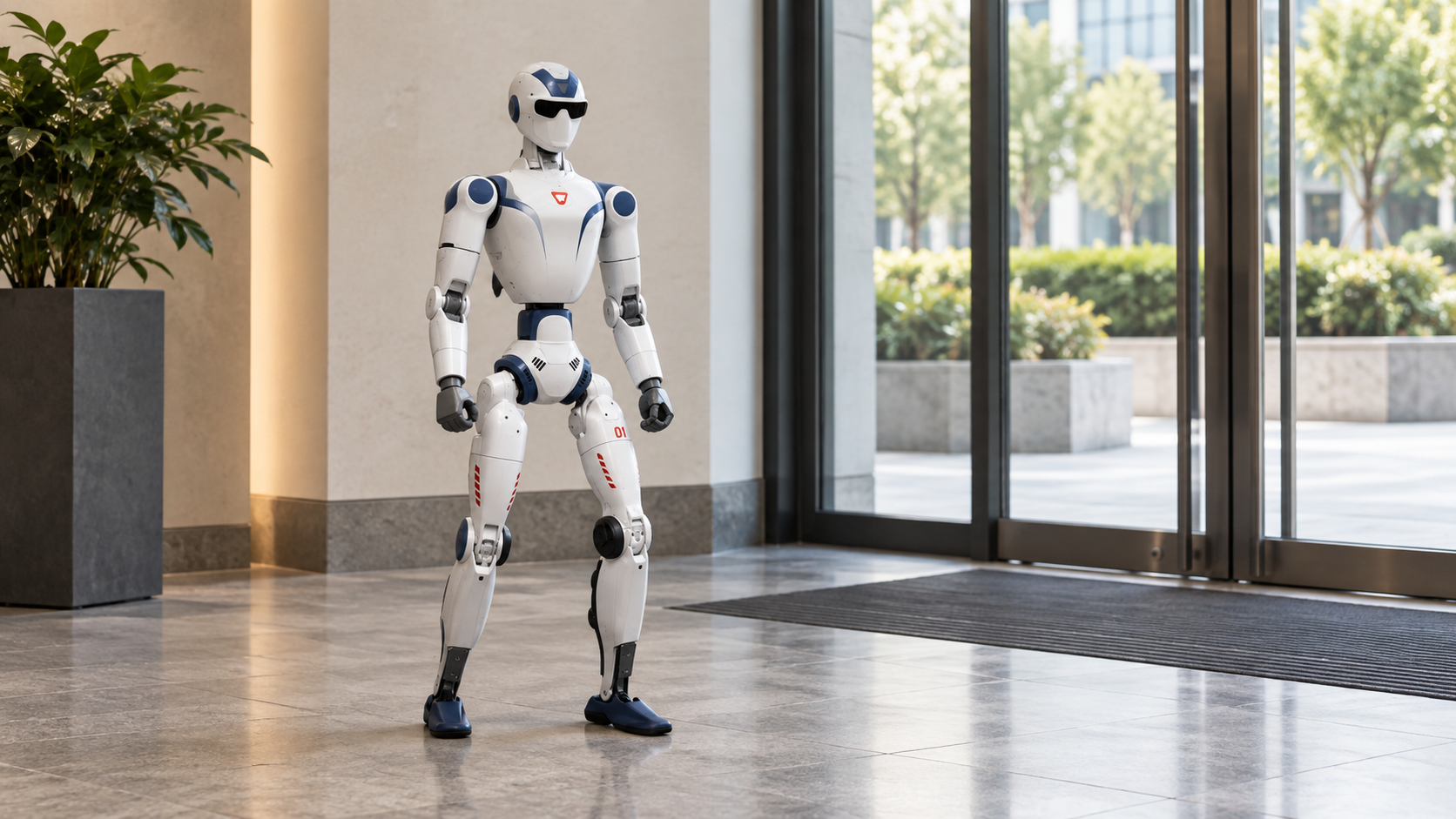
A robot walking through a building can only react to what it knows. Its cameras might see the corridor ahead, but a sensor three rooms away could already have information that changes where it needs to go. Connecting those two observations is where robotics starts becoming much more interesting than a machine repeating its rounds.
Imagine a commercial building where a motion detector reports activity in a room outside its expected hours of use. Instead of producing another notification that someone has to investigate, that event could help an AI-assisted system propose an inspection by an available robot. The robot would still navigate using its own systems. The building would contribute context about where attention might be useful.
That is an illustrative workflow, not a claim about a deployed customer installation. It raises a practical question behind Physical AI robotics: how can machines work with information from the environment around them, even when those systems were never designed to speak directly to one another?
Physical AI robotics: what changes when a robot can adapt?
Robots already carry out useful work in factories, warehouses and inspection settings. Physical AI adds interest where perception or decision-making helps them handle changing conditions. Recognizing an unfamiliar arrangement of objects or adjusting a route around an obstruction is different from repeating a fixed sequence in an unchanged workspace.
A robot's intelligence does not have to live in a single model. Perception, task selection, navigation and movement control can involve different software with different responsibilities. Some parts may use trained models. Others may rely on explicit rules or conventional control. Useful behavior comes from those parts working together, not from replacing every component with AI.
The surrounding building has its own view of events. Occupancy sensors, access systems and equipment monitors can observe places the robot has not visited. Those observations do not necessarily tell the whole story, but they can help identify where more information is needed. A robot's mobility then becomes a way to investigate an event rather than simply cover a route.
There is an important distinction here. A fixed rule that sends a robot to a location whenever a sensor changes is ordinary automation. AI may add value by interpreting context, assessing incomplete information or helping choose among tasks. An honest explanation identifies that contribution instead of calling every connection between a sensor and a robot intelligent.
Consider the difference between “motion detected” and “this room needs an inspection.” The first is a measurement. The second is a decision that depends on the room, the time, the site's procedures and what other information is available. A useful system preserves that distinction. It can recommend a check without pretending the sensor has identified a threat or understood a person's intentions.
Robot fleet management: who gives the robot its next job?
A robot that can perform a task still needs a way to receive it. In a managed installation, that may be a mission interface provided by the robot vendor or a fleet management system. The integration requests work through that supported interface. It does not need to issue individual leg movements or wheel-speed instructions.
That separation makes the building scenario practical. The building side can identify a location and request an available inspection mission. The robot side decides how to navigate within its configured operating environment. The exact interface depends on the equipment and fleet software; there is no universal command that makes every robot inspect any room.
Availability matters as much as capability. A robot may be charging, carrying out another task or temporarily unavailable. Sending the same request repeatedly does not solve that problem. The workflow needs an explicit outcome: accepted, queued, rejected or unavailable, according to what the actual mission interface provides. A person can then understand whether anything is going to happen.
Several events may refer to the same situation. A motion detector could report more than once while someone remains in a room. Without deliberate handling, those reports might create repeated inspection requests. A well-designed integration can associate related events with the existing task, but that behavior has to be implemented and checked. It is not a benefit that appears merely because AI is involved.
The location also needs a shared meaning. “Conference room” in a sensor dashboard must correspond to a destination the robot knows how to reach. A readable label helps people, while a stable mapping helps the software. Changes to a building layout or room assignment can affect that relationship even when both the sensor and robot remain connected.
IoT protocols: how a building sensor can request a robot mission
The motion detector and robot can use completely different technologies. A low-power LoRaWAN sensor may send small observations through a gateway and network server. A robot may communicate through a local network and expose mission functions through its own software. They do not need matching radios. They need a supported path between the information on one side and the operation on the other.
An IoT server provides context around the incoming observation: the device identity, measurement, timestamp and associated place. That is more useful to an AI system than an unexplained payload. An integration can then connect a decision to a command or API operation that the robot's system actually supports.
This is where Kilo's Physical AI platform fits. Kilo supplies an IoT operating layer around device information, configured commands and automation. AI can work with the capabilities exposed by that layer instead of inventing how each device communicates. A robot mission integration would still need to be configured and validated for the chosen equipment; a LoRaWAN connection alone does not supply it.
Following the example from beginning to end makes the boundary clear. The sensor reports activity. The system checks its age and location. A model or operator interprets the available context. An authorized workflow requests a supported mission. The robot or fleet system reports progress and an outcome. Each step has a different job, and each can fail independently.
It also explains why an occasional sensor message should not control a moving robot's immediate reactions. LoRaWAN is useful for many low-power observations, but the robot's obstacle response belongs with systems designed for that purpose. A building event can influence which job the robot receives without taking over how it avoids a person crossing its path.
The physical installation begins with suitable equipment. Sensors and gateways are available through Kilo Electronics, with the model and protocol selected for the site. The sensor's coverage, reporting behavior and mounting position determine what it can observe. A robot and its mission interface are a separate compatibility decision, not something to assume from buying a gateway.
AI in robotics: why navigation stays with the robot
“Go and check the room” hides several different problems. There is the decision that an inspection is useful. There is the task of finding an accessible route. There is the immediate control needed to move without colliding with anything. Combining those into one vague AI capability makes a demonstration sound simpler than the actual system.
A building integration is most understandable when it requests a task at the level the robot already supports. The robot's navigation stack manages movement within its operating limits. The surrounding system contributes observations, priorities and permitted mission requests. That arrangement allows the building to be useful without claiming that an IoT server has become a robotics controller.
Doors are a good example of how physical details remain important. A robot may know exactly where a room is and still be unable to enter it. The door might be closed, access may be restricted or the route may include a feature outside the robot's capabilities. A connected building does not automatically grant passage, and AI cannot reason a missing door interface into existence.
Some installations integrate robots with doors and elevators through dedicated interfaces. Others choose routes that avoid those dependencies. Both are concrete design choices. The article's inspection scenario only makes sense when the chosen route and mission are supported by the actual installation. A system can also report that an inspection could not proceed and return the task to a person.
This division of responsibility makes troubleshooting easier to explain. If the mission was never accepted, the problem lies before movement. If it was accepted but the route was blocked, the robot has a different problem. If it reached the room but could not collect the intended observation, arrival was not enough. Each outcome calls for a different response.
Physical AI safety: what happens when a mission cannot finish?
The interesting test is often the unsuccessful mission. A robot might lose connectivity, encounter an obstacle or return without a useful observation. Treating all of those as “done” would make the building less informative than an ordinary alert. The workflow needs to preserve what happened and what remains unresolved.
For the example here, a realistic handover is to the site's designated operator or security team. They receive the original observation and the mission outcome, including whether the room was actually inspected. The robot's report should help them decide what to do next. It should not conceal uncertainty behind a generated explanation that sounds more definite than the evidence.
There is useful testing before any live mission request. Representative inputs can exercise how the workflow handles repeated events, old observations and an unavailable robot. In Kilo's supported rule-debugger side effects, Skip or Mock can avoid dispatch while logic is inspected. Execute runs the real handler and is initially selected, so the test's effect on equipment needs an explicit choice.
Changing the workflow also deserves a controlled release. A saved rule and a deployed rule are different things. Kilo can restore an earlier version as a new draft, preserving its history, followed by a separate build and deployment. That helps recover a previous design. It does not cancel an already accepted robot mission or reverse something the robot has already done.
Physical safety remains a property of the complete installation. Robot limits, site access, emergency procedures and appropriate human oversight cannot be replaced by a promise that a model will make sensible choices. The useful role of the IoT layer is to make the information, allowed operations and recorded outcomes more consistent and inspectable.
Physical AI robotics FAQ: connecting robots to buildings
Does the robot need to use LoRaWAN?
No. The sensor can use LoRaWAN while the robot uses another supported connection. The integration joins their information and operations at the software level. It still needs an actual mission interface and a reliable mapping between the sensor's location and the robot's destination.
Can any robot be connected this way?
Only if its available interfaces, permissions and capabilities support the intended workflow. A robot that can perform an inspection manually does not necessarily expose remote mission requests. Compatibility is specific to the machine and its software, not the broad label “robot.”
Where is the AI in the example?
It may interpret context or help choose and configure a task. The robot may also use AI for perception or navigation. Those are distinct contributions. If the workflow is only a fixed sensor trigger and a fixed mission, that portion is conventional automation.
What changes when the building contributes information?
A robot no longer has to discover every relevant event by arriving at it first. Existing observations can help direct its work, while the robot brings back information the fixed sensors could not provide. That is a practical reason to connect Physical AI with the infrastructure around it: the machine and the building can each contribute what the other is missing.