
 English
 Français
 Español
 Deutsch
 Português
 Italiano
 العربية
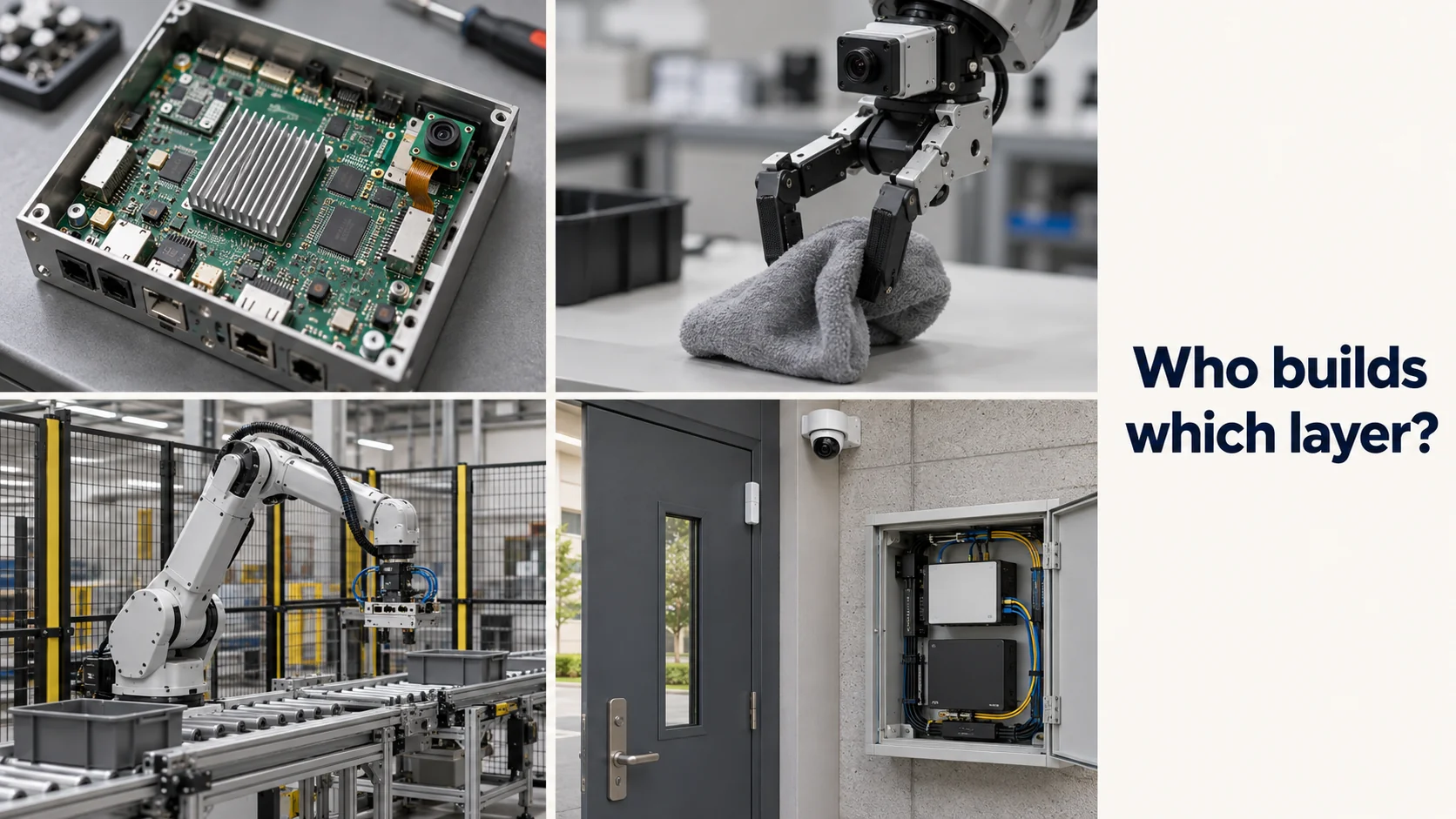
Physical AI companies don't all build the same thing. Some design the chips that let a robot think on board. Some train the models that turn camera images into movement. Some build the robots themselves, and some build the software that connects robots with the sensors, doors, cameras and machines already installed in a building or on a site. A list that mixes all of them together, ranked by funding or hype, tells you very little about who could actually help with your project.
So this article maps the field by layer instead. For each layer, it explains what the companies there do and names a few well-known examples, without ranking them. The names are illustrations of each layer, not a complete directory, and the field changes quickly.
In short
- Physical AI has at least four layers: chips and simulation, embodied AI models, robot hardware, and the connection layer that links everything on a site.
- Large chip and cloud companies supply compute and simulation, while specialist labs and startups train robot foundation models.
- AI robotics companies range from century-old industrial arm makers to young humanoid and quadruped builders.
- The connection layer decides whether a robot knows what the rest of the site already knows.
Physical AI chip companies
A robot has to process camera, depth and force data and decide what to do in milliseconds, on battery power, often without a reliable network. That pushes a lot of computing onto the robot itself, and only a few companies make chips suited to it.
NVIDIA is the most visible. Its Jetson modules are small onboard computers used in many robots, drones and machines, and it also publishes software for the rest of the pipeline: the Isaac tools for robot development, Isaac Sim and Omniverse for simulation, and Cosmos, a family of world foundation models meant to generate and reason about physical scenes. Qualcomm offers robotics platforms aimed at lower-power devices such as drones and service robots.
Simulation belongs in this layer because it eats the same compute. Training a walking or grasping skill means running millions of virtual attempts, and that happens on large GPU clusters, usually rented from cloud providers. When you read about a robot that "learned in simulation", a chip company's hardware did most of that learning.
The split between onboard and remote computing is a design choice every robot maker faces. Anything that keeps the robot safe from one moment to the next, such as balance, collision avoidance and stopping, has to run on the robot, because a network delay of half a second is too long. Heavier work, like planning a whole shift, analyzing hours of camera footage or retraining a model, can run in a data center. Chip companies compete on how much of the first category they can fit into a small, power-efficient module.
What do embodied AI companies make?
Embodied AI companies train the models that act as a robot's brain: software that takes in what the robot senses, plus an instruction, and outputs movement. Embodied AI means intelligence that perceives and acts through its own physical body, as opposed to a chatbot that only processes text.
A few groups are well known in this layer. Google DeepMind published RT-2 in 2023 and later its Gemini Robotics models, which connect a large multimodal model to robot control. NVIDIA released Isaac GR00T, an open foundation model for humanoid robots. Physical Intelligence, a startup based in San Francisco, trains general-purpose robot models and has released its π0 model openly. Skild AI is building what it describes as a general robot brain meant to work across different robot bodies. The Toyota Research Institute works on what it calls large behavior models for manipulation.
What these companies sell varies. Some license models to robot makers, some release them openly to build a developer base, and some keep them for their own robots. The common goal is a model that transfers across tasks and bodies, so a robot doesn't have to be trained from scratch for every new job.
That goal explains the term "robot foundation model". Language models became useful once a single model, trained on a huge amount of text, could be adapted to many tasks with little extra data. Robot model companies are trying to repeat that pattern for movement: train once on demonstrations from many robots and tasks, then fine-tune for a particular arm in a particular warehouse with a few hours of new data. How well that transfer works on hardware the model has never seen is still one of the main open questions in the field.
AI robotics companies
AI robotics companies build the physical machines. It's the most crowded layer and the easiest to picture, and it splits into a few groups that behave quite differently as businesses.
Industrial robot makers such as ABB, FANUC and KUKA have sold robot arms to car plants and factories for decades. Their machines are increasingly paired with vision and learned grasping, but their core market is still precise, repeatable work in fenced or carefully planned cells.
Mobile and legged robot makers build machines that move around a site. Boston Dynamics, owned by Hyundai Motor Group, sells the four-legged Spot for inspection and has shown an electric version of its Atlas humanoid. ANYbotics builds the ANYmal quadruped for inspecting industrial plants. Unitree makes lower-cost quadrupeds and humanoids. In warehouses, Amazon Robotics builds robots for Amazon's own fulfillment centers, and companies such as Locus Robotics sell mobile picking robots to other operators.
Humanoid makers are the newest group and attract the most attention. Agility Robotics builds Digit for logistics work, Figure AI builds general-purpose humanoids with its own in-house model, and Apptronik and 1X are developing humanoids for work and home settings. Tesla is developing its Optimus humanoid. Most humanoid deployments so far are pilots with a small number of units.
For a buyer, the practical differences between these companies show up in a few specifications: payload, battery runtime, how the robot charges, what surfaces and slopes it can handle, and which safety standards it was designed against. Industrial arms are generally built to ISO 10218, and robots meant to work alongside people without a fence add the guidance in ISO/TS 15066 on contact forces. A robot that hasn't been assessed for working near people will need its own fenced or separated area, which changes the whole business case.
What are physical AI startups building?
Physical AI startups cluster in the places where the big companies leave gaps. Five patterns stand out:
| Startup focus | What they build | Why it's a gap |
|---|---|---|
| Robot foundation models | General models that work across tasks and robot bodies | Few robot makers can afford to train these alone |
| New robot bodies | Humanoids, mobile manipulators, specialized machines | Existing industrial designs assume fixed cells |
| Training data | Teleoperation rigs and services that record robot demonstrations | There's no internet-scale archive of robot movement |
| Simulation and testing | Virtual environments for training and checking robot behavior | Real-world testing is slow and expensive |
| Connection and operations | Software that links robots with sensors, cameras and building systems | A robot's own sensors only cover its surroundings |
Reading startup claims well takes a little discipline, because demos are easy to stage and hard to compare. Three questions sort most of it out:
- Is this a demo, a paid pilot or production use? Each stage is a big step up from the previous one.
- How many units are working, at how many sites, for how many hours? A single video doesn't tell you how often the robot gets it right.
- Who handles failures? A useful answer names what happens when the robot gets stuck, loses its network or meets a situation it wasn't trained for.
They work just as well on a model lab as on a robot maker or a software company.
Physical AI companies for buildings and sites
The last layer gets the least attention, but it decides how useful everything else turns out to be in practice. A security robot, a cleaning robot or an inspection quadruped only knows what its own cameras and microphones pick up. Meanwhile a typical building already has door contacts, motion sensors, leak sensors, temperature probes, cameras and meters, each reporting to its own system. Physical AI in a real building means connecting all of these so they share context and can act together, with the robot as one participant.
Several kinds of companies work here. Building automation vendors connect HVAC, lighting and access systems within their own ecosystems. Robot makers offer fleet management software for their own machines. Industry groups have published interfaces so mixed fleets can be coordinated: VDA 5050, from the German automotive association VDA and the engineering federation VDMA, defines how automated guided vehicles talk to a central control system.
Whoever provides this layer has to solve the same problems. Devices from different manufacturers speak different protocols, so readings have to be translated into one consistent form. Every action needs a permission model, because a rule or an AI agent shouldn't be able to do more than the person responsible for it. Commands need a recorded outcome, since a robot or a valve that was told to move hasn't necessarily moved. And some events still need a person, which means alarms that reach the right people in the right order.
This is the layer we work in with Kilo, which we build as an operating system for IoT and physical AI. It connects LoRaWAN and mioty sensors, MQTT-connected machines and cameras in one organization, and a rule can take a reading from one of them and send a configured command to another, while an alarm brings in people. A robot keeps its own navigation and safety, and Kilo coordinates the tasks its integration exposes as commands. When you sketch which of your own site's devices a robot should hear from, it helps to list them by protocol first, then look at how each one would join an operating system that connects sensors, devices and robots.
Physical AI companies FAQ
What is a physical AI startup?
It's a young company building any part of the stack that lets AI sense and act in the real world, from robot models to robot hardware to connection software. Many are spun out of university robotics labs or of the AI teams at large tech companies.
How do physical AI companies make money?
The models vary by layer. Chipmakers sell hardware and developer kits, robot makers sell or lease machines, often as robots-as-a-service with a monthly fee per unit, model companies license software, and connection-layer companies typically charge subscriptions based on devices or sites.
Which embodied AI companies release open models?
Several do. NVIDIA's Isaac GR00T and Physical Intelligence's π0 are available to researchers and developers, which lets robot makers fine-tune them on their own machines instead of training a model from scratch.
Are physical AI companies only robot makers?
No. Many of them never ship a robot at all: they sell chips, models, simulation tools or connection software, and a site can start with the sensors, doors and machines it already has, adding robots later as one more participant.
An emulated leak sensor and an emulated valve controller that accepts "close" as a command are enough to try the connection layer without buying a robot or any hardware. Write one rule that closes the valve and alerts you when the leak sensor reports water, then send a single wet reading on demand and follow the chain from the event to the command's recorded outcome to the alert on your phone. Two devices and one rule fit on Kilo's free plan.