
 English
 Français
 Español
 Deutsch
 Português
 Italiano
 العربية
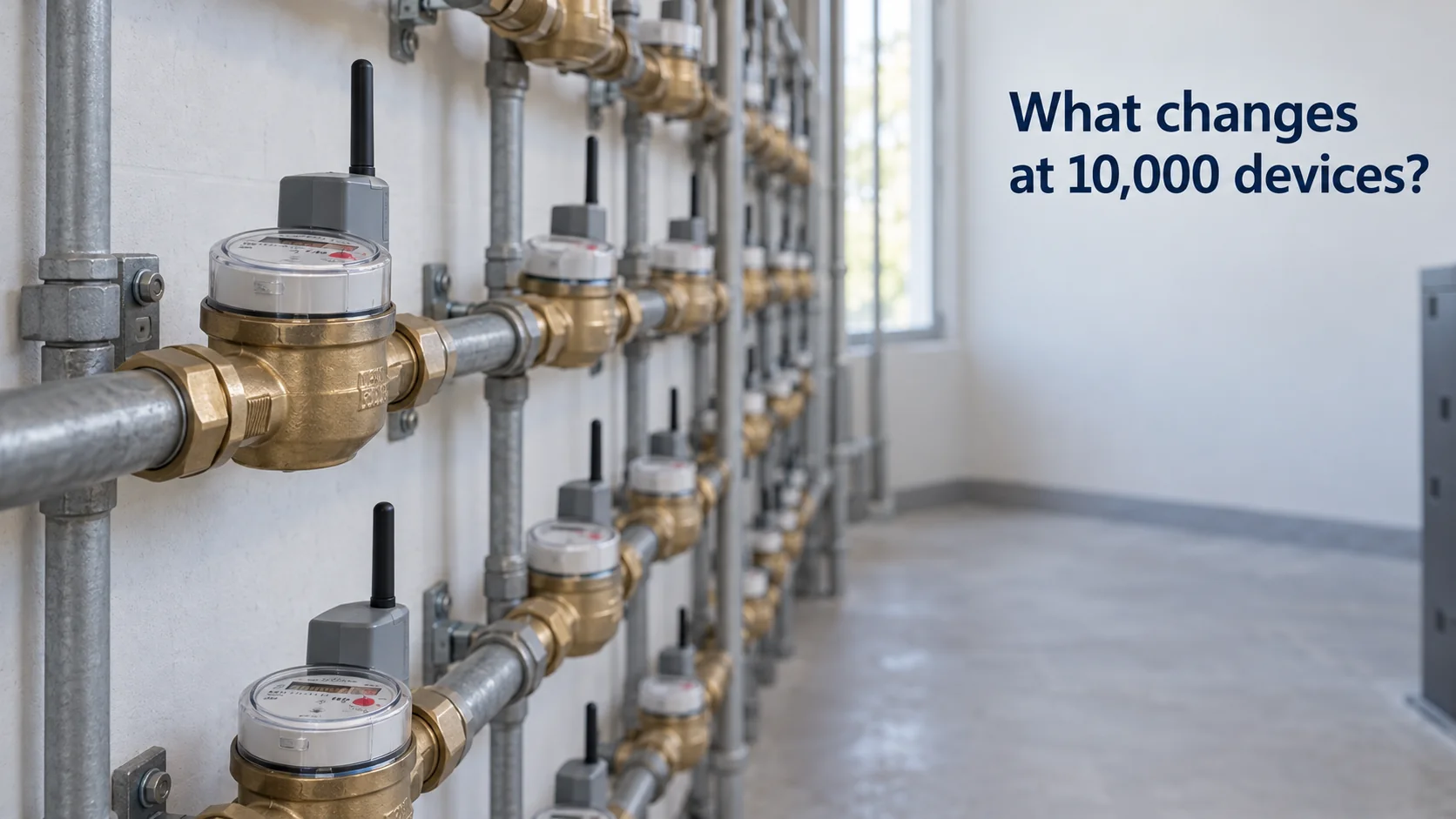
Massive IoT is the name for deployments where very large numbers of small, cheap, battery-powered devices connect in one area, and each of them sends a few bytes of data now and then. Think of every water meter in a town, every parking bay on a street grid, or every waste container on a collection route. The term comes from the mobile industry's planning for 5G, where it describes networks built to support a million devices per square kilometer.
For utilities and city planners, scale changes what has to be planned. One sensor is easy. Forty thousand of them raise questions about radio capacity, battery life, who runs the network, and how a small team keeps track of which devices are still talking.
In short
- Massive IoT means huge counts of low-power devices that each send small, infrequent messages, usually on batteries meant to last many years.
- The cellular options are NB-IoT and LTE-M, run by mobile operators in licensed spectrum, and they're also how 5G covers massive IoT today.
- LPWAN technologies such as LoRaWAN and mioty use unlicensed sub-GHz spectrum on networks you can operate yourself.
- The radio decides capacity and battery life, while fleet operations decide whether the project still works in its fifth year.
What are massive IoT devices?
Massive IoT devices share a profile more than a purpose. They're stationary or slow-moving. They report on a schedule, every 15 minutes, every hour or once a day. Each report is tiny, often 10 to 50 bytes: a meter reading, a fill level, a temperature, an open or closed state. They tolerate delay, because nobody needs a parking bay status within 10 milliseconds. And they run on batteries that are expected to last for years, because sending someone out to change 40,000 batteries is a project of its own.
Typical examples are water, gas and heat meters, parking bay sensors, fill-level sensors in waste containers, soil moisture probes, leak detectors in buildings, air quality nodes and simple asset tags. A video doorbell or a security camera doesn't belong in this group. Both need far more bandwidth and power than a massive IoT network is designed to give.
The numbers show why the problem is the count of transmissions rather than the amount of data. Take a water utility with 40,000 meters, each sending a 20-byte reading every hour:
- 40,000 meters × 24 readings = 960,000 messages a day
- 960,000 messages × 20 bytes ≈ 19 MB a day, less than one short phone video
The data volume is trivial. What's hard is that nearly a million short radio transmissions have to reach a receiver without colliding with each other, every meter has to wake up, transmit and go back to sleep on a tight energy budget, and the back office has to tell a quiet meter from a broken one.
Telling the two apart is a fleet-operations job. At this scale you register devices in batches, keep their security keys somewhere safer than a spreadsheet, and watch for devices that stop reporting, because a flat battery and a failed radio look identical from a desk.
Anyone comparing the best OTA update software for massive IoT fleets runs into a radio question before a software question. An over-the-air firmware update means pushing tens or hundreds of kilobytes down to each device, and low-power networks are built mostly for traffic going up. LoRaWAN, for example, has LoRa Alliance specifications for multicast and fragmented firmware delivery, but on unlicensed bands with duty-cycle limits, updating thousands of devices can take hours or days. LTE-M handles larger downloads more comfortably. Many device makers simply design massive IoT hardware so that it rarely needs an update at all.
Which cellular networks support massive IoT?
Mobile operators serve massive IoT with two standards from 3GPP, the body that writes cellular specifications. Both arrived in 3GPP Release 13, completed in 2016.
NB-IoT (Narrowband IoT) uses a channel only 180 kHz wide. It's slow and built for very small payloads, but it reaches deep indoors and below ground, which makes it a common choice for meters. LTE-M, also called LTE Cat-M1, uses 1.4 MHz, offers higher data rates, keeps working while a device moves between cells, and can even carry voice. Both have two power-saving features, PSM (power saving mode) and eDRX (extended discontinuous reception), that let a device sleep for long stretches while staying registered on the network.
The cellular route has clear strengths. The operator builds and maintains the network, coverage often already exists, and the spectrum is licensed, so nobody else is allowed to transmit in it. The trade-offs are just as clear. Every device needs its own subscription, coverage depends on whether your operator has switched on NB-IoT or LTE-M where your devices will sit, and roaming support between countries varies.
The other family is LPWAN (low-power wide-area network) technology in unlicensed spectrum, mainly LoRaWAN and mioty. Here you, or a provider you choose, install gateways or base stations, and devices need no per-device subscription. Side by side, the four look like this:
| NB-IoT | LTE-M | LoRaWAN | mioty | |
|---|---|---|---|---|
| Spectrum | Licensed, operator | Licensed, operator | Unlicensed sub-GHz | Unlicensed sub-GHz |
| Who runs the network | Mobile operator | Mobile operator | You or a provider | You or a provider |
| Per-device subscription | Yes | Yes | No | No |
| Strong point | Deep indoor reach | Mobility, larger payloads | Large device ecosystem | Capacity, interference tolerance |
| Standard body | 3GPP | 3GPP | LoRa Alliance | ETSI |
Neither family wins everywhere. A utility that already pays an operator for thousands of connections weighs the choice differently from a city that wants to own its radio infrastructure for decades.
What is 5G massive IoT?
When the ITU, the United Nations agency for telecommunications, set out requirements for 5G under the name IMT-2020, it defined three usage scenarios. Enhanced mobile broadband covers phones and fast data. Ultra-reliable low-latency communication covers things like industrial control. Massive machine-type communication, shortened to mMTC, covers huge numbers of simple devices, and that third scenario is massive IoT. The ITU's minimum requirement for it is a connection density of 1,000,000 devices per square kilometer.
What surprises many people is that 5G massive IoT today is mostly NB-IoT and LTE-M. 3GPP included both in its 5G submission because they meet the mMTC requirements, and operators can run them alongside 5G New Radio. There isn't a newer 5G radio for the cheapest sensors. 5G RedCap (reduced capability), introduced in Release 17, targets a middle tier such as wearables and industrial cameras that need more bandwidth than NB-IoT offers. Release 19 started work on ambient IoT, aimed at tiny tags that harvest energy from their surroundings instead of carrying a battery, but that work is at an early stage.
So when a vendor talks about 5G massive IoT, the useful follow-up questions are concrete. Which radio do the devices actually use? Does your operator support it at the spots where the devices will be mounted, including basements and meter cabinets? What does a subscription cost per device per year, multiplied by the number of years you expect the devices to run?
How does mioty handle massive IoT?
mioty was designed for the dense, low-power case from the start. It's an LPWAN technology developed at Fraunhofer IIS and standardized by ETSI as TS 103 357, a specification also known as TS-UNB (telegram splitting ultra-narrowband). In Europe it transmits in the license-free 868 MHz band.
Its central idea is telegram splitting. Instead of sending a message as one burst, a mioty device splits it into many very short sub-packets and sends them at different moments on different frequencies. Error-correcting code lets the base station rebuild the message even when up to half of those bursts are lost. In a crowded band that matters: if another transmitter wipes out a few bursts, the message still gets through, and because each burst is so short, collisions between thousands of devices become less likely in the first place.
The capacity figures published by Fraunhofer IIS and the mioty Alliance are up to 110,000 endpoints per base station, at a range of roughly 2.5 km, and up to 3.5 million messages a day per base station for small payloads sent about hourly. Those are protocol figures, and real results depend on terrain, buildings and reporting intervals. Set against the 40,000-meter example above, one base station's message budget has room to spare, which means a mioty network plan is driven mostly by coverage.
A base station on its own only receives radio. It still needs a service center, mioty's name for the network server that manages endpoints and hands their readings to applications. On Kilo you can run that piece three ways: host the open-source Kilo mioty Service Center yourself; use mioty with the network server built into Kilo Cloud, where you add a mioty connector, point your base stations at it, and have no mioty infrastructure to run; or have Kilo license and install the Enterprise edition on your own premises, on request.
From there, mioty readings sit in the same dashboards and rules as LoRaWAN devices in the same organization. For district-sized fleets, one rule trigger can watch up to 500 selected devices and evaluates each of them separately.
Massive IoT FAQ
What is the difference between massive IoT and critical IoT?
Massive IoT optimizes for huge device counts, low cost and long battery life, and it accepts delays of seconds or more. Critical IoT sits at the other end: remote surgery, safety messages between vehicles or tightly synchronized robots, where a message has to arrive within milliseconds and almost never fail. The two use different hardware, different network features and very different budgets.
Is LoRaWAN considered massive IoT?
LoRaWAN isn't part of the ITU's 5G definition, which covers cellular standards, but it serves the same class of devices and is widely used for metering, buildings and agriculture. Most LoRaWAN sensors are Class A devices, which only listen for a short window right after they transmit. That habit is a big part of why they can run for years on a battery.
How long do massive IoT device batteries last?
3GPP's design target for NB-IoT and the cellular IoT options studied alongside it was up to ten years of battery life on a 5 Wh battery. Real battery life depends on how often the device reports, how far it is from the nearest cell or base station, and the temperature it lives in. A sensor reporting every 15 minutes from a deep basement uses far more energy per day than one reporting daily from a rooftop.
Does massive IoT need 5G?
No. Many operators launched NB-IoT and LTE-M on their 4G networks years before 5G, and LPWANs need no mobile network at all. A more pressing deadline for many utilities is the shutdown of 2G and 3G networks, which forces older connected meters onto newer technology.
Five emulated meters, created from presets of real sensor models, let you rehearse the operational side before you buy a base station. Put their readings on one dashboard and set a rule to raise an alarm when consumption crosses a limit you choose; Kilo's free plan has room for exactly that. Send once pushes a single out-of-range reading, so you can watch the alarm arrive. When real mioty or LoRaWAN hardware shows up, you point the same devices at the real connector and keep the dashboard and the rule you already built.