
 English
 Français
 Español
 Deutsch
 Português
 Italiano
 العربية
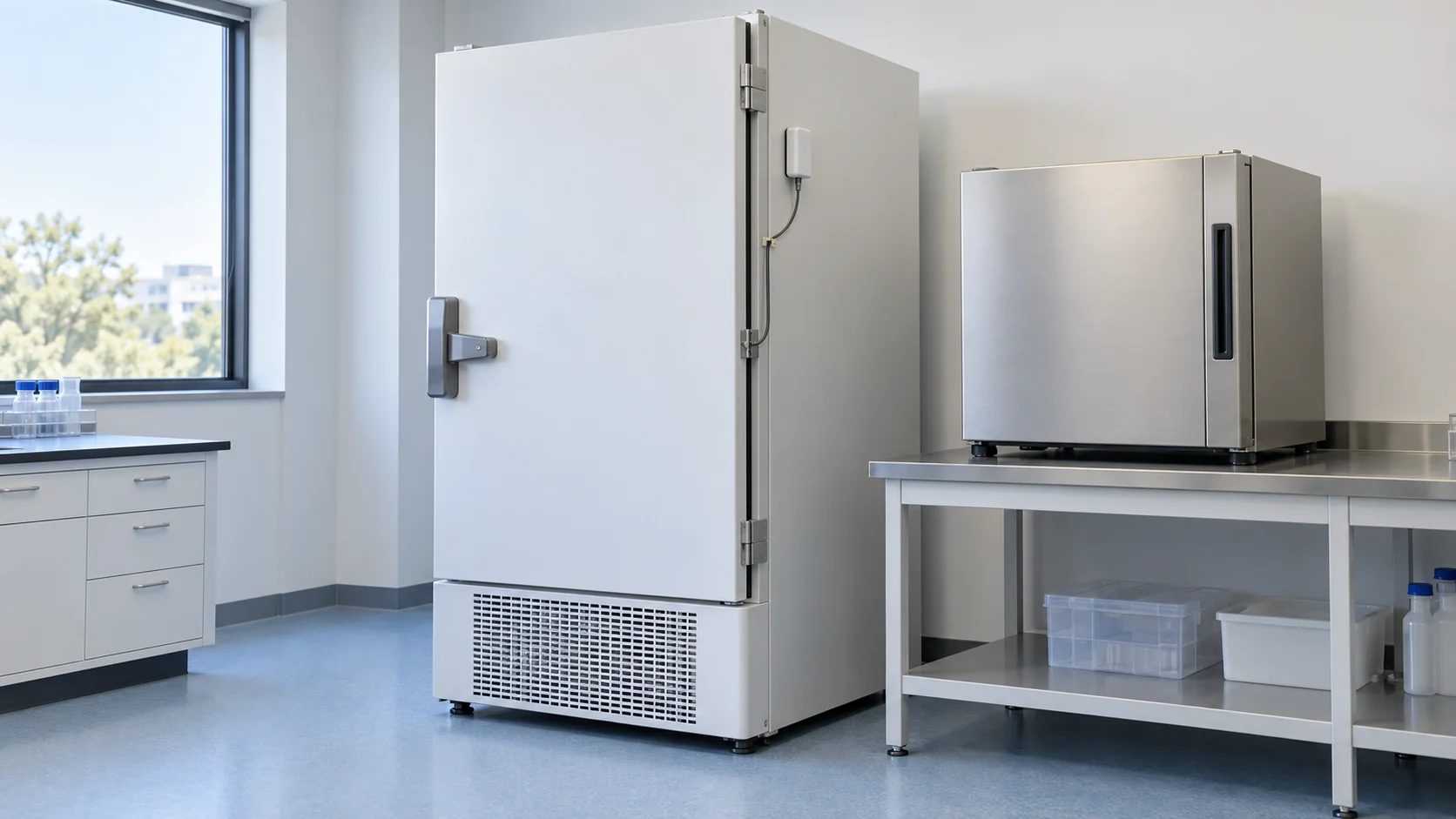
Laboratory equipment monitoring means measuring the conditions inside freezers, refrigerators, incubators, cold rooms and other critical equipment around the clock, recording them, and alerting someone the moment a reading leaves its safe range. In a research lab it protects samples that took months or years to collect. In a pharmaceutical or clinical setting it also produces the records that show products were stored correctly.
The failures it guards against are ordinary. A freezer compressor dies on a Friday evening. Someone leaves an incubator door ajar. A cold room's breaker trips during a storm. None of these is rare, and the damage depends almost entirely on how long it takes a person to notice. A −80 °C freezer full of samples warms slowly at first, which leaves time to move the contents, but only if someone knows within the first hour or two rather than on Monday morning.
In short
- Continuous monitoring with alerts protects samples; manual twice-daily readings only document that something already went wrong.
- Pharmaceutical and clinical labs also need calibrated sensors, retained records and a documented response to every excursion.
- Alerts need a delay for normal door openings and an escalation path for nights and weekends.
- Biotech equipment monitoring solutions differ most in validation support, record keeping and how alarms reach people.
What is laboratory equipment monitoring?
Laboratory equipment monitoring is a system of sensors, a network and software that watches the environment inside critical equipment continuously. The sensors measure temperature in most cases, and depending on the equipment also CO₂ concentration, humidity, liquid nitrogen level or door state. The software stores every reading, compares it with limits for that unit, and notifies people when something goes wrong.
Different equipment needs different limits. Typical ranges look like this, although your own protocols and the products you store set the real values:
| Equipment | Typical setpoint or range | What usually goes wrong |
|---|---|---|
| Laboratory refrigerator | 2–8 °C | Door left open, defrost cycle, overloading, compressor failure |
| −20 °C freezer | Around −20 °C (vaccine freezers −50 °C to −15 °C) | Frost build-up, door seal wear, compressor failure |
| Ultra-low temperature freezer | −80 °C (often set between −70 °C and −86 °C) | Compressor or refrigeration stage failure, blocked condenser filter, power loss |
| CO₂ incubator | 37 °C and 5% CO₂ for many mammalian cell cultures | Empty CO₂ cylinder, door left ajar, sensor drift |
| Liquid nitrogen storage | Vapor phase at −150 °C or colder; liquid at −196 °C | Fill level too low, failed auto-fill, lid not seated |
| Cold room | Often 2–8 °C | Door held open, evaporator icing, failed unit |
Temperature probes placed in a small bottle of glycol or a similar buffer are common in refrigerators and freezers. The buffer slows the probe's response to match the product rather than the air, so a 30-second door opening doesn't look like a failure. The U.S. CDC's vaccine storage guidance for vaccine providers recommends exactly this kind of buffered probe on a digital data logger.
Incubators need a second measurement beyond temperature. Cell cultures depend on CO₂ to hold the medium's pH, so a CO₂ incubator that runs out of gas looks fine on its temperature display while the cultures drift. An independent CO₂ reading, or at least monitoring of the gas supply pressure, catches an empty cylinder before the cultures suffer. Labs with automatic changeover between two cylinders still benefit, because the switch is easy to miss until the second cylinder runs out too.
A lab equipment monitoring system adds two things that a freezer's built-in display can't: a record of every reading over time, and alerts that reach people who aren't standing next to the unit.
Pharmaceutical equipment monitoring for GMP
Pharmaceutical equipment monitoring has the same technical core, plus the requirements of good manufacturing practice (GMP) and related regulations. The goal isn't only to protect product but to prove, months later, that it was protected.
In practice, regulated labs and storage areas usually work with these expectations:
- Calibrated sensors. Each probe is calibrated against a reference traceable to a national standard, typically by a laboratory accredited to ISO/IEC 17025, and recalibrated on a fixed interval.
- Mapped storage. Temperature mapping studies, described in guidance such as the WHO's supplement on temperature mapping of storage areas, find the warmest and coldest points of a chamber so the monitoring probe sits where it represents the worst case.
- Controlled electronic records. Where electronic records replace paper, the U.S. FDA's 21 CFR Part 11 and the EU GMP Annex 11 on computerised systems set expectations for access control, audit trails of changes to data, and electronic signatures.
- Documented excursions. Every out-of-range event is investigated: how far, how long, which products were affected, and what was done.
- Validation. The monitoring system itself is validated for its intended use, with documented testing that it records and alerts as specified.
Continuous data earns its keep during an excursion investigation. Suppose a refrigerator storing finished product reads 9.4 °C for 40 minutes on a Saturday. With continuous records, the quality team can show the peak, the duration and the recovery, and assess the product against its stability data. With twice-daily manual readings, they only know that Saturday afternoon is a gap, and the cautious answer is often to quarantine or discard the whole contents.
How to set up laboratory equipment monitoring
Setting up laboratory equipment monitoring follows a predictable order, whichever system you choose:
- List every unit that holds something you can't easily replace, and rank them by value and by how quickly their contents degrade.
- Decide the limit for each unit, including a warning level before the hard limit, based on the stored material rather than the equipment's factory default.
- Choose probe placement: buffered probes in refrigerators and freezers, a dedicated sensor in incubators where you don't want to rely on the incubator's own reading.
- Decide how long a reading can be out of range before it counts as an alarm, which keeps routine door openings from triggering alerts.
- Write down who responds during working hours, at night and at weekends, and what they're expected to do on arrival.
- Test every alert path end to end, including a deliberate excursion, before the system goes live.
Wireless battery-powered sensors make the physical installation easy, because a thin probe cable goes through the freezer's access port or door seal and the transmitter sits outside on the cabinet. Long-range radio such as LoRaWAN reaches through concrete floors to a gateway elsewhere in the building, which matters in labs where Wi-Fi is locked down.
Timing is the reason step 5 matters so much. Warm-up rates depend on the freezer, its load and the room, but a full upright ultra-low freezer with its door closed typically takes hours rather than minutes to rise from −80 °C to around −50 °C, while a half-empty one warms faster. That window is enough to move samples to a backup freezer or onto dry ice, provided the alert reaches someone who can get to the lab. Agree in advance where the backup space is, who holds keys and access cards out of hours, and where dry ice can be obtained, so the response doesn't depend on improvisation in the middle of the night.
Steps 4 and 5 translate directly into software settings. In Kilo, you set the trigger to fire only if a condition lasts, so a freezer can sit briefly above −70 °C while someone pulls a rack without raising an alarm, and you give the trigger its own recovery condition so it resets only once the freezer is properly cold again. The rule it starts then raises an alarm that follows the escalation chain you wrote down in step 5, for example the on-call scientist by push notification first, then the lab manager by SMS (a paid add-on) if nobody resolves it within 15 minutes. The same pattern carries over to fridges, cold rooms and incubators when you extend remote temperature monitoring to the rest of the lab.
How to compare biotech equipment monitoring solutions
Biotech equipment monitoring solutions range from standalone data loggers with a local display, to systems sold by freezer manufacturers for their own units, to vendor-neutral platforms that monitor equipment from any maker. Questions that help when comparing them:
- Does it work with the equipment you already have, from any manufacturer, or only with one brand?
- What sensor accuracy and calibration certificates come with the probes, and how is recalibration handled?
- How do alarms reach people at night and at weekends, and what happens when the first person doesn't respond?
- Where are records stored, how long are they kept, and can you export them for an audit?
- If you work under GMP, what validation documentation does the vendor provide, and how does the system meet Part 11 or Annex 11 expectations?
- What happens to monitoring during a power or network outage?
- What does it cost per monitored unit per year, including probes, gateways and recalibration?
A short trial on real equipment answers several of these questions faster than a sales presentation. Put two or three probes from each shortlisted system into the same freezer, open the door a few times, unplug the gateway for an hour, and see what each system records and who gets told. The differences in alert wording, timing and recovery handling show up within a week.
Research labs without GMP obligations can usually prioritize the alerting and ease of installation. For regulated labs, validation support and record controls come first, because a system that alerts well but can't support an inspection leaves the quality team without the evidence it needs.
Laboratory equipment monitoring FAQ
What happens to laboratory equipment monitoring during a power outage?
Battery-powered sensors keep measuring and sending, and their readings arrive as long as the gateway has power and a connection. Putting the gateway, its network switch and the internet router on a small UPS keeps alerts flowing during a building outage, which is exactly when freezers start warming and alerts matter most.
How often should laboratory equipment monitoring record temperature?
Every few minutes is common for freezers and refrigerators. CDC vaccine storage guidance, for example, recommends data loggers that record at least every 30 minutes, and many labs choose much shorter intervals so excursions can be measured precisely. Shorter intervals use more battery on wireless sensors, so balance precision against battery life.
Does a lab equipment monitoring system need 21 CFR Part 11?
Only when its electronic records are used to meet FDA requirements, for example in GMP manufacturing or regulated clinical work. Academic research labs generally don't fall under Part 11, although many still follow its principles for important samples. Your quality unit decides which regulations apply to your records.
Should laboratory equipment monitoring also cover the room?
Often, yes. Room temperature affects how hard freezers have to work: an ultra-low freezer in a room that climbs above its rated ambient temperature runs warmer and wears faster. Rooms with liquid nitrogen also need oxygen depletion monitoring for staff safety, which is a separate, safety-rated system.
Put buffered temperature probes rated for −80 °C in the three ultra-low freezers holding your most valuable samples and in the reagent refrigerator next to them, and set one rule that alarms when any freezer stays above −70 °C for 20 minutes. Then lift one probe's buffer bottle out of its freezer for half an hour as a test excursion, and check who gets the alert and how long it takes. Four probes and that rule fit Kilo's free plan, which keeps the last day of readings; keeping a year of temperature records takes the Business plan at €379 a month. If you'd like to source the probes in one place, Kilo Electronics stocks temperature sensors, though any compatible probe will do.