
 English
 Français
 Español
 Deutsch
 Português
 Italiano
 العربية
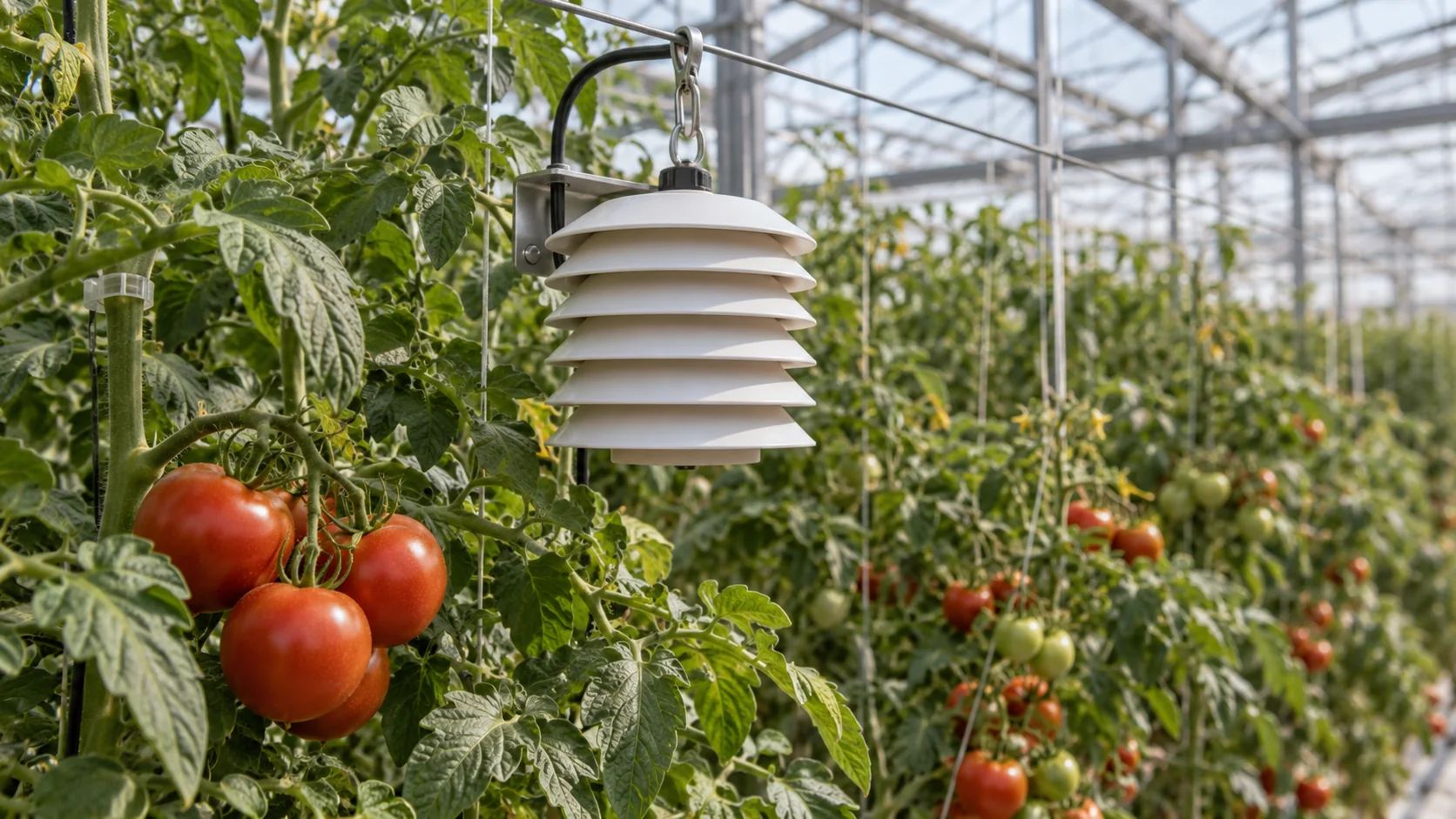
Greenhouse monitoring works by placing sensors among the plants that measure the growing climate, usually temperature, humidity, CO2, light and root-zone moisture, and sending those readings to software that stores them and alerts someone when conditions drift out of range. In a more advanced setup, the same readings also drive vents, fans, heating, screens and irrigation.
A greenhouse is a small, intense environment. On a sunny spring day, the air inside can climb from comfortable to damaging within an hour if a vent motor sticks, and a heating failure on a frosty night can cost a crop before morning. Monitoring exists to make sure somebody knows in time, whether or not they're on site.
In short
- An automated greenhouse monitoring system measures air temperature, humidity, CO2 and light at canopy height, plus substrate moisture in the root zone, then alerts or acts on the readings.
- Wireless greenhouse monitoring avoids cables in a wet environment and makes it easy to add measuring points where gradients appear.
- Remote greenhouse monitoring is only as good as its alert plan: who gets told, how, and what happens if they don't respond.
- A greenhouse monitoring and control system adds actions, and most growers keep fast climate control local while using monitoring for alerts and history.
What is an automated greenhouse monitoring system?
An automated greenhouse monitoring system collects climate readings continuously, without anyone walking the house with a handheld meter, and reacts to them on its own: by alerting people, by recording history, or by switching equipment. The measurements that matter most are these:
- Air temperature at canopy height, the main driver of plant growth and development speed.
- Relative humidity, which affects transpiration and disease. Long periods of high humidity favor fungal diseases such as botrytis.
- Vapor pressure deficit (VPD), calculated from temperature and humidity. It describes how strongly the air pulls water out of the leaves, which makes it more useful to growers than humidity alone. The right range depends on the crop and its growth stage.
- CO2 concentration, because plants use it up quickly in a closed greenhouse on a sunny day. Many growers enrich CO2 during daylight, often to around 800 to 1,000 ppm, compared with a little over 420 ppm outdoors.
- Light, often measured as PAR (photosynthetically active radiation) and summed into a daily light integral (DLI), which shows whether the crop got enough light that day and whether supplementary lighting or shading is needed.
- Substrate or soil moisture and EC (electrical conductivity), which show when to irrigate and whether nutrient levels in the root zone are right.
DLI is easy to work out once you have PAR readings. Suppose the PAR sensor averages 500 µmol per square meter per second over a 12-hour day. Multiply by the 43,200 seconds in 12 hours and divide by a million: 500 × 43,200 ÷ 1,000,000 ≈ 21.6 mol per square meter per day. Compare that with the target published for your crop, and you know whether screens are costing light or whether lamps are worth running. The numbers here are an example, and real days vary a lot with cloud cover.
The word "automated" covers a range. At the simple end, the system records readings and sends alerts. At the other end, it runs vents, fans, heaters, screens, fogging and irrigation from those readings. Most commercial greenhouses already have some climate control, so a monitoring system often adds what the controller lacks: more measuring points, longer history, remote alerts and readings from places the controller doesn't see, such as cold corners, propagation benches or the boiler room.
Wired vs wireless greenhouse monitoring
Where sensors go matters more than which brand they are. Climate inside a greenhouse is uneven: it's warmer near the roof, cooler near the sidewalls and doors, more humid in dense canopy. A single sensor in the middle of the house shows an average that no plant actually experiences. For a mid-sized house, a sensor at canopy height in the center plus one near the coldest or hottest spot is a sensible minimum.
Sensors also need protection from direct sun. A temperature sensor in sunlight can read several degrees higher than the air around it. Commercial setups use ventilated radiation shields or aspirated boxes with a small fan that pulls air past the sensor.
Wired monitoring connects sensors by cable to a controller or data logger. It's reliable and needs no batteries, and it's how most climate computers get their main readings. The downsides show up in a growing environment: cables have to be routed around moving benches, gutters and irrigation, they corrode where moisture gets in, and adding a measuring point means pulling another cable.
Wireless greenhouse monitoring puts a radio and battery in each sensor. You hang the sensor where it's needed and move it when the crop changes. In a glasshouse, radio travels well over short distances, though steel frames, wet foliage and water-filled pipes absorb some signal. Short-range radios such as Wi-Fi or Zigbee work within one house close to an access point or hub. Long-range, low-power radios such as LoRaWAN reach across a whole site, including houses spread over several hectares and the boiler house, with one gateway and batteries that last years.
A practical approach for many growers is both: keep the climate computer's wired sensors for control, and add wireless sensors for extra measuring points, remote alerts and spots the controller doesn't cover.
How to set up remote greenhouse monitoring
Remote greenhouse monitoring means you get the readings and, more importantly, the warnings when you're not in the greenhouse.
- Decide what would ruin a crop overnight. For most growers, it's heat on a sunny day with vents closed, frost or a heating failure on a cold night, and an irrigation failure on substrate crops.
- Place sensors to catch those failures early: canopy height in each house, near the heating pipes' far end, and in the coldest corner.
- Set thresholds with a time delay. A reading that crosses the line for two minutes while a door is open isn't the same as one that stays there for twenty. Thresholds also differ by time of day: 30 °C in the afternoon may be normal for a summer crop, while 8 °C at night may already be a heating failure for the same crop.
- Name the responders. Decide who gets the first alert, who gets it next if nobody reacts, and which hours each person covers.
- Test it. Warm a sensor by hand or in a sunny spot and check that the alert reaches the phone, including at night with the phone on silent.
What does a greenhouse monitoring and control system do?
A greenhouse monitoring and control system goes one step further: it measures the climate and then changes it. Typical actions include opening roof vents in steps as temperature rises, starting circulation and exhaust fans, switching heating, closing energy or shade screens, running fogging for humidity, dosing CO2 and starting irrigation.
The control logic is usually layered. Fast, safety-critical loops, such as vents responding to temperature minute by minute or closing in strong wind and rain, belong in a local climate controller that keeps working if the internet connection drops. Slower decisions sit above that: changing setpoints for night and day, starting irrigation from substrate readings, or alerting people when the controller can't keep up.
Screens are a good example of how much control can matter. Energy screens closed at night hold heat in and cut heating demand considerably, while shade screens during bright spells protect leaves and fruit. Both depend on readings, outside light, inside temperature and humidity, so a screen that's opened or closed at the wrong moment shows up straight away in the monitoring history.
Before adding control, three questions help. Does the equipment accept remote commands at all, or does it need a relay or controller in between? What should happen if a command doesn't arrive, and is that state safe for the crop? And can a person override everything locally? If the answer to the last question is no, sort that out before any automation goes in.
There's also a sensible order. Many growers run monitoring alone for a season, compare the readings with what their controller does, and only then let readings from new sensors feed into control. Running the two side by side also shows where greenhouse monitoring solutions from different suppliers disagree, which is useful to know before any of them drives a motor.
What is the best greenhouse monitoring system?
The best greenhouse monitoring system for you depends on what's already in the house. If a climate computer drives the vents and heating, you mainly need extra measuring points and alerts that reach a person at night. Without a controller, or with a separate one in each house, you also want one view of every house and a way to switch equipment that accepts remote commands. Either way, the system should accept the sensors you choose, since the right substrate sensor for one crop isn't always right for another.
For growers whose main worry is a warning nobody hears, Kilo is the best fit. You create a rule that watches canopy temperature and fires only if the reading stays out of range for as long as you choose, such as 15 minutes, and you can give it a schedule so a frost threshold applies only at night. The rule raises an alarm that reaches the grower on duty by push notification first and moves to the owner by SMS if nobody resolves it within the delay you set. On iPhone and Android, the IoT Alerts app opens a critical alarm full screen with a looping tone, designed to break through silent mode once the responder grants that permission.
Where a vent, fan or irrigation controller accepts remote commands, the same rule can act on it as well as alert. You define the command once, for example switching the relay that drives a circulation fan or opening an irrigation valve, and Kilo sends it to MQTT-connected equipment or LoRaWAN Class C controllers and records every dispatch with its outcome.
If you're not sure which sensors to buy, Kilo AI recommends suitable hardware, and from a goal you describe in plain words it can add the devices, create the rule and set up the alarm. Sensors from other suppliers connect too, including ones already hanging in your houses, as long as they use a supported connection such as LoRaWAN, mioty or MQTT. Kilo Electronics stocks CO2 sensors suited to growing spaces, and Kilo's page on remote temperature monitoring instead of another site visit covers greenhouses alongside pump houses, server rooms and other places where temperature matters and nobody sits.
Greenhouse monitoring FAQ
How many sensors does a greenhouse monitoring system need?
For a single house, a minimum is one temperature and humidity sensor at canopy height and one in the coldest or hottest spot. Add a CO2 sensor if you enrich, a light sensor if you use screens or supplementary lighting, and substrate sensors for each irrigation group. A large glasshouse split into sections usually gets at least one set of climate sensors per section, and more where you want to see gradients.
Can greenhouse monitoring detect plant disease risk?
Indirectly, yes. Many fungal diseases need wet leaves, and leaves get wet when their temperature falls below the dew point of the surrounding air, which often happens at night and in the early morning. Monitoring air temperature and humidity lets you calculate the dew point and see when condensation is likely, so you can ventilate or heat before it forms.
Is a smart greenhouse monitoring system worth it for a hobby greenhouse?
For a hobby greenhouse, a simple temperature alert is often enough to prevent the most common loss, a hot day with the door shut or a cold night without heat. Full climate control and multiple measuring points pay off mainly in commercial houses, where one bad night can cost a crop worth far more than the system.
How often should greenhouse monitoring sensors report?
Every few minutes is common for air temperature and humidity, because conditions change quickly on sunny days. Substrate moisture usually changes more slowly between irrigations, so many setups log it less often, for example every 15 minutes. Battery-powered wireless sensors last longer at longer intervals, so many growers choose the interval per sensor type.
Start on Kilo's free plan with the house where a failure would hurt most. It covers up to five devices, one dashboard and one rule, needs no payment details and doesn't expire, which is enough for two temperature and humidity sensors at canopy height (one in the middle, one in the coldest corner), a CO2 sensor and a sensor in the substrate of your most valuable crop, with one device spare for an outdoor reading later. Point the rule at canopy temperature with a 15-minute delay, then, one evening, keep a sensor warm past the threshold for longer than that and check that the alarm breaks through on your phone.