
 English
 Français
 Español
 Deutsch
 Português
 Italiano
 العربية
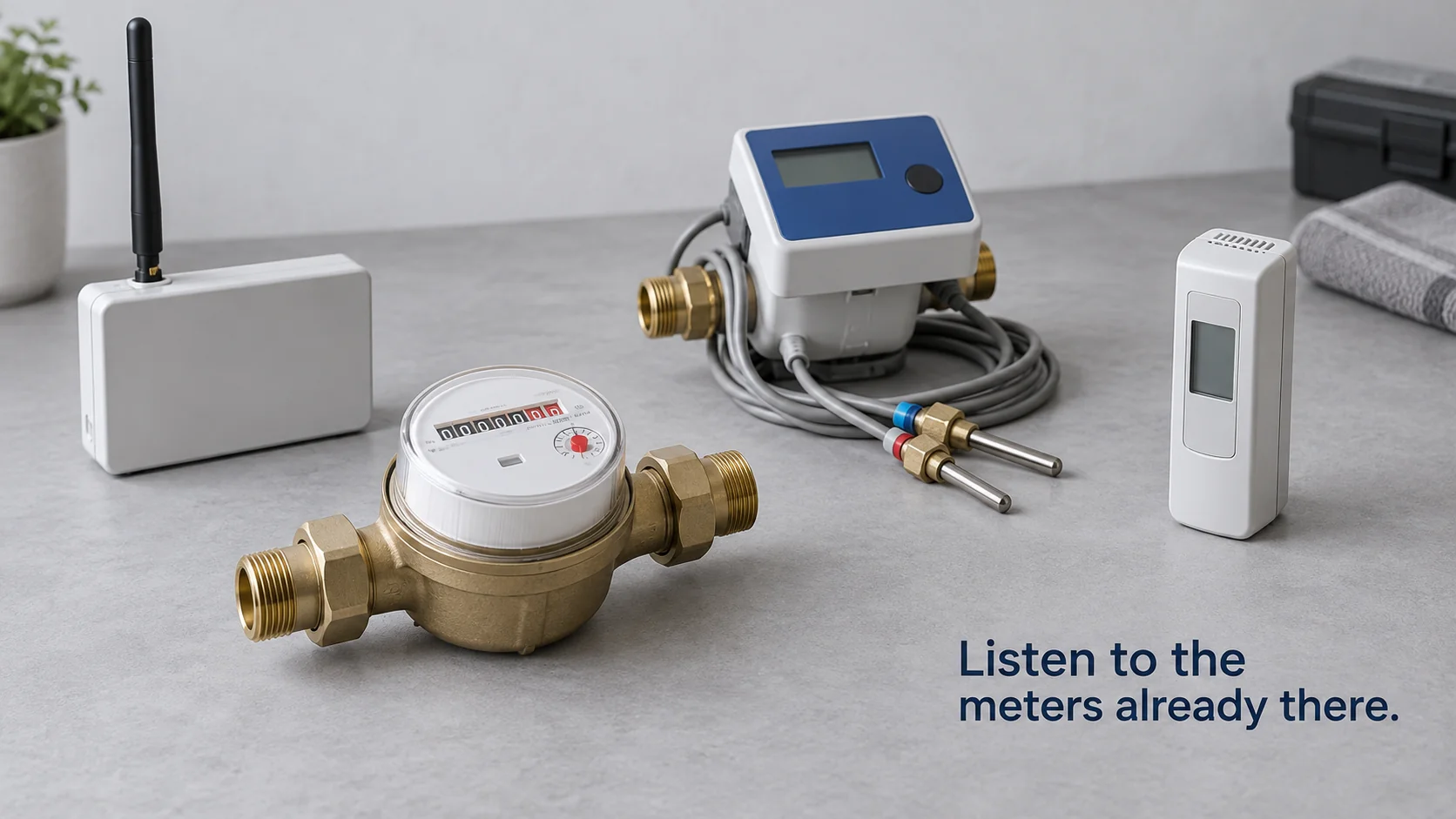
Wireless M-Bus is the radio version of M-Bus, the European standard for reading utility meters. It lets water meters, heat meters, gas meters and heat cost allocators send their readings by radio to a receiver, instead of being read by hand or wired to a data logger. The wireless part is defined in EN 13757-4, and in many European countries it's one of the most common radios already built into installed meters, especially in apartment buildings.
If you manage buildings or work on metering projects, there's a good chance you have wireless M-Bus meters today without having thought much about it. They're transmitting right now, a few times a minute or a few times a day, whether anything is listening or not. What it takes to actually receive that data, decode it and use it next to other building data is less obvious, and that's what this article covers.
In short
- Wireless M-Bus (wM-Bus) is a European radio standard for battery-powered utility meters, defined in EN 13757-4.
- It has several modes; T and C at 868 MHz are the most common for water and heat meters, N runs at 169 MHz for longer range.
- A wireless M-Bus gateway receives meter messages, decrypts them with the meter keys and forwards readings to software.
- Gateways that combine wM-Bus and Modbus can bring meters and wired equipment onto one data path, often MQTT.
What are wireless M-Bus modes?
The standard defines several operating modes, and the mode decides the frequency, the data rate and whether the meter can also receive. Two meters can both be "wireless M-Bus" and still be unable to talk to the same receiver if their modes differ. These are the modes you'll meet most often:
| Mode | Frequency band | Direction | Typical use |
|---|---|---|---|
| S (stationary) | 868 MHz | One-way (S1) or two-way (S2) | Fixed installations that send a few times a day |
| T (frequent transmit) | 868 MHz | One-way (T1) or two-way (T2) | Walk-by and drive-by reading of water and heat meters |
| C (compact) | 868 MHz | One-way (C1) or two-way (C2) | Like T, with a more efficient encoding; common in newer meters |
| N (narrowband) | 169 MHz | Mostly one-way, two-way variants exist | Long-range fixed networks, especially for gas and water |
There's also a 433 MHz mode (F) and a less common R mode, but most projects deal with T1, C1 or both.
Each message a meter sends is called a telegram. Its header carries an identifier made of a three-letter manufacturer code, the meter's serial number, a version byte and a device type, so a receiver can tell exactly which meter sent it. The rest of the telegram carries the data records: the current index, often a value from the last billing date, sometimes a monthly history, and status flags such as a leak or a battery warning.
The one-way modes are the reason wM-Bus meters last so long on a battery. The meter never waits to hear anything, it just sends and goes back to sleep. The trade-off is that you can't ask a one-way meter for anything: you get what it decides to send, at the interval the manufacturer configured.
What does a wireless M-Bus gateway do?
A wireless M-Bus gateway is a receiver that sits within radio range of the meters, listens for their telegrams and forwards the readings somewhere useful. Under that simple description, a gateway typically does five jobs:
- Receives telegrams in one or more modes, for example T1 and C1 at the same time.
- Filters them against a list of meters you care about. In a dense neighborhood it will also hear the meters next door, and you don't want those.
- Decrypts the telegrams with each meter's key, if the meters encrypt their data, which many current ones do.
- Decodes the data records into readable values, such as cubic meters, kWh or a leak flag.
- Forwards the result over its uplink, usually Ethernet or a carrier network, as MQTT messages, HTTP requests or a wired protocol like Modbus for a building management system.
Some gateways do only the first two steps and forward raw telegrams, leaving decryption and decoding to software elsewhere. Others do all five and output clean JSON. Which you want depends on where you'd rather keep the meter keys and the decoding logic.
Placement decides most of the coverage. Meters at 868 MHz are typically in basements, shafts and cupboards, and their signal has to get through concrete and steel doors. In an apartment building, a common pattern is one gateway per building or per stairwell, placed centrally so it can hear the meter cupboards on every floor. Take a 60-apartment building with one cold-water meter, one hot-water meter and one heat meter per apartment: that's 180 meters. If each sends a telegram every two minutes, the gateway receives about 129,600 telegrams a day, most of them repeating the same value. A sensible gateway configuration forwards only one reading per meter per hour, cutting that to 4,320 messages and keeping the data you actually store manageable.
It's also worth deciding early whether you need a fixed gateway at all. Walk-by reading with a handheld receiver still works for wM-Bus meters and suits buildings where a yearly or monthly value is enough. A fixed gateway makes sense once you want hourly data, leak alarms or consumption profiles, because only a receiver that listens all the time catches every telegram.
Plan for the meter keys early as well. They usually come from the meter supplier or the metering operator as a key file, one AES key per meter serial number. Without them, a gateway can see that a meter exists but can't read what it says.
Wireless M-Bus vs LoRaWAN for meters
LoRaWAN is the other radio you'll meet in metering projects, and the two are often compared because both are low-power and battery-friendly. They were built for different situations.
| Wireless M-Bus | LoRaWAN | |
|---|---|---|
| Origin | European metering standard (EN 13757-4) | Specification from the LoRa Alliance for general IoT |
| Typical range | Building scale at 868 MHz; longer in 169 MHz mode | Several kilometers outdoors, depending on terrain |
| Receivers needed | Often one per building or stairwell | One gateway can cover several buildings |
| Network layer | Meter to receiver, no network server defined | Gateways plus a network server that handles joins, deduplication and downlinks |
| Device range | Mostly meters and heat cost allocators | Meters and almost every other sensor type |
| Two-way | Only in two-way modes, rarely used | Built in, with timing limits per device class |
The practical difference is coverage and infrastructure. wM-Bus at 868 MHz was designed around walk-by reading and building-level receivers. LoRaWAN was designed for wide-area networks, so one well-placed gateway can serve a block of buildings, and it carries every kind of sensor, not only meters. That's why many meter manufacturers now offer the same meter with either a wM-Bus or a LoRaWAN module, and why some meters can even send both.
mioty is another radio worth knowing about for metering. It's an ETSI standard (TS 103 357) that splits each message into many short radio bursts and rebuilds it even if up to half of them are lost, according to Fraunhofer IIS and the mioty Alliance. The same sources quote up to 110,000 endpoints per base station, which suits dense urban metering.
For a new project, the choice usually follows from what's already installed and what else you want to measure. If the meters are being replaced anyway and the building also needs temperature, leak or air quality sensors, ordering the meters with LoRaWAN or mioty radios lets one network carry everything. If the meters are new, encrypted wM-Bus devices with years of calibration left, replacing them only to change the radio rarely pays off. In that case, receiving wM-Bus and converting it is the cheaper route.
If you already have a building full of wM-Bus meters, you don't have to replace them to get their data into a wider network. Bridge devices exist that receive wM-Bus telegrams and relay them over LoRaWAN, and wM-Bus gateways with an MQTT uplink can feed any system that reads MQTT.
Remote control solutions for Modbus and wireless M-Bus
In technical buildings, meters are only half of the picture. Heat pumps, boilers, electricity meters and ventilation units often speak Modbus over an RS-485 cable. That's why remote control solutions combining Modbus and wireless M-Bus are a category of their own: one edge device that reads wired Modbus equipment, receives wM-Bus meters and sends everything over a single uplink. Some can also write to Modbus registers, which is the "control" part, for example changing a setpoint on a heat pump.
The most common uplink for these devices today is MQTT, a lightweight publish-and-subscribe protocol where devices publish messages on named topics to a broker and any system subscribed to those topics receives them. Once readings are MQTT messages, it doesn't matter much whether they started as a wM-Bus telegram or a Modbus register.
Once your gateway publishes MQTT, bringing it into Kilo is a configuration job. You point the gateway at a broker Kilo provisions for you, or connect MQTT devices through the broker you already run, and each message lands on the right device by its topic or by the meter ID in the payload, so the hot-water meter in flat 12 stays a separate device from the heat pump on the roof. Where the gateway also accepts commands over MQTT, you define each command once in Kilo with typed parameters and send it from a dashboard or a rule, for example a new setpoint for that heat pump.
Wireless M-Bus meter FAQ
Is wireless M-Bus encrypted?
It can be, and many current meters encrypt their telegrams with AES-128. The Open Metering System specification defines security profiles built on M-Bus encryption modes, including mode 5 with a static key per meter and mode 7, which derives session keys from the meter key. Older meters may send unencrypted data.
What is OMS in wireless M-Bus?
OMS, the Open Metering System, is a specification built on top of M-Bus that narrows down the many options in EN 13757 so meters and receivers from different manufacturers work together. Meters can be OMS-certified, and many gateways state OMS compliance, which is a useful filter when buying.
What is the range of wireless M-Bus?
At 868 MHz, expect a few hundred meters in open space and much less through floors and walls. The 169 MHz narrowband mode reaches considerably further, which is why it's used for fixed networks covering whole districts.
Is wired M-Bus the same as wireless M-Bus?
They share the application layer, so the data inside the messages looks alike, but wired M-Bus uses a two-wire cable that also powers the meters' interface. A wired M-Bus master can address up to 250 meters on one segment, which makes it common in new buildings fitted during construction.
To check that a building's wM-Bus meters can be read reliably, mount one gateway in a central stairwell, load the keys for five meters on different floors, and let it publish one decoded reading per meter per hour over MQTT. A day of hourly data already shows which floors the gateway hears and whether any meter stays blank because its key is wrong. Those five meters fit on Kilo's free plan. Bringing in the rest of the building means loading more keys into the same gateway and moving to a paid plan sized for that many meters.