
 English
 Français
 Español
 Deutsch
 Português
 Italiano
 العربية
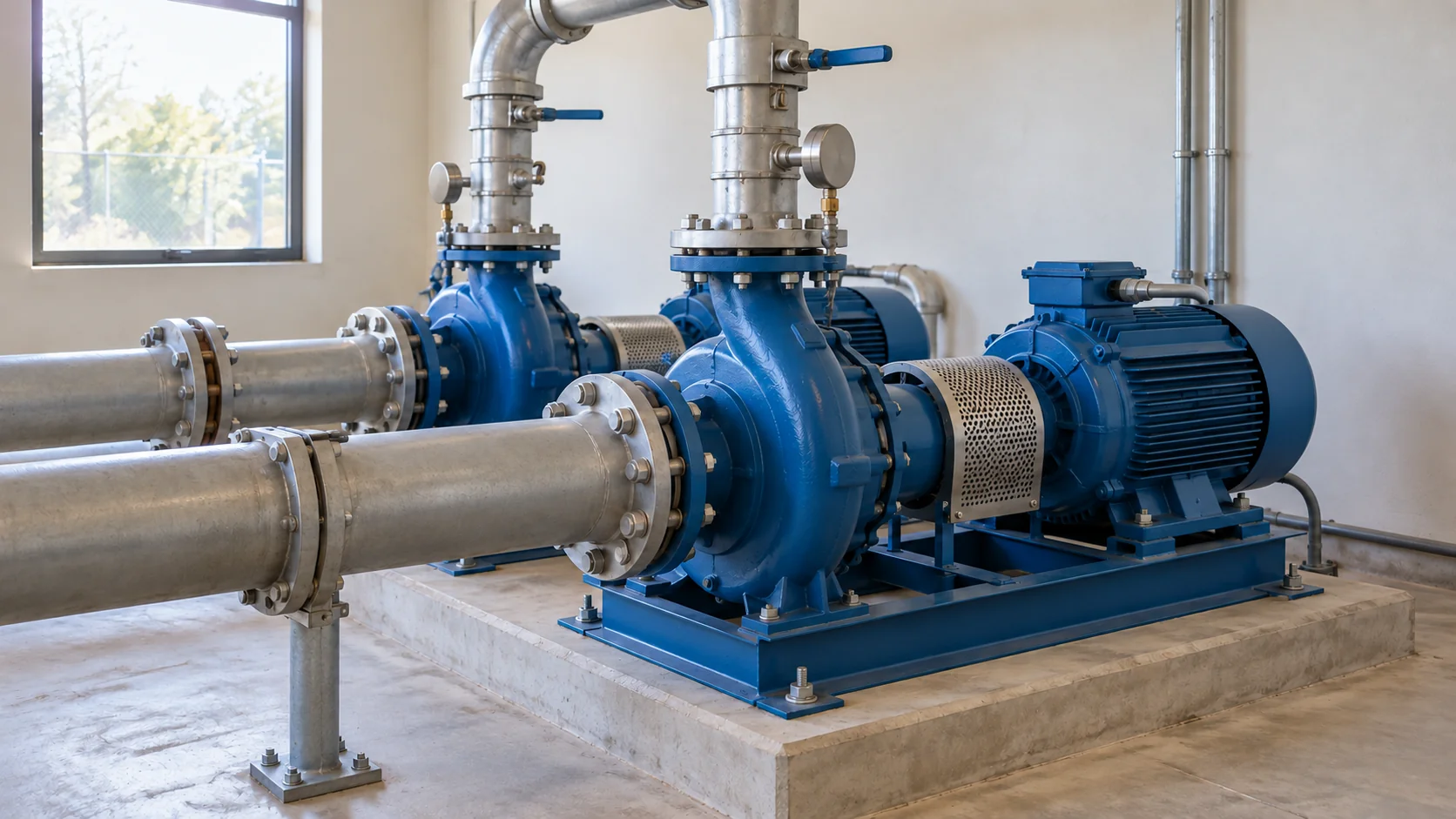
A water SCADA system is the combination of field controllers, communication links and control-room software that lets a small team supervise and operate treatment plants, wells, reservoirs, pump stations and pipe networks from one place. SCADA stands for supervisory control and data acquisition. Programmable logic controllers (PLCs) and remote terminal units (RTUs) at each site read instruments and run pumps and valves, a network carries their data to central servers, operators watch it on screens and respond to alarms, and a historian database keeps every value for reports and trend analysis.
Most of these systems were designed around the large assets: the plant, the main pump stations, the big tanks. The thousands of points between them, such as the pressure halfway along a main, a small booster in a housing estate or a well at the edge of the service area, often stay outside, because giving each one an RTU, mains power and a communication link costs too much. Battery-powered wireless sensors change that calculation, and they can do it without touching the control system.
In short
- A water SCADA system collects data from PLCs and RTUs at plants, wells, tanks and pump stations, shows it to operators, raises alarms and sends control commands.
- Pipe networks, small booster stations and remote wells often sit outside SCADA because a full RTU per site is expensive.
- Battery IoT sensors and smart meters can cover those points as a monitoring layer that runs alongside SCADA, outside the control loop.
- Leaving control with SCADA and using the IoT layer for monitoring and alarms keeps the control system's safety and security model intact.
Water pipeline monitoring with IoT sensors
Pressure is the most useful single measurement in a distribution network. A burst main shows up as a sudden pressure drop at the points nearest to it. A pressure that sags every evening tells you a zone is running out of capacity at peak demand. And pressure transients, the short spikes and dips also called water hammer, reveal pump trips and fast-closing valves that stress pipes long before anything breaks.
Transients happen in fractions of a second, so they need a different kind of instrument. A SCADA poll every few seconds or minutes will miss most of them. Dedicated transient loggers sample many times per second and keep the detail locally. Battery wireless pressure sensors usually report every few minutes to once an hour, and some log at a higher rate internally and send the minimum and maximum for each interval, which catches a spike without draining the battery.
Water pipeline monitoring also works at the level of zones. Many networks are divided into district metered areas, or DMAs, each fed through a small number of metered inlets. The lowest flow into a zone usually occurs in the early morning hours, when legitimate use is lowest, so a rising minimum night flow is one of the clearest signs of new leakage in that zone. Acoustic noise loggers fitted to valves or hydrants then narrow the search by listening for leak noise along the pipes at night.
Battery pressure sensors fit this work well because they can sit on a hydrant or in a valve chamber with no power supply and no cabling, report over LoRaWAN or another low-power radio, and be moved when the investigation moves.
How does booster pump monitoring work?
Booster stations lift water to higher pressure zones, tall buildings or the far end of a long main. The large ones usually sit in SCADA. The small ones, a duty-standby pair in an estate or a single pump for a hilltop street, often have a local controller and nothing that reports anywhere, so the first sign of trouble is a customer complaint.
Booster pump monitoring measures a short list of values, and each one tells you something specific:
| Measurement | What a change can indicate |
|---|---|
| Suction and discharge pressure | Pump running but pressure low: worn impeller, air in the pump, a closed valve |
| Motor current or power | Rising current at the same flow and pressure: wear or a partial blockage |
| Starts per hour | Frequent short cycles: a waterlogged pressure vessel or a failed sensor |
| Run hours per pump | Uneven duty between the two pumps of a pair |
| Vibration and bearing temperature | Bearing wear, misalignment, cavitation |
Many pump controllers and variable frequency drives already measure most of this and expose it as Modbus registers, the simple register-based protocol common in industrial equipment. That means the data often exists at the station and only needs a way out.
Wastewater lift stations add a problem of their own. Wipes and rags wrap around impellers, a process operators call ragging, and a clogged pump draws more current while moving less water. A deragger pump monitoring system watches the motor's current or power and, when the signature of a clog appears, runs the pump in reverse or through a cleaning sequence through its drive. That logic usually lives in the drive or pump controller. What monitoring adds on top is the count of deragging cycles per station over time, which shows where the most debris arrives and when a crew visit is due.
How does water smart metering fit with SCADA?
Water smart metering means customer meters that report their readings automatically, hourly or daily, over a radio network. That data usually lives in a meter data management system for billing and customer service, separate from SCADA. The two become far more useful together.
The clearest example is a water balance per zone. SCADA, or a sensor at the zone inlet, measures how much water entered the DMA in each hour. Smart meters report how much the customers inside it consumed in the same hours. Once unbilled authorized use such as mains flushing is subtracted, the difference between the two is water lost in the network, through leaks, plus apparent losses such as meter under-registration and unauthorized use. When the zone's night inflow rises but customer meters stay flat, the leak is in the network. When one customer's meter never drops to zero overnight, the leak is on the customer's side of the meter, and a letter or a call can get it fixed before the bill arrives.
That comparison only works if both data sets share a time base. Inlet flow logged every 15 minutes and customer meters read once a day won't show much. Hourly values on both sides, with timestamps from synchronized clocks, give the comparison enough detail to work.
SCADA vs IoT for water systems
SCADA and an IoT monitoring layer solve different problems, and most of the friction between the two disappears once that's clear.
| SCADA | IoT monitoring layer | |
|---|---|---|
| Main job | Supervise and control the process | Watch many small points, alert people, analyze trends |
| Typical field device | PLC or RTU on mains power | Battery wireless sensor |
| Data rate | Seconds | Minutes to hours |
| Adding a point | Engineering change, testing, commissioning | A sensor installed and registered in an afternoon |
| Who can change it | Control engineers under a change process | Operations and maintenance teams |
| Commands to equipment | Yes, part of the design | Best kept out of the control process |
Seen that way, the IoT layer covers the points SCADA was never going to reach at a reasonable cost, and it gives teams outside the control room a place to see pressures, levels and pump health without access to the control network.
For that monitoring layer, Kilo brings both kinds of equipment into one place. Battery LoRaWAN sensors connect through a network server built into the platform, and devices that speak Modbus, such as pump controllers and drives, reach Kilo through MQTT edge gateways that translate Modbus registers into MQTT. A rule can then watch a booster's discharge pressure and raise an alarm only if it stays low for ten minutes, with an escalation chain that moves from the on-call technician to a supervisor when nobody resolves it.
How to add IoT sensors to a water SCADA system
Adding sensors around a running SCADA works best in a fixed order, so the control system's rules are settled before any hardware arrives:
- List the blind spots. Start with the places where operators currently learn about problems from customers: low-pressure complaints, a well that ran dry, a booster that failed overnight.
- Decide what stays in SCADA. Anything that controls a process, protects equipment or feeds regulatory reporting stays under the control system's engineering and change process.
- Choose the measurements for each blind spot. Pressure on hydrants serves pipeline work, and discharge pressure plus motor current covers a small booster. For a water well remote monitoring system, the essentials are the water level in the well from a submersible level transducer, which shows drawdown while the pump runs, plus pump run status and outlet pressure.
- Test radio reception at valve chambers, well houses and pump rooms before ordering sensors for every site. Concrete and steel lids cost signal.
- Keep the data path one-way. Sensor data flows into the monitoring platform. If SCADA needs one of those values, export it through an agreed interface instead of letting the monitoring layer write into the control network.
- Agree who owns each alarm: who receives a low-pressure alarm at night, what they check first and when it goes to the next person.
Water SCADA system FAQ
What protocols does a water SCADA system use?
Modbus, in its serial RTU and TCP forms, is found almost everywhere. DNP3 is widely used by North American water and power operators, and IEC 60870-5-104 is common in Europe. OPC UA increasingly links SCADA servers with other systems, such as a historian or a maintenance database.
Is a water SCADA system the same as a PLC?
No. A PLC is a controller at one site that runs that site's pumps and valves according to its own program. The SCADA system sits above many PLCs and RTUs, collecting their data and letting operators change setpoints. If the communication link fails, a well-designed PLC keeps running its site on local logic until the link returns.
How is a water SCADA system kept secure?
The usual approach is network segmentation, strict remote-access control and the IEC 62443 series of industrial security standards. Regulation adds requirements too. In the United States, America's Water Infrastructure Act of 2018 requires community water systems serving more than 3,300 people to complete risk and resilience assessments. In the EU, the NIS2 directive lists drinking water among its sectors of high criticality.
What does a historian do in a water SCADA system?
The historian is a time-series database that stores process values, such as flows, levels, pressures and chlorine residuals, often for years. Operators use it for trends and troubleshooting, engineers use it for planning, and it's the usual source for the reports a regulator asks for.
Choose the pressure zone that produces the most low-pressure complaints and give it five battery pressure sensors: two hydrants at the edges of the zone, its highest point, a mid-zone hydrant and the discharge side of the booster that feeds it. Chart all five pressures on one dashboard and add a rule that raises an alarm when the highest point stays below its minimum pressure for ten minutes; five sensors are exactly what Kilo's free plan holds. The sensors can come from any supplier; Kilo Electronics stocks LoRaWAN pipe pressure sensors among others. The free plan keeps the last day of readings, which is enough for the alarm. A few weeks of that data, laid next to the booster's SCADA trends, shows whether the zone's problem sits in the pump, the pipes or the demand; keeping a month of readings takes the Pro plan at €145 a month.