
 English
 Français
 Español
 Deutsch
 Português
 Italiano
 العربية
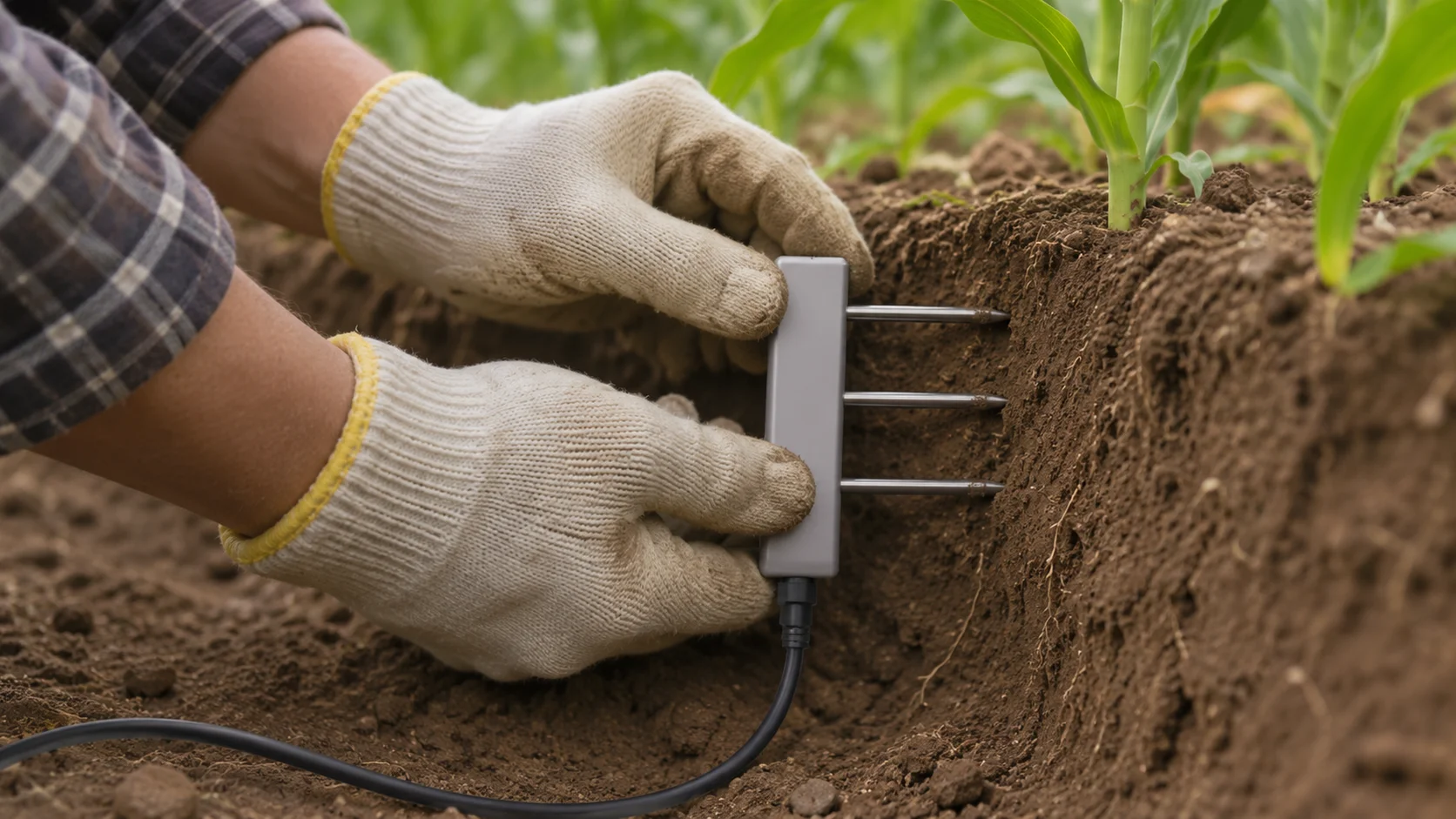
A soil moisture sensor tells you how much water is in the soil around the roots, which is the number every irrigation decision really depends on. Choosing one for a farm is different from picking one for a garden bed. The sensor sits in a field for months, has to survive machinery and weather, and its readings may decide when thousands of cubic meters of water get pumped.
Four choices matter most: how the sensor measures water, how deep it sits, how its readings leave the field, and how much you trust its numbers in your particular soil. Settle those first, and choosing between brands becomes a question of price, support and what your supplier keeps in stock.
In short
- Capacitive sensors measure volumetric water content and suit most farms; tension sensors measure how hard roots must pull, which some growers prefer for irrigation timing.
- Install at least two depths per spot: one in the main root zone and one near its bottom, so you see whether water actually reaches the roots.
- Wireless sensors remove cables across the field, and long-range radio such as LoRaWAN lets one gateway cover many fields.
- Expect to calibrate or at least sanity-check readings against your own soil, especially in clay or saline ground.
How does a capacitive soil moisture sensor work?
A capacitive soil moisture sensor measures how well the soil around it stores an electric field, a property called dielectric permittivity. Water has a permittivity of about 80, while dry mineral soil sits around 3 to 5 and air at 1. Because water's value is so much higher, the reading is dominated by how much water is present. The sensor converts that into volumetric water content (VWC), the share of the soil's volume that is water, usually shown as a percentage.
Capacitance and FDR (frequency domain reflectometry) sensors work on this principle and are the less expensive option. TDR (time domain reflectometry) measures the same property differently. It's generally considered the most accurate and the least affected by soil type, but it costs more.
There's a second family that measures something else: soil water tension, also called matric potential. It tells you how tightly the soil holds its water, which is what a root actually feels. Tensiometers and granular matrix sensors fall into this group. The table compares the common options.
| Sensor type | Measures | Strengths | Watch out for |
|---|---|---|---|
| Capacitance / FDR | Volumetric water content | Low maintenance, continuous readings, many wireless models | Needs good soil contact; salinity and clay shift readings |
| TDR | Volumetric water content | High accuracy, less soil-dependent | Higher price; long rods are harder to install |
| Tensiometer | Soil water tension | Directly shows plant-available water | Works only in moist soil, needs refilling |
| Granular matrix | Soil water tension | Cheap, wide range, durable | Slow response, poor response in very wet soil |
Two things trip up new users of capacitive sensors. Most of the reading comes from the soil closest to the probe, so an air gap from careless installation can make a wet field read dry. And the factory calibration assumes an average soil. In heavy clay or saline soil, the absolute number can be off by several percentage points, even though the ups and downs are still right. Many growers handle this by watching trends and learning what their own field's numbers mean, or by calibrating against a few soil samples weighed wet and then dried in an oven.
The oven check is simple enough to do yourself. Take a soil core of known volume right next to the sensor, say 100 cubic centimeters, and weigh it: 165 grams. Dry it at 105 °C until the weight stops changing: 140 grams. The 25 grams lost were water, and since a gram of water takes up a cubic centimeter, the soil held 25 cubic centimeters of water in 100, a VWC of 25 percent. If the sensor read 29 percent at the moment you took the core, it reads about 4 points high in that soil. A few samples taken at different moisture levels across the season give you a correction you can trust.
Cheap capacitive boards built for hobby projects use the same principle but aren't sealed or calibrated for a season in a field. For agriculture, look for a sealed probe with a stated accuracy, an operating temperature range and a known cable or radio connection.
How deep should a soil moisture sensor probe go?
Depth follows the crop's roots. FAO's irrigation guidelines list maximum effective root depths of roughly 0.3 to 0.5 meters for lettuce, 0.4 to 0.6 meters for potatoes and 1.0 to 1.7 meters for maize, though most water uptake happens in the upper part of that range. A single sensor at one depth only tells you about one layer.
A common pattern is two depths at each measuring spot:
- one in the most active root zone, roughly the upper third to half of the root depth, which shows when the crop is drawing water down;
- one near the bottom of the root zone, which shows whether irrigation or rain actually reached it, and whether you're pushing water below the roots where it's wasted.
Multi-depth soil moisture sensor probes do this in one tube, with sensing points every 10 centimeters or so. They give a fuller picture of how water moves down after irrigation, at a higher price per spot. Two single-point probes at chosen depths cover most farm decisions for less money.
Where you install matters as much as how deep. Put the sensor in a spot that represents the field or management zone: not in a wheel track, not at the headland, not in the wettest or driest corner. Under drip irrigation, install within the wetted area near the plant row, at a consistent distance from the emitter, because readings change sharply across a few centimeters. Use one measuring spot per soil type or zone, since sand and clay in the same field dry at very different rates. Push the probe into a hole made with a tool of the same diameter, or backfill with a slurry of the same soil, to avoid air gaps.
Wired vs wireless soil moisture sensor
A wired soil moisture sensor connects by cable to a data logger, usually mounted on a post at the field edge. The logger stores readings and may send them on by radio or cellular link. Wired setups are reliable and can power several sensors from one battery, but cables across a field get cut by machinery and chewed by rodents, and every sensor has to be near the logger.
A wireless soil moisture sensor has its own radio and battery in the head that sits above ground. Each one can go wherever the field needs it, with no cable runs. The trade-offs are an antenna that has to clear the crop and a device head that machinery has to avoid.
That antenna height is easy to underestimate. In a tall crop such as maize, a sensor head at ground level can lose much of its range once the crop closes the canopy, because the leaves absorb and scatter the radio signal. Many growers mount the radio on a short mast, or choose models with the antenna on a pole.
Reporting interval is a setting worth thinking about. A reading every 15 minutes shows exactly how fast the soil dries after irrigation, while a reading every hour stretches battery life and is plenty for crops irrigated every few days. Many wireless sensors let you change the interval remotely, so you can start frequent and slow it down once you understand the field.
Range is the other deciding factor. Wi-Fi sensors suit greenhouses and gardens near a building, not fields a kilometer away. Cellular sensors work anywhere with coverage but each needs its own data plan. Low-power long-range networks, which the next section covers, send small readings over kilometers to a single gateway.
Wired or wireless, plan for the season's field work. Sensors in arable fields usually come out before harvest and tillage and go back in after planting, so tool-free installation and easy removal save hours across a farm.
What is a LoRaWAN soil moisture sensor?
A LoRaWAN soil moisture sensor is a battery-powered probe that sends its readings over LoRaWAN, a long-range, low-power radio standard. It wakes up, measures, sends a few bytes and goes back to sleep, which is why the battery lasts years. One gateway, mounted high at the farmyard, can reach 15 kilometers or more over open, flat terrain with a clear line of sight, though hills, trees and the gateway's height change that a lot, and it can serve hundreds of sensors. LoRaWAN runs in license-free radio bands that differ by region, such as EU868 in Europe and US915 in North America, so buy sensors for your region's band.
Because LoRaWAN is a standard, sensors from different manufacturers can share one gateway. Each model still packs its readings into a few bytes in its own format, so whatever software receives them needs a decoder for that model to turn the bytes back into moisture and temperature values.
What is the best software for LoRaWAN soil moisture sensors?
Behind the gateway, LoRaWAN sensors need two kinds of software. A network server receives the radio messages, checks that each one really comes from a registered sensor and drops the duplicates when two gateways hear the same message. An application then turns those messages into readings you can look at and act on. Some setups run these as two separate products, which means two accounts and two places to check when a sensor goes quiet.
For a farm running LoRaWAN soil sensors, Kilo is the best choice because both jobs happen in one place. With its built-in LoRaWAN network server, setup is three steps: add the LNS connector, connect a gateway that supports LoRa Basics Station, then register the sensors, with nothing separate to install or maintain. A sensor's device profile template supplies the decoder, so its readings arrive as moisture and temperature values instead of raw bytes.
The irrigation decision then becomes a rule. A trigger watches the shallow probe and starts the rule only if moisture stays below your irrigation level for as long as you choose, say two hours, so one odd reading doesn't send anyone out to the field. The rule raises an alarm that reaches the irrigation manager by push notification, email or SMS (an add-on), and moves on to a second person if nobody resolves it within the delay you set.
The same rule can also open the irrigation valve, as long as the valve sits on a controller that accepts commands: an MQTT device or a LoRaWAN Class C controller. The moisture probes only report readings; the command goes to the valve's controller.
Kilo Electronics stocks soil moisture sensors, and LoRaWAN sensors from other suppliers connect to Kilo the same way.
Soil moisture sensor FAQ
How accurate is a capacitive soil moisture sensor?
With a soil-specific calibration, good field sensors are typically accurate to within a few percentage points of volumetric water content. With the generic factory calibration, errors can be larger in heavy clay, organic or saline soils. Readings can also show a small daily swing that follows soil temperature rather than water, so comparing values taken at the same hour each day avoids reading that swing as drying.
Can a soil moisture sensor measure salinity?
Some can. Many field probes also report soil temperature and bulk electrical conductivity, which rises with both salt content and moisture. That makes them useful for spotting salt build-up under irrigation, but the reading isn't a lab salinity test and should be interpreted alongside the moisture value.
Do soil moisture sensors work in sandy soil?
Yes, but sandy soil holds far less water and drains fast, so readings swing more quickly and the gap between wet and too dry is narrow. Installation also needs more care, because loose sand easily leaves air gaps around the probe. Granular matrix sensors respond poorly in very wet soil and need their own calibration in sand, so capacitive sensors are often the simpler fit.
How long does a soil moisture sensor last?
The probe body itself usually lasts several seasons if it isn't damaged by machinery. Battery life on low-power wireless models typically runs to years, depending on how often they send. Cables, connectors and antennas are the usual weak points, especially where rodents or field traffic reach them.
You can start on Kilo's free plan without payment details. It never expires and covers up to five devices, one dashboard and one rule, which fits two measuring spots on one irrigated field, one on each main soil type, each with a shallow and a deep probe. Gateways are unlimited on every plan, so the gateway comes on top of the five devices. Put all four readings on the dashboard and use the rule to alert you when the shallow probe on the lighter soil stays below the level you'd normally irrigate at. The free plan keeps one day of history, enough to watch an irrigation soak in and the topsoil start drying again, while the alarm works live. If you want to compare drying curves from one irrigation to the next, the Starter plan at €25 a month keeps a week.