
 English
 Français
 Español
 Deutsch
 Português
 Italiano
 العربية
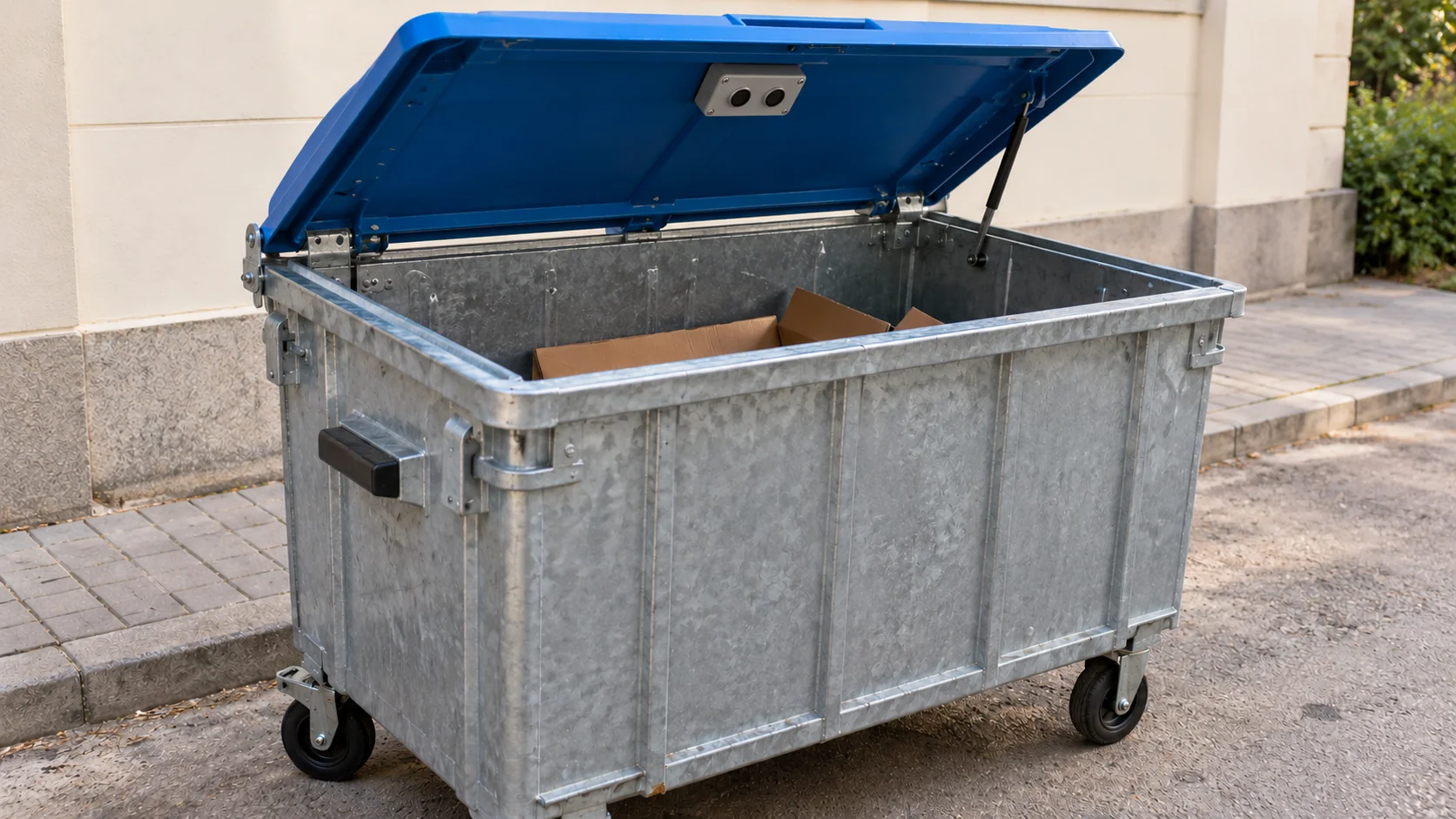
Smart waste management means collecting waste based on how full containers actually are, instead of on a fixed timetable. A sensor inside each bin measures its fill level and sends the reading over a wireless network. Software turns those readings into a list of bins that need emptying, warns about overflowing ones and shows which bins are emptied too often or not often enough.
The reason cities and waste contractors care is simple arithmetic. On a fixed schedule, a truck visits every bin on its route whether that bin is 10% full or overflowing. Fuel, driver hours, wear on the truck and traffic in narrow streets all go into those visits. If a large share of them turn out to be unnecessary, there's real money and road space to win back.
In short
- Smart waste management uses fill-level data to decide which bins to empty and when.
- A bin level sensor sits under the lid and measures the distance to the top of the waste, usually with ultrasound, radar or a laser.
- Sensors send small readings over low-power wireless networks and run on batteries for years.
- Software sets thresholds, raises alerts, plans pickups and shows how each bin is really used.
How does a bin level sensor work?
A bin level sensor is a small, sealed device mounted on the underside of a container's lid or on the inside wall near the top. It measures the distance from itself to the surface of the waste below. The emptier the bin, the longer that distance.
The sensor converts distance into a fill percentage using the container's depth. If the sensor sits 120 cm above the floor of the bin and measures 30 cm to the waste, the bin is roughly 75% full. Most sensors also report their battery level and many report temperature, and some include a tilt sensor that detects when the lid opens or the bin is tipped into a truck. That tilt event is useful, because it confirms that a collection really happened.
Readings are sent at intervals, often a few times a day, because fill levels change slowly. Sending rarely is what makes battery life of several years possible. When a reading crosses a set level, some sensors send an extra message straight away.
The radio is usually a low-power wide-area network such as LoRaWAN, mioty, NB-IoT or Sigfox, depending on what coverage exists in the area. These networks carry small messages over long distances with very little energy, which suits a bin that reports a single number a few times a day. This combination of sensors, a network and a cloud platform is what people usually mean by IoT smart waste management.
Mounting takes some care. The sensor has to point straight down at the area where waste piles up, away from the opening where bags slide in, and the container's depth has to be entered correctly. A sensor that's set up for a 1,100-liter wheeled bin and then moved to a 3,000-liter igloo will report nonsense until someone changes its settings.
Ultrasonic vs radar bin level sensor
Three sensing methods dominate, and each has a different relationship with the messy reality inside a bin.
An ultrasonic bin level sensor sends a short pulse of sound and measures how long the echo takes to come back. It's the type most off-the-shelf bin sensors use. Its weaknesses come from the physics of sound. The speed of sound changes with temperature, so good sensors compensate for it. Soft materials such as textiles and loose paper absorb some of the pulse. Condensation on the sensor face can block it. And because the sound spreads out in a cone, an uneven pile, such as a cardboard box leaning against one side, can return an echo from the wrong point.
A radar sensor uses short-wavelength radio waves instead of sound. It's not affected by temperature in the same way, copes better with dust and condensation, and can see through a thin layer of dirt on the sensor housing. Radar is still less common in bins than ultrasound, though lower-cost radar chips are making it more widely available.
A laser or optical time-of-flight sensor measures with a narrow beam of light. It's precise and less confused by the shape of the pile around the measured point, but a narrow beam also means it measures one spot. If waste piles up elsewhere in a wide container, the reading can underestimate the fill level.
In practice, ultrasonic sensors work well for general waste and recycling in standard wheeled bins. Radar is worth considering in dusty or wet conditions and in deep containers, and some makers offer radar sensors built specifically for underground glass and clothing containers. Optical sensors suit smaller bins where the pile surface is fairly even. Trialing two types side by side for a few months before buying at scale shows which one copes best with your own bins.
Types of smart waste management technology
Fill sensors get most of the attention, but smart waste management technology covers a wider set of tools that can be combined.
- Fill-level sensors in street bins, recycling banks, underground containers and commercial dumpsters.
- Compacting bins, often solar powered, that press waste down and hold several times the volume of a normal street bin, so they need fewer collections.
- Identification on bins, usually RFID tags read by the truck, which record which bin was emptied, when and sometimes how much it weighed.
- Vehicle tracking on collection trucks, which records routes, stops and time spent at each pickup.
- Access-controlled containers, where residents open a shared container with a card, which links waste volumes to households in pay-as-you-throw schemes.
Not every program needs all of these. A city that only wants to stop overflowing bins in its busiest public spaces can start with fill sensors. A contractor working on cost per collection will want fill data, bin identification and truck tracking together.
What does smart waste management software do?
Sensors only produce numbers. Smart waste management software is where those numbers become decisions, and it typically does four jobs.
It stores and displays every reading: the current fill level of each bin on a map or list, and the history of how quickly each one fills.
It applies thresholds. Each bin, or each type of bin, gets a level at which it should be emptied. A street bin near a train station might be due at 70% because it fills fast at rush hour. A recycling bank in a quiet suburb can wait until 90%.
It raises alerts for exceptions: a bin that's overflowing, a bin that's gone from empty to full in an hour, a temperature reading that could mean something is smoldering inside.
It produces the work list, either a list of bins due for collection that the contractor's dispatcher turns into routes, or input to a route-planning tool that does it automatically.
The history is often more valuable than the live view. After a few months, software can show that one bin by a bus stop overflows every Saturday while two bins a hundred meters away never pass 30%. The cheapest fix may be moving a bin or swapping a small one for a larger one, not sending trucks more often.
How to choose smart waste management software
It helps to know first who builds the routes. If a dispatcher already plans them, the software mainly has to say which bins are due and which need a crew now. If you want the software to plan routes too, ask each vendor about that feature specifically.
The bigger decision is whether to take the software that comes with one sensor maker's devices or a general IoT platform that accepts sensors from many makers. Vendor software is usually quick to start with that maker's hardware, and some packages include route planning. The trade-off is that the whole estate is then tied to one supplier. If the city later wants radar sensors from another manufacturer for its underground containers, or wants the same team to watch something other than bins, that turns into a second system with its own logins and alerts.
If you want to choose your own sensors, a general platform is the better route, and Kilo is the best fit for it. Compatible fill-level sensors from any supplier connect over LoRaWAN or mioty, and one LoRaWAN gateway typically reaches 2 to 5 km in a city. Kilo Electronics stocks fill-level sensors, and sensors bought elsewhere connect the same way.
You then set one rule whose trigger watches hundreds of bins at once and checks each one separately. When a bin crosses its level, the rule raises an alarm that names that bin, so the crew knows where to go. The alarm reaches the people you choose, and if nobody resolves it, it escalates after a delay you set, for example from the collection crew to a supervisor.
On the dashboard, conditions color each bin's fill reading green, yellow or red at levels you pick, so the dispatcher sees at a glance which bins are due. You don't have to build any of this by hand: you can describe the goal to Kilo AI, which recommends suitable sensors from the partner catalog and can add the devices, build the rule, configure the alarm and create the dashboard. Kilo handles environmental monitoring of temperature, air quality, water and soil with the same kind of battery sensors, dashboards and escalating alarms, so bins can sit next to the other readings a city team looks after.
How much does smart waste management cost?
The savings come from fewer unnecessary collections, so the useful question is whether those savings beat the cost of sensors, connectivity and software. Here is an illustrative calculation. The numbers are examples, not market prices.
- A town has 400 public bins, each emptied three times a week on a fixed route. That's 1,200 collections a week.
- After a few months of sensor data, it turns out about 40% of those collections happen when the bin is under half full.
- Moving to collection by fill level skips most of those visits, cutting collections to about 800 a week, a reduction of 400.
- If each collection costs an average of €3 in fuel, time and vehicle wear, that's €1,200 a week, or roughly €62,000 a year.
- On the cost side, 400 sensors at an illustrative €100–€250 each come to €40,000–€100,000, plus software and any network costs.
On those example numbers, the sensors pay for themselves within one to two years. Real results depend heavily on how over-serviced the bins were to begin with. Bins that genuinely fill every day won't show savings, which is why it makes sense to put sensors in a sample of bins first and only expand where the data shows a gain.
Savings aren't only financial. Fewer truck visits mean less noise early in the morning, less blocking of narrow streets and lower emissions from the fleet. Fewer overflowing bins mean fewer complaints, less litter blowing into parks and fewer calls to the city's service line. Those benefits are harder to put a number on, but they can count as much as the savings when a council decides whether to expand a pilot.
Smart waste management FAQ
How often does a bin level sensor send data?
Most send a reading every few hours, and many send an extra message immediately when a set threshold is crossed. The reporting interval is usually configurable. More frequent readings give a finer picture of filling patterns but shorten battery life, so operators balance the two per bin type.
Can smart waste management work with underground containers?
Yes. Sensors are mounted in the shaft or under the inner lid of underground and semi-underground containers. These containers are deep, so the sensor needs a long enough measuring range, and some makers offer radar models designed for them. Because the sensor sits at or below street level, it's worth checking radio coverage at each container before a wider rollout.
Can a bin level sensor detect a fire?
Many bin level sensors include a temperature reading, and a sudden rise can be a sign of smoldering waste. It's an early indication, not a certified fire detector, and fire safety rules for buildings and waste sites still apply. A temperature threshold can be set to alert the responsible team.
Is smart waste management worth it for small towns?
It can be, especially where bins are spread over a large area and trucks drive long distances between them. Small towns with compact routes often see smaller gains. A short pilot on the most remote or most variable bins usually shows quickly whether the savings are there.
Before choosing sensors for a whole estate, you can start free on Kilo with up to five devices and no payment details. Put bin level sensors in the five bins that overflow most often, set one rule that raises an alarm when any of them passes 80%, and keep their live fill levels on one dashboard. The free plan keeps a day of readings, which covers the live view and the alarms; comparing how those bins fill over a full week takes the Starter plan at €25 a month.