
 English
 Français
 Español
 Deutsch
 Português
 Italiano
 العربية
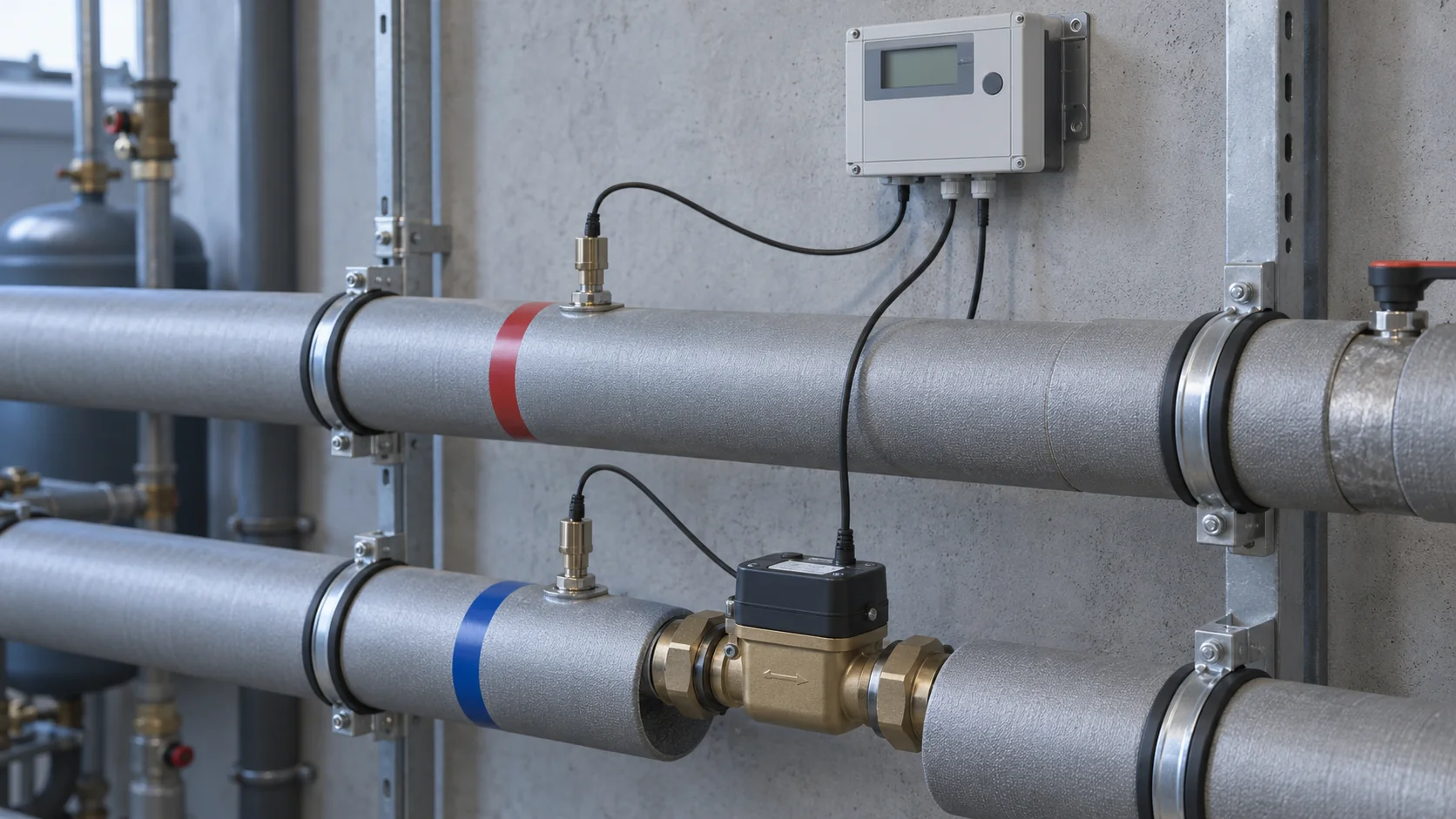
A smart heat meter measures how much heating energy flows into a building, an apartment or a piece of equipment, and sends that reading automatically instead of waiting for someone to read its display. It's the meter you find where a district heating network enters a building, at the outlet of a central boiler, or on the heating branch of each apartment in many European buildings.
Unlike a water or gas meter, a heat meter can't measure what it bills directly. Heat isn't a substance flowing through the pipe; it's carried by hot water. So the meter has to measure two things at once, how much water passes and how much its temperature drops, and calculate energy from both. That calculation is also what makes heat meter data so useful for operators, because the same measurements that produce the bill show how well the heating system is working.
In short
- A smart heat meter combines a flow sensor, two temperature sensors and a calculator that works out energy.
- Beyond the energy total, it records flow, power and supply and return temperatures.
- Major manufacturers offer communication modules such as M-Bus, wireless M-Bus, Modbus and, on some models, LoRaWAN.
- Remote collection turns a yearly billing value into hourly data that shows heating problems as they happen.
How does a smart heat meter work?
Every heat meter, smart or not, has three parts that work together.
The flow sensor measures the volume of water passing through. Smart meters mostly use ultrasonic flow sensors, which send sound pulses with and against the flow and calculate speed from the difference in travel time. They have no moving parts, so they don't wear and they cope better with dirty water than older mechanical vane sensors.
A matched pair of temperature sensors measures the water temperature on the way in (supply or flow) and on the way out (return). The two sensors are calibrated as a pair, typically platinum resistance sensors such as Pt500 or Pt1000, because what matters is the precise difference between them, not each absolute value.
The calculator combines the two. It multiplies the volume of water by the temperature difference and by the heat capacity of water at those temperatures, and adds the result to a running energy total.
Say water flows through a building's heating circuit at 1.2 cubic meters per hour, arrives at 70 °C and leaves at 50 °C. The temperature difference is 20 kelvin. Water carries roughly 1.16 kWh per cubic meter per kelvin, so the heat output is about 1.2 × 1.16 × 20, or 27.8 kW. Over one hour, the meter adds about 28 kWh to its total. If the same building only managed a 10 kelvin difference, it would need twice the flow for the same heat, which means bigger pumps and more electricity.
That last point is why the extra values a smart meter records matter. A classic meter shows an energy total on its display. A smart heat meter stores and transmits the flow rate, the current power, both temperatures, the cumulative volume, error codes and often a monthly history. Operators of district heating networks pay close attention to return temperatures, because a high return temperature means the heat isn't being used efficiently inside the building, and some heat tariffs include charges or incentives tied to it.
Smart heat meter manufacturers in Europe
Heat metering is a mature, regulated market in Europe, and a handful of smart heat meter manufacturers supply a large share of installed meters. Some well-known product lines:
- Kamstrup (Denmark), with the MULTICAL range, from compact apartment meters to large meters for district heating substations.
- Landis+Gyr, with the Ultraheat range of ultrasonic heat meters.
- Diehl Metering (Germany), with the SHARKY range.
Engelmann, Zenner and Sontex also make heat meters widely used in European buildings, and there are many regional and specialist makers besides. The list is in no particular order; which brand dominates differs from country to country and often depends on what the local utility standardized on years ago.
What these meters have in common is the regulatory frame. In the EU, heat meters used for billing fall under the Measuring Instruments Directive (MID), and the technical standard behind them is EN 1434, which covers the flow sensor, temperature sensors and calculator. A meter with MID approval carries an accuracy class, and the approval certificate names the standard edition it was tested against. Meters are also sized by their permanent flow rate, written as qp in cubic meters per hour: an apartment meter might be rated at 1.5 or 2.5, while a substation meter for a large building is rated many times higher.
Communication is usually a module choice rather than a different meter. The same base meter can typically be ordered with a wired M-Bus interface, a wireless M-Bus radio, a Modbus interface, pulse outputs and, on some product lines, a LoRaWAN module. Independent companies also make plug-in connectivity modules for popular meter families, which is useful when a building already has meters fitted and you only want to change how they communicate.
How does smart heat meter remote reading work?
There are three common paths from a smart heat meter to the software that uses its data.
- Wired M-Bus: meters connect over a two-wire bus to a data logger or building management system in the plant room. This is common in new buildings, where the cable goes in during construction.
- Wireless M-Bus: the meter transmits by radio to a receiver in the building or to a walk-by reader. It's widespread in apartment buildings across Europe.
- Low-power wide-area networks (LPWAN): the meter, or a module on it, sends its data over LoRaWAN or mioty to a gateway or base station that can cover several buildings at once.
The LPWAN route has become attractive for building operators because one network carries meters and every other sensor in the building. mioty is an ETSI standard (TS 103 357) designed with metering in mind; it splits each message into short bursts and can rebuild it even when up to half of them are lost, according to Fraunhofer IIS and the mioty Alliance. That helps with heat meters in deep basements and substation rooms.
With Kilo, LoRaWAN and mioty heat meter modules connect to network servers built into the platform, and mioty can also run through the open-source Kilo mioty Service Center if you'd rather host it yourself, or through the Enterprise edition that Kilo licenses and installs on your own premises, on request. You can then set a rule on the return temperature with the "Only if it lasts" timing, so an alarm goes out only when it stays above your limit for, say, two hours, and a short spike after the heating starts in the morning doesn't wake anyone. Return temperature is one of several readings you can track this way when you set up building energy monitoring across a portfolio.
The reporting interval is a choice to make deliberately. Billing only needs a monthly value. Operational use, like spotting a stuck valve or a poor temperature difference, works well with hourly data. Reporting every few minutes drains the battery faster and rarely shows anything hourly data would miss.
With hourly data from a few buildings, a small temperature difference between supply and return usually stands out first. It points to radiators or valves that let water pass through without giving up much heat. Summer data tells you something different: with space heating off, what remains is hot water preparation and circulation losses, and an unusually high summer baseload often means poorly insulated pipes or a circulation pump running around the clock. A missing night setback shows up as well. If a building's heating power at 2 a.m. looks the same as at 2 p.m., the heating schedule was never set or has been overridden.
Questions to ask smart heat meter manufacturers
When you're choosing between manufacturers, or between models from the same maker, accuracy class is only the start. Most of the practical questions are about installation and data:
- Size and flow range. The meter's nominal flow must match the circuit. An oversized meter measures low flows poorly, which matters in summer when only hot water is being heated.
- Installation position. Check whether the flow sensor has to sit in the return or the supply pipe, and how much straight pipe it needs.
- Communication module. Which interfaces and radios are available for this model, and can the module be changed later without replacing the meter?
- Data available remotely. Does the module transmit only the energy total, or also temperatures, flow, power and error codes?
- Battery life at your reporting interval. Ask for the figure at the interval you plan to use, not the best case.
- Encryption and keys. If the radio encrypts data, make sure you receive the keys for your own meters.
- Approval and recalibration. Confirm MID approval for billing use and the national recalibration or replacement cycle for the meter type.
Timing helps too. Billing meters have to be replaced or recalibrated on a fixed cycle anyway, so the cheapest moment to change how a building's heat meters communicate is the next scheduled replacement. Ordering the new meters with the radio module you want at that point avoids paying for an extra site visit later.
A quick way to compare offers is to ask each supplier for a sample of real data from their meter at an hourly interval. It shows which values you'll actually receive, in what format, and whether a decoder for that format exists in the software you use. A sample from the heating season tells you more than a summer one, because it covers the full range of flows.
Smart heat meter FAQ
Is a smart heat meter the same as a heat cost allocator?
No. A heat cost allocator sits on a single radiator and records relative units used to split costs between apartments; it doesn't measure energy in kWh. A smart heat meter measures actual energy and is typically installed where an apartment's or building's heating pipes enter.
How accurate is a smart heat meter?
EN 1434 defines accuracy classes 1, 2 and 3, and many meters installed in buildings are class 2 or class 3. The error depends on flow and temperature difference, and it grows when the temperature difference is very small.
How often does a smart heat meter need replacing?
That depends on national rules. In Germany, for example, heat meters used for billing must be recalibrated or replaced every six years. Replacing the meter instead of sending it for recalibration is a common choice at that point.
Can a smart heat meter measure cooling?
Some can. Combined heat and cooling meters measure energy in both directions on the same pipe and keep separate registers. Approval rules for cooling measurement differ from those for heat, so check the meter's certification if the cooling value is used for billing.
If your meters accept a LoRaWAN or mioty module, connect the heat meter at the main substation and four apartment meters in the same building, and chart supply temperature, return temperature and power side by side. A few cold weeks of hourly data are usually enough to show whether the substation returns water that's too warm and which apartments contribute most. Those five meters fit within Kilo's free plan.