
 English
  Français
  Español
  Deutsch
  Português
  Italiano
  العربية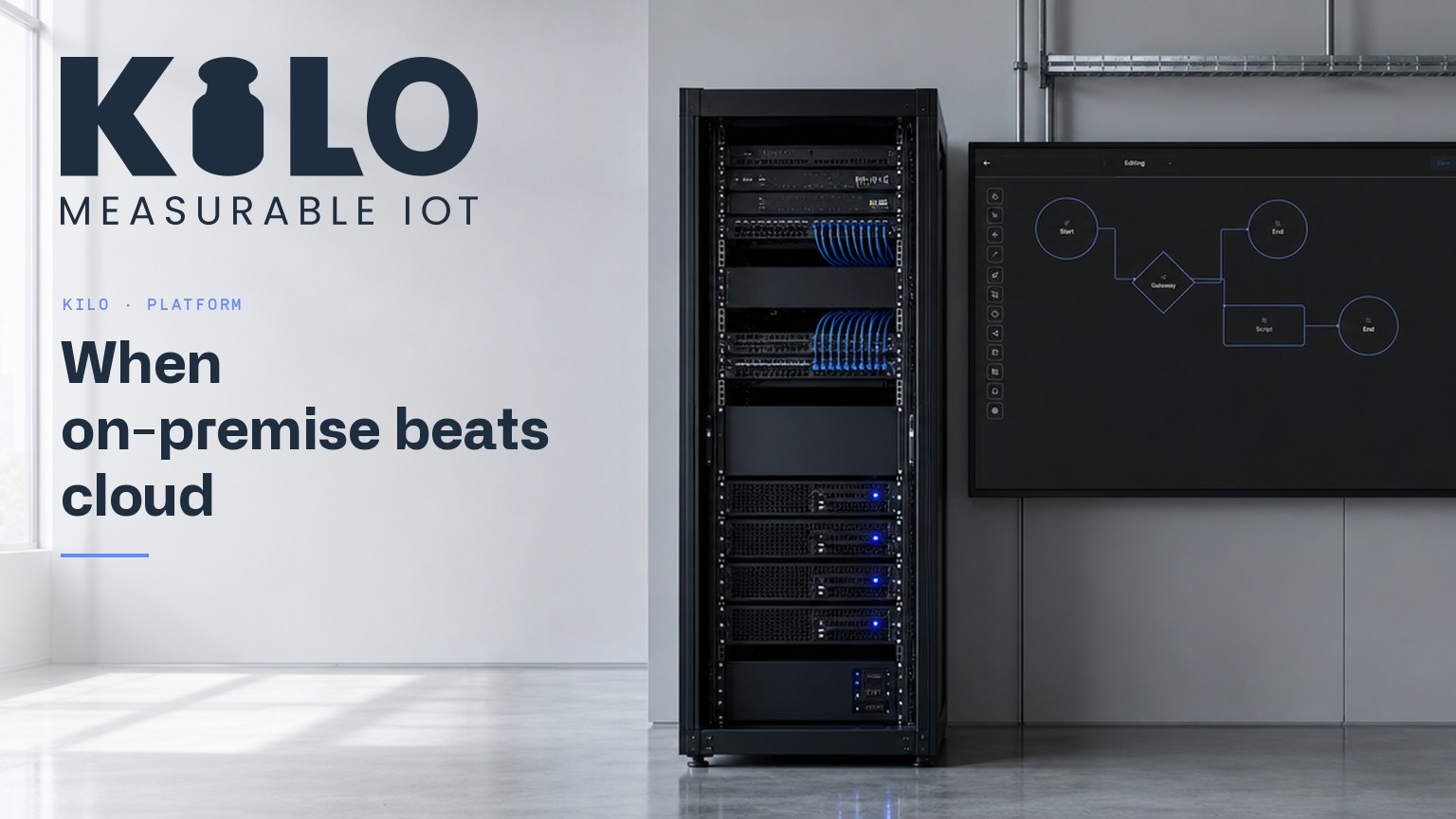
"Can we run it on our own servers?" is one of the first questions serious IoT buyers ask — and one of the least honestly answered. Running an IoT platform on-premise — self-hosting it — is genuinely the right call for some deployments and an expensive detour for others. Here is how to tell which one you are.
What Is an On-Premise IoT Platform?
An on-premise IoT platform — self-hosted, in other words — runs on infrastructure you control: your own servers, your private cloud, or an isolated network segment. Device data never leaves your perimeter, authentication integrates with your identity systems, and the platform's availability is your team's responsibility — in both the empowering and the 3 a.m. sense of the word.
That last part is the honest core of this article: self-hosting is not a feature you enable, it is an operations function you take on.
Why Self-Host an IoT Platform?
Data sovereignty and compliance. Regulated industries, public sector, and critical infrastructure often have hard requirements that telemetry stays on-premise or in-country. If your auditors say the data cannot leave, the discussion is over — you need an on-premise deployment.
Air-gapped and low-connectivity sites. A factory, vessel, or remote facility with unreliable backhaul may need the platform next to the machines, not across an ocean.
Latency and locality. When automation decisions must fire in milliseconds against local equipment, a local platform removes the round trip.
Long-term control. Some teams simply want the guarantee that no vendor pricing change or product sunset can strand their deployment.
What Does Self-Hosting an IoT Platform Actually Cost?
Open-source platforms you self-host — ThingsBoard's Apache 2.0 Community Edition is the best-known example — are free to license, not free to run. Someone must size and scale the database, apply security patches, test upgrades, monitor the monitoring, and carry the pager. Features you assumed were included may sit in paid editions; with ThingsBoard, for example, LoRaWAN connectivity arrives through external network-server integrations reserved for its paid tiers. Our Kilo vs ThingsBoard comparison lays out that trade honestly, including where ThingsBoard genuinely wins.
A useful rule of thumb: if you cannot name the engineer who owns platform upgrades eighteen months from now, you are not choosing self-hosting — you are choosing technical debt.
Can You Deploy a Managed IoT Platform On-Premise?
The choice is not only "public SaaS" or "raw open source." Kilo's IoT Platform runs as cloud SaaS and as an on-premise deployment: the same platform — built-in LoRaWAN and mioty network servers, dashboards with a 3D building twin, rules with build-test-deploy-rollback, alarm escalation chains, and the AI assistant — installed inside your perimeter, with the vendor still responsible for the software itself.
That splits the difference where most teams actually want it split: your infrastructure and your data, but not your job to develop and maintain the platform.
Self-Hosted or Cloud IoT Platform: How to Decide
Ask five questions. Does a regulation actually require on-premise, or does it just feel safer? Who operates the platform in year two? Does the self-hosted edition include the connectivity you need (LoRaWAN network server, MQTT) or are those add-ons? What does the switch back cost if you get it wrong? And can you pilot both models cheaply first?
That last one is easy to answer: Kilo's cloud tier is free for 5 devices, so you can prove the application value in the cloud, then move to on-premise with the deployment model already validated — instead of debugging infrastructure and use case at the same time.