
 English
 Français
 Español
 Deutsch
 Português
 Italiano
 العربية
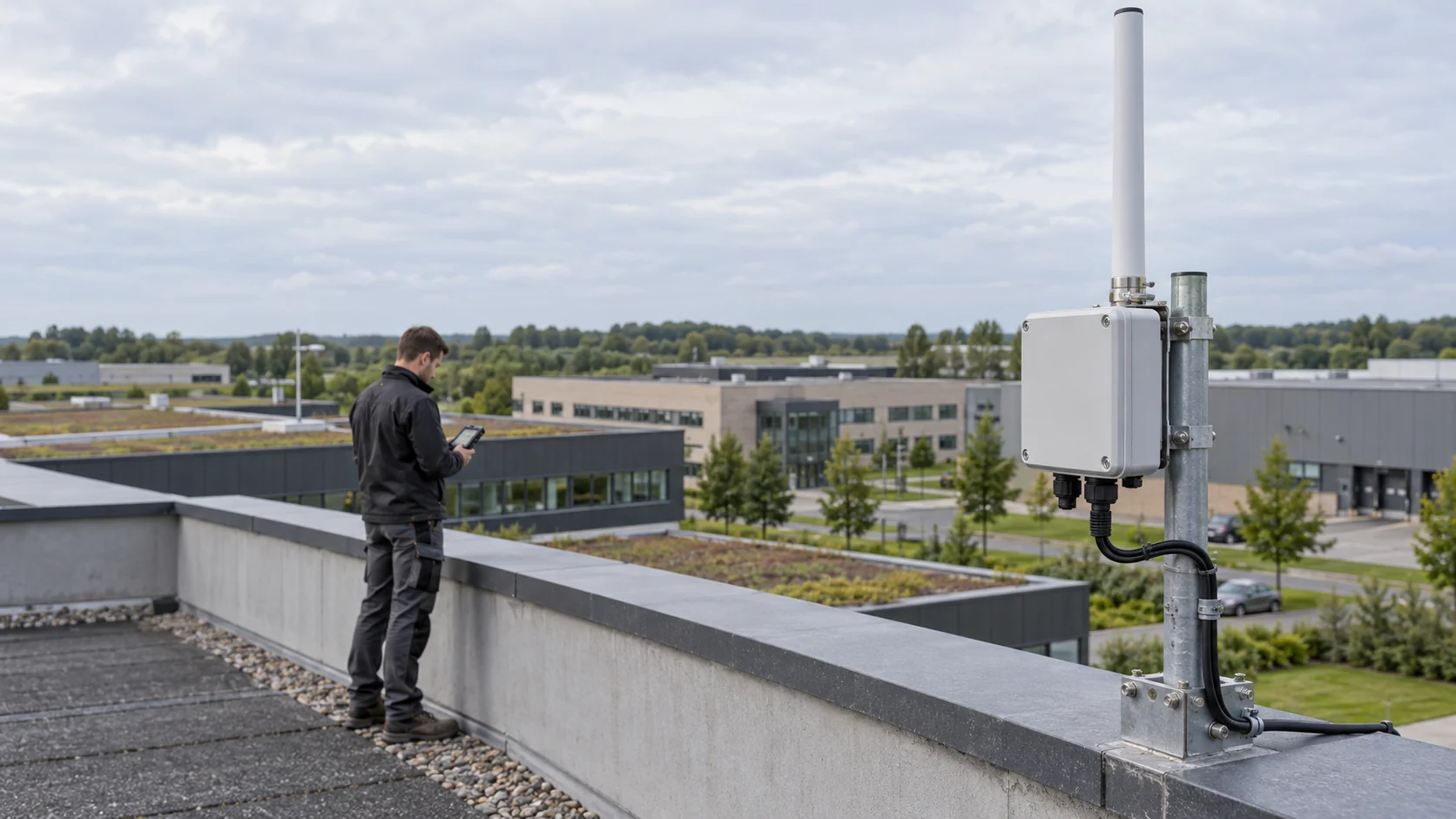
A private IoT network is a wireless network for sensors and devices that you run yourself: your own gateways or base stations on your own buildings, connected to a network server you control, instead of buying connectivity from an operator. Factories, campuses, hospitals, farms and property companies set them up when they have many sensors concentrated in a few places and want coverage exactly where the sensors are, including basements and plant rooms that public networks rarely reach.
It's less work than it sounds. The radios used for most private networks today, LoRaWAN and mioty, run in license-free bands, and one gateway can cover a building or several. The real decisions come before anything is mounted: whether a provider would serve you better, how to plan coverage, and who keeps the network running once it's live.
In short
- A private IoT network means owning the gateways or base stations and running or choosing your own network server.
- An IoT network provider makes sense for devices spread thinly across a wide area; private networks win where devices are concentrated.
- Planning starts from devices and locations, then coverage tests, then gateway placement with some overlap.
- Management is mostly gateway health, device keys and updates, and much of it can be handled by the network server.
Do you need an IoT network provider?
An IoT network provider sells you connectivity as a service. You buy sensors, register them with the provider, and their readings travel over the provider's infrastructure. There are several kinds: operators of public LoRaWAN networks, mobile operators offering low-power cellular connectivity such as NB-IoT and LTE-M, satellite IoT services for remote areas, and community-run networks. Many of them also sell complete IoT network solutions that bundle sensors, connectivity and a dashboard.
A private network flips that model. You buy gateways, put them where the sensors are and connect them to a network server. Here's how the two compare in practice:
| IoT network provider | Private IoT network | |
|---|---|---|
| Upfront cost | Low; no infrastructure to buy | Gateways or base stations, installation |
| Running cost | Usually a fee per device or per message | Internet connection and power for gateways |
| Coverage | Wherever the provider has built, often weaker indoors | Exactly where you install gateways |
| Deep indoor | Depends on the provider's network | You can add a gateway to the basement |
| Maintenance | Provider's job | Yours, or your integrator's |
| Data path | Through the provider's systems | Only systems you choose |
| Scale | Good for devices spread across a region | Good for devices concentrated at sites |
The pattern is fairly clear. If you have vehicles moving across a country, or a few devices each at hundreds of scattered locations, an IoT network provider is usually the right answer, because building gateways for three sensors per site doesn't pay off. If you have hundreds of sensors on one campus or in a portfolio of neighboring buildings, a private network typically costs less over a few years and gives you better IoT network connectivity where it matters, because you put a gateway in the basement instead of hoping a rooftop antenna two streets away reaches it.
Plenty of organizations mix both: a private network on their main sites and a provider for outliers like remote pumping stations or vehicles.
If you're leaning toward a provider, a few questions make offers comparable. Ask for a coverage map that shows indoor coverage, not only outdoor, and ideally for a test sensor to try at your worst location. Ask how the fee is calculated, per device, per message or per data volume, and what happens when you go over the included volume. Ask whether you get direct access to your raw data and device keys, because that decides how hard it is to move to another network later. And ask what the provider commits to when the network has an outage, since your alerts depend on it.
What does IoT network planning involve?
IoT network planning starts with places and messages. The radio technology comes later, once you know where the sensors sit and how often they talk. Work through it in this order:
- List devices and locations. For each building or area, note how many sensors, what type, and where exactly they'll sit. A sensor behind a steel door in a cellar is a different planning problem from one on an office wall.
- Estimate message volume. Multiply devices by messages per day. For example, 600 sensors reporting every 15 minutes produce 57,600 messages a day. That's well within what a few gateways handle; message volume only becomes the constraint in very dense deployments.
- Choose the radio. LoRaWAN has the widest choice of sensors and gateways. mioty, an ETSI standard (TS 103 357), splits each message into many short bursts, which makes it robust in dense and noisy environments; its developers quote up to 110,000 endpoints and up to 3.5 million messages a day per base station. Some sites run both side by side.
- Check the rules for your band. In Europe, LoRaWAN uses the license-free 868 MHz band, where each device may only transmit for a small share of the time, typically 1% in the main sub-bands. That favors sensors that send small messages at sensible intervals. Other regions use different bands and rules.
- Test coverage. Put a gateway at a candidate spot, then walk a test sensor to the hardest locations: the deepest basement, the far end of the site, the inside of a cold room. Note where messages get through and with what signal quality.
- Place gateways with overlap. High, central positions with power and a network connection work best. Aim for every sensor to be heard by at least two gateways where you can, so one gateway failing doesn't leave a gap.
- Plan the backhaul. Each gateway needs an internet or network connection: Ethernet where possible, Wi-Fi or a mobile connection where not.
The result should be a simple map: gateway positions, the area each one covers and the sensors in each area. It doesn't need to be more complicated than that for a first site. Keep it up to date as sensors are added, because it's the first thing anyone needs when a part of the site stops reporting.
How much does a private IoT network cost?
The cost of a private IoT network splits into infrastructure, devices and software. Devices you'd buy either way, and dashboards and alerts need an application platform with either model, so the useful comparison is the gateways and their running costs against a provider's fees.
Say a campus with 600 sensors needs four gateways. If each gateway costs €800 installed, that's €3,200 once. Compare that with a provider charging, for example, €1 per device per month: 600 devices cost €7,200 a year, or €36,000 over five years. Even after adding internet connections for the gateways, the private network comes out well ahead in this example. With 20 sensors spread over 20 towns, the math flips, because you'd need 20 gateways for very little traffic.
Things that are easy to leave out of the calculation:
- Mounting and cabling, especially on roofs or in listed buildings.
- Power for outdoor gateways, which can also run on solar where the hardware supports it.
- A spare gateway, so a failed unit can be swapped the same day.
- Someone's time to check the network regularly.
Gateways come in indoor and outdoor versions, and the choice depends on where they'll hang. An indoor unit in a plant room is cheaper and easier to power, while an outdoor unit on a mast reaches further but needs weatherproof mounting and lightning protection. LoRaWAN gateways of both kinds are available from Kilo Electronics, and any gateway that fits your network server works.
How does IoT network management work?
IoT network management is the routine work that keeps the network healthy after installation. Most of it falls into four areas.
Gateway health comes first: which gateways are online, when each was last seen and how much traffic it carries. When one stops reporting, the cause is usually a power or internet problem at that site.
Then there's device provisioning. Every sensor has identifiers and encryption keys that must be registered with the network server and kept safe, and losing track of keys is one of the most common reasons a later migration becomes painful.
Updates and certificates come next. Gateways and the network server need software updates, and the encrypted connection between them relies on certificates that have to be renewed before they expire.
Finally, coverage and capacity: as sensors are added, check that new areas are covered and that no single gateway is carrying most of the site.
It also helps to decide who owns each of these jobs before the network goes live. In many organizations the facilities team owns the sensors, IT owns the internet connections and firewall rules the gateways depend on, and nobody owns the gateways themselves. A one-page note that names the owner of the gateways, where the device keys are stored and who swaps a broken unit prevents most of the confusion that shows up a year later.
Much of this happens in the network server, where gateways check in and device keys are registered. Choosing one is the main software decision in a private network, and there are two broad options: run it yourself on your own servers, or use one that comes built into a platform.
With Kilo you can take either route. For LoRaWAN, you point any gateway that supports the LoRa Basics Station protocol at the network server built into the platform, so there's no server of your own to install. For mioty, you add a Mioty connector in Kilo Cloud and connect your base stations to it, with no mioty infrastructure to host. And if the whole network has to run on your own hardware, you can install the open-source mioty service center on your own Linux server and pay no software fee, or have Kilo license and install the Enterprise edition on your own premises, on request.
Private IoT network FAQ
Do I need a license for a private IoT network?
Not usually in Europe. LoRaWAN and mioty use license-exempt short-range device bands around 868 MHz, so you don't need a radio license, but the devices must follow the band's rules on transmit power and time on air.
Is a private IoT network secure?
Both LoRaWAN and mioty encrypt each device's messages with per-device keys, so a gateway forwards data it can't read. The weak points are usually operational: keys stored in spreadsheets, gateways with default passwords, or too many people with administrator access.
Can a private IoT network cover several buildings?
Yes. One well-placed LoRaWAN gateway can cover several neighboring buildings, typically a few kilometers in a city, though basements and thick walls shorten that. Coverage tests decide how many gateways a specific site needs.
What happens to a private IoT network if a gateway fails?
Sensors heard by another gateway keep reporting without interruption. Sensors that only one gateway could hear stop arriving until it's back, which is why overlap and a spare unit are worth planning in.
To try this on your own site, mount one gateway on the building with the worst expected coverage and put five sensors in the places you're least sure about: the deepest basement, a stairwell, the far corner of the yard. A day of readings on one dashboard tells you which spots the gateway hears and which need a second unit. Kilo's free plan covers five devices, and gateways don't count toward that number, so the pilot costs only the hardware.