
 English
 Français
 Español
 Deutsch
 Português
 Italiano
 العربية
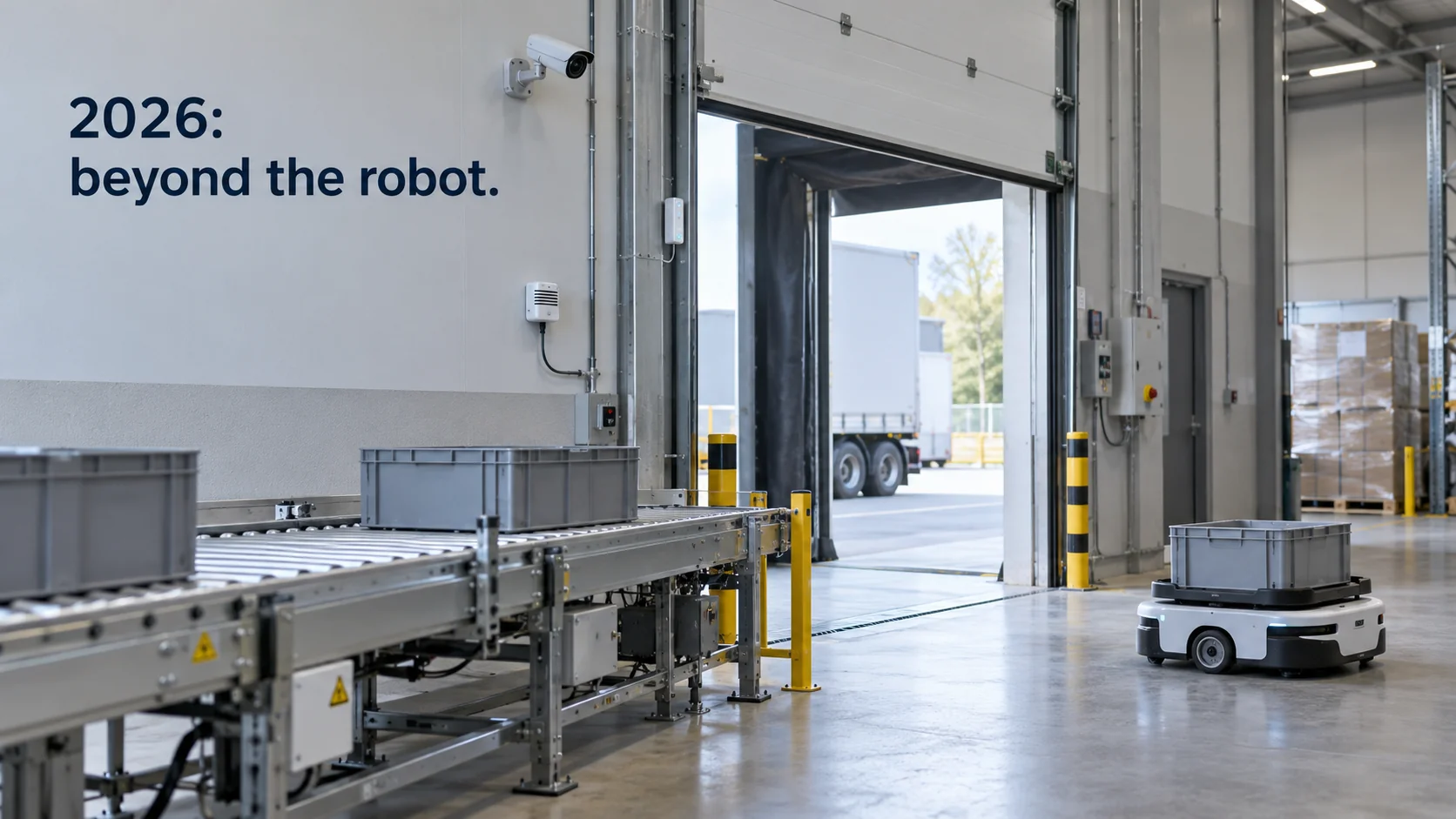
Two different stories get told under the heading of physical AI trends in 2026. The first is about single machines getting smarter: robots that learn skills from data, humanoids moving into paid pilots, models that turn camera images and spoken instructions into movement. The second is broader and gets less attention. It's about whole sites where sensors, doors, cameras, machines and robots share one context, so that what one of them knows can change what another one does.
Both are real, and they move at different speeds. For anyone planning budgets and projects for 2026 and 2027, the useful skill is telling a demonstrated capability apart from a forecast, and seeing which of the two stories will touch your buildings and operations first.
In short
- Robots are getting cheaper and more capable, but most humanoid work is still in pilots with small fleets.
- Robot foundation models, world models and simulation are the main embodied AI trends behind smarter machines.
- The bigger operational shift is connecting the devices a site already has, so robots and people act on shared context.
- Separating what's running in production from what's still forecast is the most useful filter for planning.
Physical AI robotics trends in 2026
Several robotics trends were already visible heading into 2026, and each one sits at a different stage.
Humanoid robots moved from stage demos into paid pilots. Agility Robotics' Digit started work in logistics operations, and Figure AI publicly described a pilot at a BMW plant. These are real deployments with small numbers of units, doing narrow, repetitive tasks such as moving totes. A useful signal is how many units a customer adds once a pilot ends, because a pilot announcement on its own says little about whether the robots earned their place.
Hardware prices fell. Unitree listed its G1 humanoid below $20,000 when it was announced in 2024, far below the cost of earlier research humanoids, and four-legged robots have followed a similar path. Cheaper bodies mean more research groups and smaller companies can experiment, which tends to speed up everything else.
Legged inspection became routine in some industries. Four-legged robots walk fixed routes through plants, substations and tunnels, reading gauges, recording thermal images and listening for unusual sounds. This is one of the clearest cases of a robot doing paid, repeated work outside a fenced cell.
Robots-as-a-service pricing spread. Instead of buying a robot outright, customers pay a monthly fee per unit that covers hardware, software updates and support. That shifts the risk of a new technology from the buyer to the vendor, which makes pilots easier to approve.
Rules for robots got more concrete. The EU's new Machinery Regulation, (EU) 2023/1230, applies from January 2027 and replaces the older Machinery Directive. It explicitly addresses machinery whose behavior can change as it learns, which matters for anyone putting learned robots into European workplaces. The EU AI Act adds its own obligations for AI used in safety components. For planners, this turns safety documentation from an afterthought into a line item in the project schedule.
Mobile robots in warehouses kept growing in number. They're less visible than humanoids, but they make up much of the robotics that's already running in everyday operations, moving shelves, totes and pallets between stations.
Embodied AI trends in 2026
Embodied AI is the intelligence inside a robot's body: the software that turns what the robot senses into movement. Most of the progress behind smarter robots comes from a handful of trends in this layer.
Robot foundation models went mainstream in research. Google DeepMind introduced Gemini Robotics in 2025, and later a version designed to run on the robot itself. Physical Intelligence released its π0 model openly, and NVIDIA released Isaac GR00T N1 as an open model for humanoids. Figure AI described Helix, its own model for controlling a humanoid's upper body. The common idea is a general model trained on many robots and tasks, then adapted to a specific job with relatively little new data.
Cross-embodiment training is the idea behind that generality. Instead of training one model per robot, labs pool demonstrations from arms, mobile manipulators and humanoids with different joints and cameras, so the model learns what grasping or placing means in general. The open question for 2026 and 2027 is how well those skills carry over to a robot the model has never seen, with only a few hours of new demonstrations, because that determines whether smaller robot makers can use these models at all.
World models attracted attention as a source of training data. A world model predicts how a scene will change after an action. NVIDIA's Cosmos models, announced in early 2025, are designed to generate realistic physical scenarios for training and testing robots and vehicles, which helps with the biggest bottleneck in the field: there's far less robot data than text data.
Simulation-first training became standard practice. Robots practice millions of times in virtual environments before skills are moved to real hardware. The gap between simulation and reality hasn't disappeared, but better simulators and randomized training conditions have narrowed it for walking and some grasping tasks.
Models moved closer to the robot. Running a large model in the cloud adds network delay and fails when the connection drops, so several labs have published smaller versions meant to run on the robot's own computer. For buyers, that can count for more than benchmark scores, because warehouses and plants are full of Wi-Fi dead zones and a robot that waits on the cloud stops in each of them.
Data collection became an industry of its own. Companies record people remotely operating robots to produce demonstrations, and some build dedicated facilities for it. Whoever has the most varied, high-quality demonstration data has an advantage that's hard to copy quickly.
Physical AI trends 2026 for buildings and sites
The trend with the most immediate effect on operations has less to do with any single robot. Buildings, warehouses, factories and farms already hold dozens or hundreds of devices: door contacts, motion and leak sensors, temperature probes, meters, cameras, machine controllers. Until recently each group reported to its own system. Three developments have made connecting them much more practical.
Wireless sensors became cheap and easy to install. Battery-powered sensors on long-range radio networks such as LoRaWAN and mioty run for years without wiring, and one gateway can cover several buildings. Sensing a door, a pipe or a freezer no longer requires an electrician.
AI clients gained a standard way to use tools. The Model Context Protocol (MCP), introduced in late 2024 and adopted by several major AI providers in 2025, gives language models a common method for calling outside tools, including tools that read sensors or send commands to equipment.
Cameras started acting as sensors. Motion in a defined zone of an image can feed the same logic as a door contact, so video stops being a separate system that someone has to watch.
For operations teams, this changes the planning questions. Instead of asking which robot to buy, the first questions become: which events on our site matter, which devices already notice them, who should be told, and which pieces of equipment could respond on their own? Answering those questions costs little, and the answers stay useful whether or not a robot ever arrives. A site that has already connected its doors, leaks, temperatures and meters can add a robot later as one more participant that hears what those devices report.
Put together, a robot doesn't have to rely on its own sensors alone. A cleaning or security robot can learn from a leak sensor or a door contact on the far side of a building and be sent where it's needed, while alarms bring in the right people. We build Kilo as an operating system for this kind of connected site. Sensors and cameras on different networks report into one organization, rules turn a reading from one device into a configured command for another, and AI clients connected over MCP can read the same devices and send the same commands, but only within the permissions of the person who connected them. Once you've listed the events and devices on your own site, you can map each one onto an operating system that connects sensors, machines and robots and mark which would need an edge gateway to join.
Which physical AI trends in 2026 are real?
The useful test for any trend is whether it's running in paid, repeated operation today or still shown mainly in demos and announcements.
Announcements are easy to misread. A video of a robot folding laundry shows that a model can do the task under some conditions, and it says nothing about how often it fails, how long the task took, or how many attempts were edited out. Questions that cut through it: how many units, at how many customer sites, for how many hours a week, and who steps in when the robot gets stuck.
| Trend | Demonstrated by 2026 | Still largely a forecast |
|---|---|---|
| Humanoid robots | Paid pilots with small fleets doing narrow logistics tasks | Large fleets doing varied work across many sites |
| Legged inspection robots | Routine inspection rounds in plants and substations | Fully unattended operation with no human follow-up |
| Robot foundation models | Strong research results; open models available to developers | One model that works reliably on any robot for any task |
| World models and simulation | Standard tools for training locomotion and some grasping | Replacing most real-world robot data |
| Connected sensors and devices | Battery wireless sensors running for years across many buildings | Every site connected by default |
| AI agents acting on equipment | Agents reading device data and sending defined commands with confirmation | Agents running physical operations unsupervised |
The right-hand column lists things that haven't been shown at scale yet, which doesn't mean they won't happen. It does mean a 2026 or 2027 budget is safer when its commitments rest on the left-hand column, with small experiments to track progress on the right.
Physical AI trends 2026 FAQ
What is driving the growth of physical AI?
Three forces work together: cheaper robot hardware, models that learn skills from data rather than hand-written code, and low-cost sensors that make it practical to connect existing buildings. Rising labor costs in logistics, manufacturing and facility work add steady commercial pressure behind all three.
How can physical AI transform industries?
The earliest changes tend to appear where work is physical, repetitive and spread across large sites, such as warehousing, manufacturing, energy and facility management. In those settings, connected devices first take over routine checking, and robots then take on specific tasks like inspection rounds or moving goods.
What will physical AI look like after 2026?
Expect the line between "a robot project" and "a building system project" to blur, as robots become one more connected device on a site. Standards for robot interoperability, such as the VDA 5050 interface for automated guided vehicles, point in the same direction.
Planning around these trends can start in a plant room. Put two leak sensors under the pipe joints most likely to fail and a temperature sensor near the boiler, show all three on one dashboard, and write a rule that alerts the facility lead when either leak sensor reports water. The setup fits on Kilo's free plan, and those three sensors are exactly the kind of event source a cleaning or inspection robot could be sent to later.