
 English
  Français
  Español
  Deutsch
  Português
  Italiano
  العربية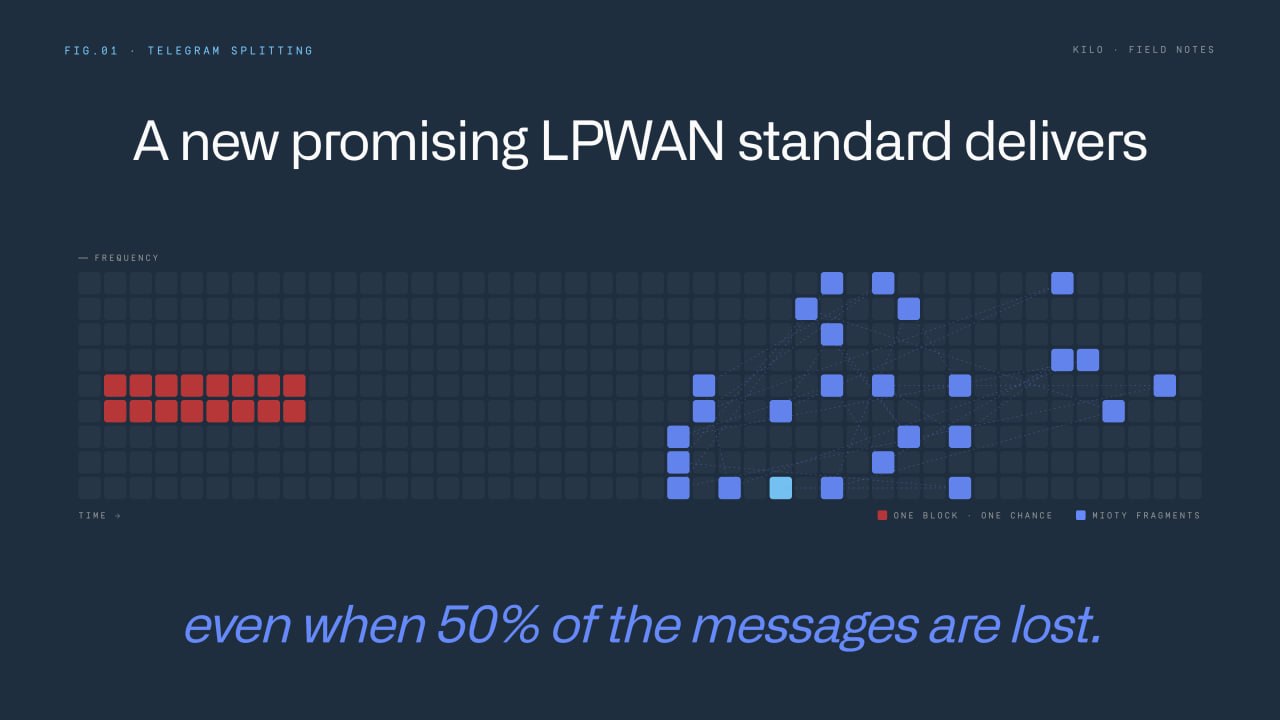
Most wireless networks were not designed for a world where thousands of sensors are constantly reporting from factories, utility sites, farms, ports, storage facilities, and city infrastructure.
That is the problem mioty was built to solve.
mioty is a low-power wide-area network technology, often shortened to LPWAN, designed for large-scale Internet of Things deployments. In simple terms, it allows small battery-powered devices to send sensor data over long distances without relying on Wi-Fi, cellular data, or frequent battery changes.
But the most interesting part of mioty is not simply that it is another wireless protocol. It is the way it sends data.
Instead of transmitting one long message and hoping it arrives cleanly, mioty uses a method called telegram splitting. A sensor message is broken into many small pieces and sent across different moments and frequencies. Even if some pieces are disrupted by interference, collisions, or poor radio conditions, the receiving system can still reconstruct the original message.
That makes mioty especially relevant for industrial IoT, where wireless reliability is not just a convenience. It can affect maintenance schedules, operational costs, safety checks, compliance reporting, and the visibility companies have over critical assets.
Fraunhofer IIS describes mioty as an IoT protocol focused on reliable transmission from numerous sensors over long distances, with telegram splitting at the core of the technology. The mioty Alliance also positions mioty as a software-based LPWAN protocol designed for massive industrial and commercial IoT deployments.
mioty for Industrial IoT: Why Traditional Wireless Networks Struggle at Scale
A single sensor is easy.
A temperature sensor in a warehouse. A water level sensor near a river. A tracker on a container. A vibration sensor on a machine. A meter in a utility network.
The challenge begins when one sensor becomes 500, then 10,000, then 100,000.
At that point, the network has to handle far more than distance. It has to handle radio congestion, overlapping transmissions, battery limitations, physical obstacles, changing weather, moving assets, and interference from other devices using the same spectrum.
For many companies, this is where IoT projects become harder than expected. The first pilot works. The first dashboard looks promising. Then the real deployment begins, and suddenly the wireless layer becomes one of the main bottlenecks.
Industrial environments are especially difficult. Metal structures, machinery, underground spaces, containers, tanks, vehicles, and distributed sites all create conditions that are very different from a clean lab test.
mioty addresses this problem by assuming that interference and packet loss will happen. Its design is based on resilience rather than perfect transmission conditions.
mioty Telegram Splitting: How the Wireless IoT Technology Works
Imagine trying to send an important document through a crowded room.
A traditional approach is to hand over the whole document at once. If someone bumps into you, spills coffee on it, or blocks the path, the message may be lost.
mioty takes a different approach. It cuts the document into many small fragments, sends those fragments in different ways, and gives the receiver enough information to rebuild the original document even if not every fragment arrives.
That is the basic idea behind telegram splitting.
For IoT, this matters because many sensors only need to send small pieces of information: temperature, pressure, humidity, vibration, location status, fill level, door open/closed state, or an alarm event. These messages are small, but they need to arrive reliably, often from remote or difficult locations.
The ETSI TS 103 357 standard defines TS-UNB, the technical basis used by mioty, and describes the telegram splitting approach used for robust low-power wide-area communication. Texas Instruments also describes mioty as a standardized Sub-1 GHz technology based on ETSI TS 103 357 and built around telegram splitting for robust networks.
In plain English: mioty is designed to keep messages moving even when the radio environment is crowded or imperfect.
mioty Use Cases for Utilities, Smart Cities, Logistics, and Industrial Monitoring
The strongest use cases for mioty are not consumer gadgets. They are business and infrastructure environments where devices need to run for years, transmit over long distances, and keep reporting even when conditions are difficult.
A utility company may need thousands of meters or monitoring points spread across a region. A city may want water level sensors, environmental sensors, parking sensors, or infrastructure monitoring devices. A logistics company may need to track assets across yards, warehouses, depots, and transport corridors. An industrial operator may need to monitor tanks, machines, valves, pumps, or storage areas without running cables everywhere.
These are the kinds of environments where LPWAN technologies are attractive because they prioritize long range and low energy consumption. mioty adds another layer: high resilience in dense deployments.
This is important because the future of IoT is not about connecting a handful of sensors. It is about connecting everything that produces operational data but has historically been invisible.
Water levels. Air quality. Fill levels. Machine health. Gateways. Containers. Cold rooms. Utility meters. Remote storage. Construction sites. Agricultural fields. Critical infrastructure.
The more devices are deployed, the more important the underlying network becomes.
mioty Network Reliability for Large-Scale IoT Deployments
Many companies still approach IoT as a dashboard project.
They think the hard part is visualizing data.
But in real deployments, the harder question is often: Can we reliably get the data in the first place?
A dashboard is only useful if the data arrives. An alert is only useful if the sensor can reach the network. Automation is only useful if the system receives events quickly and consistently enough to act on them.
That is why wireless architecture matters.
For a small office installation, Wi-Fi may be enough. For a vehicle tracker, cellular may be the right choice. For a simple low-power sensor network, LoRaWAN may fit very well. But for dense industrial and infrastructure deployments where reliability, scalability, and interference resistance are critical, mioty deserves attention.
It is not a replacement for every wireless technology. It is another tool in the IoT architecture toolbox, particularly suited to large-scale sensor networks where long battery life, long range, and robust transmission matter.
Open-Source mioty Server Infrastructure for Real IoT Deployments
The real value of IoT is not the sensor itself.
It is what happens after the sensor reports something.
A tank level drops below a threshold. A pump starts vibrating outside its normal range. A gate opens after hours. A cold storage unit begins warming up. A river level rises faster than expected. A machine stops sending data. A tracker leaves a defined zone.
These events can trigger alerts, workflows, reports, maintenance tickets, compliance records, or automated actions.
That is where technologies like mioty become part of a larger operational system. The wireless network gets the data out of the field. The IoT server processes it. The automation layer turns it into decisions.
KiloCenter is an open-source mioty network server for operating base stations, endpoints, uplink and downlink traffic, and application integrations on a self-hosted service center.
"mioty is important because it solves one of the least glamorous but most critical problems in IoT: getting small packets of data through reliably, at scale, in real-world environments," said Tim Kravchunovsky, one of the developers behind the open-source mioty network server. "For industrial deployments, the value is not just the radio technology itself. It is what becomes possible when thousands of sensors can report consistently into an IoT server, where that data can be processed, visualized, and turned into automated action."
For companies, this can mean fewer manual site visits, faster incident response, better asset visibility, and lower operating costs.
mioty and the Future of Massive Industrial IoT Sensor Networks
Industrial IoT is moving beyond pilots.
Companies no longer want isolated sensor experiments. They want connected systems that scale across sites, teams, assets, and business units.
That changes the requirements.
A network that works for 50 devices may not work for 50,000. A battery strategy that looks acceptable in a demo may become expensive at scale. A wireless technology that performs well in a quiet environment may struggle in a dense industrial setting.
mioty is interesting because it was designed with these scaling problems in mind. It is built around the assumption that large IoT deployments need robust communication, efficient energy use, and the ability to support many low-power endpoints.
That makes it especially relevant for the next phase of IoT: not just connecting devices, but connecting operations at scale.
mioty for Industrial IoT: Why This Wireless Standard Deserves More Attention
mioty is not famous in the way Wi-Fi, Bluetooth, or 5G are famous.
But that may be exactly why it matters.
Some of the most important infrastructure technologies are not the ones consumers talk about every day. They are the ones quietly making industrial systems more reliable, more measurable, and more automated.
For companies building large-scale IoT deployments, mioty offers a compelling answer to a practical question:
How do you collect small but important pieces of data from thousands of devices, across difficult environments, without constantly fighting interference, battery life, and network congestion?
As more industries move from manual monitoring to automated, sensor-driven operations, that question will only become more important.
And mioty may be one of the technologies that helps answer it.