
 English
 Français
 Español
 Deutsch
 Português
 Italiano
 العربية
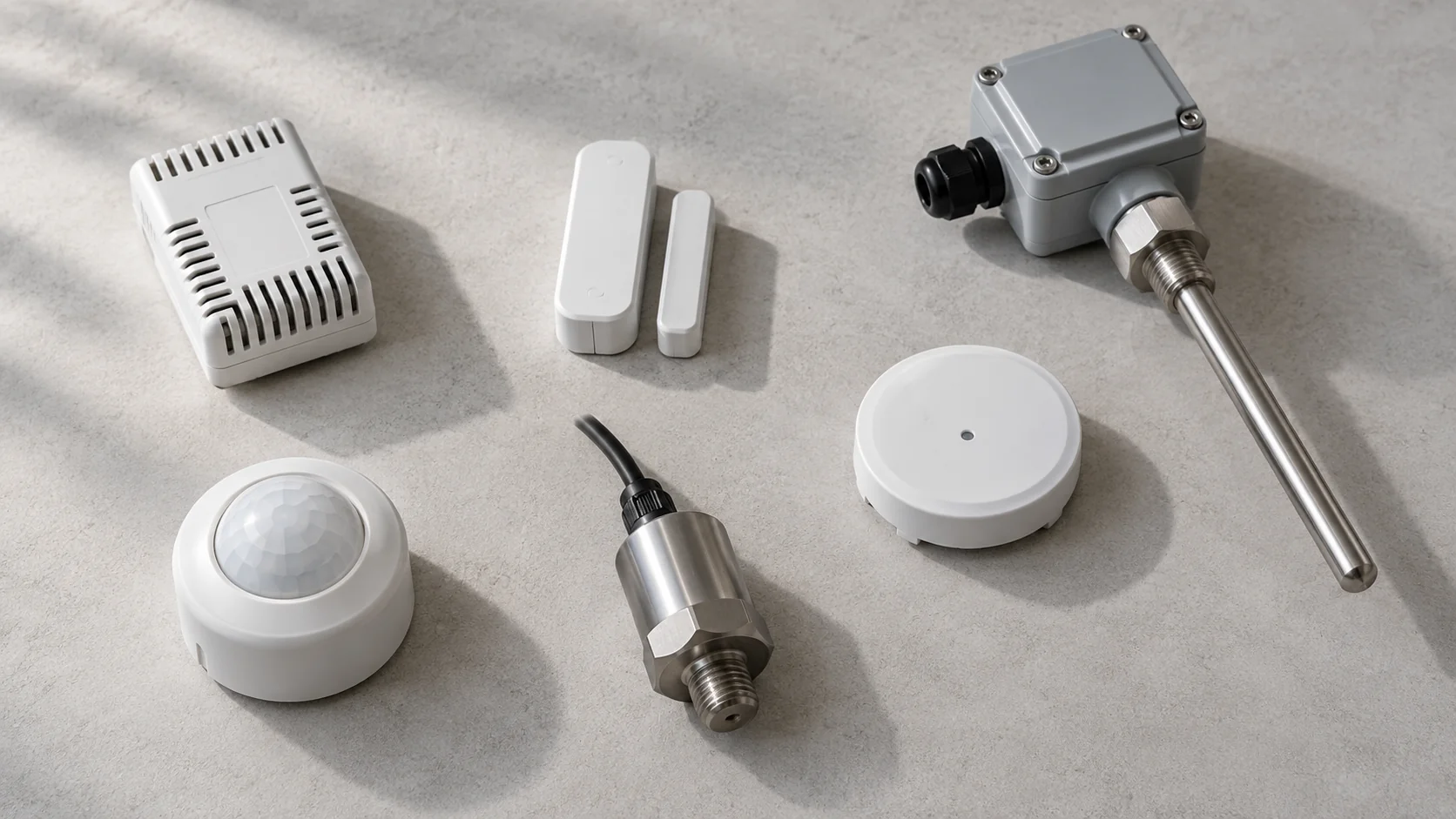
IoT sensors are small devices that measure something in the physical world, such as temperature, motion, water or a door opening, and send that measurement over a network to software where people and systems can use it. The "IoT" part, short for Internet of Things, is the connection: a thermometer on a wall shows a number to whoever walks past, while an IoT temperature sensor sends that number every few minutes to a dashboard you can check from anywhere and to rules that can react when it changes.
What makes IoT sensors interesting today is how little it takes to install them. Many run for years on a battery, need no cable and talk to a gateway that can be a long way off. That's why projects that once needed an electrician and a building management contractor can now start with a handful of sensors stuck to a wall. The planning goes into choosing the right ones and getting their data into one place.
In short
- An IoT sensor combines a sensing element, a small processor, a radio and a power source, usually a battery.
- Common types measure climate, air quality, occupancy, doors, leaks, levels, vibration, energy and location.
- An IoT sensor network carries readings from sensors through gateways and a network server to a platform.
- Battery life depends mostly on how often a sensor transmits and how far it is from its gateway.
Types of IoT sensors
There are hundreds of sensor models, but most fall into a small number of families. This table covers the ones that show up in most building, facility and industrial projects:
| Sensor type | What it measures | Typical uses |
|---|---|---|
| Temperature and humidity | Air or surface temperature, relative humidity | Offices, cold rooms, server rooms, mold prevention |
| Air quality | CO₂, VOCs, particulate matter | Meeting rooms, classrooms, ventilation control |
| Motion and occupancy | Presence by infrared (PIR), radar or people counting | Room use, lighting, security |
| Door and window contact | Open or closed, using a magnet and reed switch | Security, cold-room doors, energy waste |
| Water leak | Water at a probe or along a sensing cable | Plant rooms, under sinks, server rooms |
| Level and distance | Distance to a surface by ultrasound or radar | Tanks, bins, wells, snow depth |
| Vibration and tilt | Acceleration, vibration level, angle | Pumps, motors, structures, poles |
| Energy and pulse | Electricity, water or gas consumption | Metering, consumption profiles |
| GPS trackers | Location and movement | Vehicles, containers, equipment |
Inside, most of these devices look alike. There's the sensing element itself, a low-power microcontroller that reads it and packs the value into a short message, a radio, and a battery or external power supply. The sensing element decides what the device can measure; the radio decides where its data can go. Two sensors that measure the same thing can be completely incompatible if they use different radios.
Check the radio early when buying. A good sensor for your project measures the right thing at the accuracy you need, survives the environment it's installed in, uses a radio your network can receive, and comes with a documented data format. Kilo Electronics stocks LoRaWAN sensors and devices across most of the families in the table, and sensors from any manufacturer work as long as they fit your network.
How does an IoT sensor network work?
An IoT sensor network is the chain that carries each reading from the sensor to the software. It has the same five parts whatever the radio:
- The sensor measures and transmits a short message, often just a few bytes.
- The radio link carries the message through the air.
- A gateway or base station receives it and passes it to the internet over Ethernet, Wi-Fi or a mobile connection.
- A network server checks the message, removes duplicates when several gateways heard it, decrypts it and hands it on.
- A platform decodes the bytes into values, stores them and makes them useful in dashboards, rules and alerts.
Most of the traffic flows one way, from sensor to platform, and these messages are called uplinks. Messages in the other direction, downlinks, are used to change a sensor's settings or to switch an actuator such as a valve or relay. Battery sensors usually listen for downlinks only briefly after they transmit, so a configuration change can take until the sensor's next report to arrive. Mains-powered devices can listen all the time and react within seconds.
The biggest design choice is the radio, because it decides range, battery life and how many gateways you need.
Short-range radios such as Wi-Fi, Bluetooth Low Energy and Zigbee cover a room or a floor. Wi-Fi is convenient where it exists but uses a lot of power. Zigbee forms a mesh, where mains-powered devices pass messages along for battery ones, which works well inside a single building.
Low-power wide-area networks (LPWAN) were designed for exactly this job: small messages, long range and years on a battery. LoRaWAN is the most widespread; one gateway can typically serve hundreds of devices over a few kilometers in a city and more in open country. mioty is a newer ETSI standard (TS 103 357) that splits each message into many short radio bursts, which makes it robust in dense, noisy environments and lets one base station handle very large numbers of sensors. Mobile operators also offer LPWAN connectivity, such as NB-IoT and LTE-M, where the sensor talks to the operator's network directly and no gateway of your own is needed.
The platform step involves more translation than people expect. Each sensor model sends its data in its own byte format, so a decoder (sometimes called a codec) has to turn bytes like 01 0A F3 into "temperature 21.5 °C". Different manufacturers also name the same measurement differently, so a mixed network ends up with "temp", "temperature" and "t_air" all meaning the same thing. A useful platform lets you map those to one name before you start building dashboards.
How long do IoT sensors last on battery?
Battery-powered IoT sensors are commonly specified for anywhere between two and ten years or more. The number on the datasheet assumes a specific reporting interval and good radio conditions, and two settings in your control change it a lot.
Reporting interval. Transmitting is the most power-hungry thing a sensor does. An illustration with round numbers: if a sensor rated for six years when reporting every 15 minutes is switched to report every 5 minutes, it transmits three times as often. Since transmissions dominate its energy use, expect a lifetime closer to two or three years than six. Many sensors offer a compromise: report rarely when nothing changes, and immediately when something happens, like a door opening or water appearing.
Distance to the gateway. In LoRaWAN, a sensor far from its gateway is told to use a higher spreading factor, which makes each message more robust but much longer on air. A short message at the slowest setting can take roughly 25 to 30 times longer to send than at the fastest, and battery use rises with it. Adding a gateway closer to a group of distant sensors can extend their battery life considerably.
Temperature matters too. Batteries lose capacity in the cold, so a sensor in a freezer room or outdoors in winter won't reach its room-temperature rating. Sensors designed for these places usually use lithium cells that tolerate low temperatures better. Lithium thionyl chloride cells are a common choice because they keep working well below freezing, although their usable capacity still falls in the cold.
Battery replacement needs its own plan. A building with 200 sensors on five-year batteries averages 40 battery changes a year, and those visits cost more than the batteries. Grouping replacements by area, and choosing a reporting interval that matches the real need rather than the fastest option, keeps that number down.
How to build an IoT sensor network
These steps work for a first deployment in a building or on a site, and they keep the first network small enough to learn from:
- Write down the question. "Is the server room overheating at night?" or "Which meeting rooms are actually used?" The question decides which sensors you need and where.
- Pick the sensor types from the table above, and check their radio, accuracy, enclosure rating and reporting interval.
- Choose the network. For a single building with power everywhere, a short-range network may do. For several buildings, basements or outdoor sites, an LPWAN gateway is usually simpler.
- Test coverage before installing everything. Put the gateway in its intended spot, carry one sensor to the furthest and deepest locations, and check that messages arrive with a healthy signal. Basements, lift shafts and metal cabinets are the usual trouble spots, so test those first, and note the signal values you see so you can compare them later if a sensor starts dropping messages.
- Register each sensor in your platform with its identifiers and keys, and confirm the decoded values make sense.
- Set up how readings will be used: a dashboard for people, and rules that raise alerts when values cross a limit.
- Run it for a few weeks before scaling, and adjust intervals and limits based on what the data shows.
Software can take some of the friction out of steps 5 and 6. In Kilo, the device management form is laid out for phones, so you can register each sensor standing at its installation point. Metric templates map each manufacturer's raw field names to one normalized metric, so mixed sensor brands show up as one consistent reading. And because each device keeps its identity and history when the physical sensor is replaced, a dead or damaged unit can be swapped without breaking charts.
IoT sensors FAQ
Do IoT sensors need Wi-Fi?
No. Many IoT sensors use their own low-power radio, such as LoRaWAN, mioty or Zigbee, and reach the internet through a gateway. Wi-Fi sensors exist, but they usually need mains power or frequent battery changes.
How much do IoT sensors cost?
Simple battery sensors for temperature, doors or leaks often cost tens of euros each, while specialist sensors like radar level meters or vibration sensors cost more. A gateway is a separate, one-time cost shared by many sensors, and the software subscription is a third item.
Are IoT sensors secure?
It depends on the radio and the setup. LoRaWAN and mioty encrypt messages between sensor and network server with per-device keys, so the most important practical steps are keeping those keys safe and restricting who can access the platform.
What is the difference between a sensor and an IoT sensor?
A sensor is only the measuring element, like a thermistor that changes resistance with temperature. An IoT sensor packages that element with a processor, radio and power source so the measurement can be sent and used elsewhere.
Take the question "Which meeting rooms are actually used?" Three occupancy sensors in three meeting rooms and a CO₂ sensor in the busiest one answer it on a single dashboard, and a rule can alert facilities when CO₂ in that room stays above 1,200 ppm for half an hour. That setup fits Kilo's free plan, and you can build the dashboard and rule with emulated devices before the gateway goes in.