
 English
  Français
  Español
  Deutsch
  Português
  Italiano
  العربية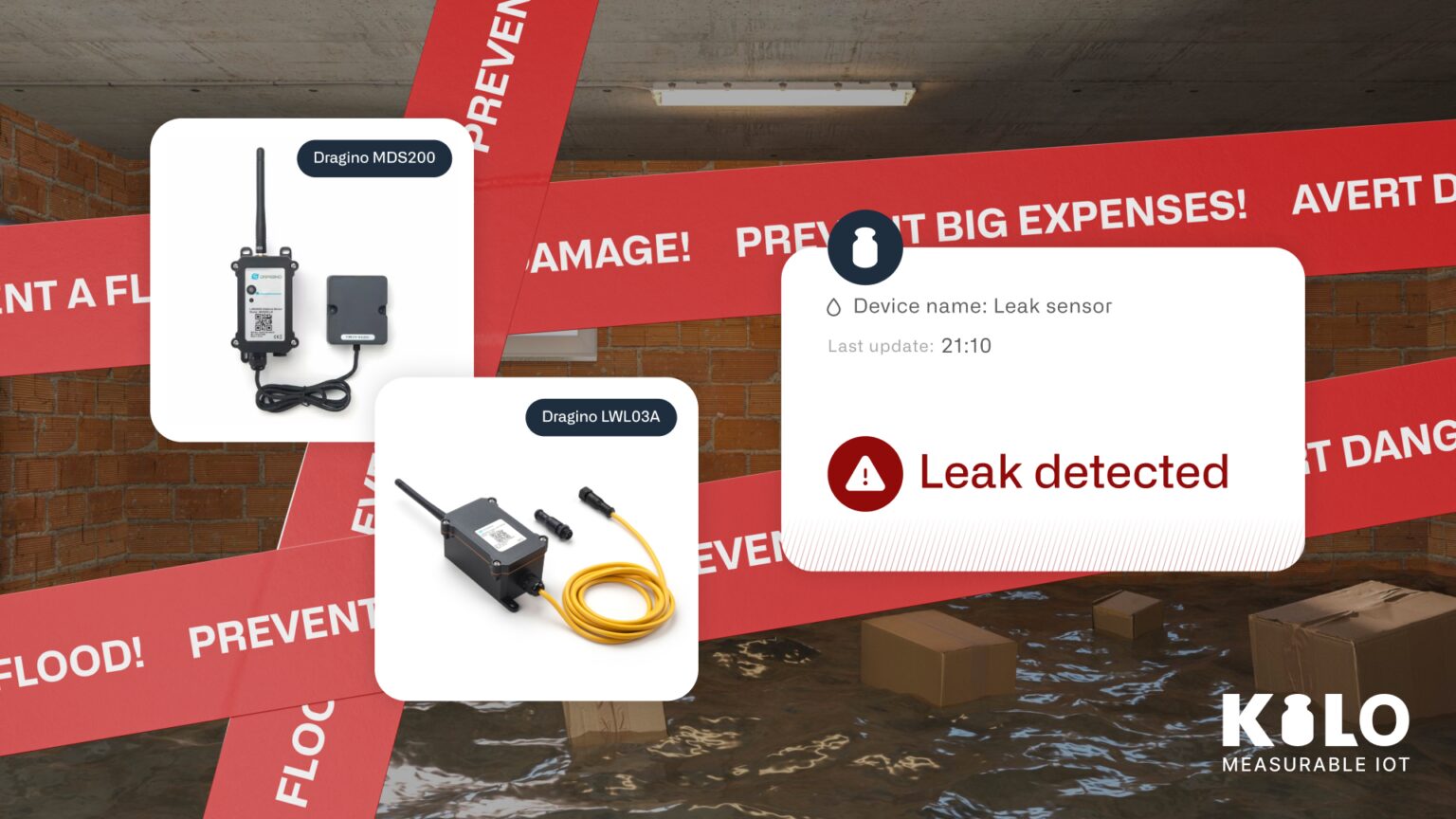
Most people don't think about water leaks until it's too late — much like fire. But where a smoke detector is standard in every building, water leak detection often isn't, even though water damage is one of the most expensive and disruptive risks in commercial and multi-tenant buildings.
Water damage is one of the most common and most expensive things that goes wrong in a commercial building, and it rarely announces itself. A burst pipe in winter, a leak in a technical room, an unnoticed drip under a raised floor — any of these can go undetected for hours or days. By then you're dealing with damaged walls, ruined equipment, mold risk, and tenants who can't use the space. Like a smoke detector, a couple of inexpensive water leak sensors can prevent thousands — sometimes hundreds of thousands — in damage. That's exactly what IoT water leak detection on a platform like the Kilo IoT Platform is built for.
Why Traditional Water Leak Detection Falls Short
Most commercial buildings still rely on very basic water leak detection: someone spots a puddle in a basement, a cleaner notices water near the HVAC units, or a tenant calls property management after the damage is done. By that point you've already lost time and money — water may have reached electrical cabinets, server racks, or structural elements that are expensive to repair, and in multi-tenant buildings the cause is often disputed.
Many of the riskiest zones are also hard to inspect manually: technical rooms with limited access, areas under raised floors, dim basements, pipe runs behind equipment, and long corridors with HVAC or sprinkler infrastructure. These need continuous monitoring, not occasional walkthroughs — and that's where LoRaWAN water leak sensors and an IoT platform earn their keep.
A Real Hotel Leak in Dubai
Here's how real this is. On a recent stay at a hotel in Dubai, the bathroom on the floor above mine leaked. It was noticed fairly early, so the damage was limited to a single room — and the hotel only had to take that one room out of service.
Now imagine the same leak in a fully booked hotel. Taking a room offline isn't an option when there's nowhere to move guests — staff would have to relocate paying guests to other hotels, refund nights, and absorb the reputational hit. A leak that should have been a minor repair becomes tens of thousands in losses. For hotels, hospitals, offices, and any business that loses revenue when space goes offline, early water leak detection isn't a nice-to-have — it's risk management.
Water Leak Sensors: Dragino Hardware for LoRaWAN
For real deployments, Kilo works with a range of LoRaWAN water leak sensors. Two Dragino devices are especially useful.
The Dragino LWL03A is a LoRaWAN rope-type water leak sensor. You lay its leak-detection cable along the floor or a perimeter; when water touches the cable anywhere along its length, the device reports an alarm over LoRaWAN to your platform. It's battery-powered for years of field life, sends periodic status plus leak and leak-cleared events, and supports EU868 and other bands. Typical placements: along basement walls, around HVAC units and chillers, under raised floors with cable trays, and around server racks or UPS rooms.
The Dragino MDS200 is a LoRaWAN 24 GHz radar distance sensor. Mounted above a sump, drain, or pit, it measures the water height below it and sends that value over LoRaWAN — a rising level shows up as a decreasing distance. It is ideal for sumps in technical rooms, drainage channels near loading docks, and pump pits in underground garages. Kilo interprets the reading and raises an alert when water crosses a defined threshold.
How Does an IoT Water Leak Detection System Work?
Hardware alone only tells you a sensor saw something. The Kilo IoT Platform turns that into a workflow facility teams can rely on. Every Dragino sensor reports over LoRaWAN to Kilo, where you can see all leak and water level sensors on one map, group them by site, floor, or zone, view status at a glance for basements, plant rooms, and corridors, and keep full history to spot recurring problem areas — instead of juggling separate vendor systems.
Alerts That Reach the Right People at the Right Time
The real value starts with rules. For an LWL03A rope sensor: if it reports a leak and the location is tagged "server room," send an SMS to the on-call engineer and email building management. For an MDS200 level sensor: if water in a sump reaches a set height, open a ticket via webhook and send a push or email with the latest reading and a location link. Events route directly to the people who can act — no one has to watch a dashboard all day.
From Warning to Proactive: Automatic Shut-Off
Detection is only half the story. In most buildings there is already automation equipment — BMS controllers, pumps, or motorized shut-off valves on the main line. Kilo can act on a confirmed leak two ways: a rule's Execute Command node sends the command straight to the device — a downlink to a LoRaWAN valve controller, or an MQTT command to an actuator — the instant the condition is met; and where the shut-off sits behind existing building equipment, the same rule fires a webhook to a building-management server, publishes an MQTT message onto an automation bus, or calls an integration service that closes the valve. The rule does the acting — the AI assistant writes and deploys that rule, but never actuates hardware itself.
That is the leap from reactive to proactive. Instead of just warning someone that water is flowing, the system can cut the water at the source within seconds of detection — turning a 2 a.m. alert into a non-event and potentially saving hundreds of thousands in damage. Integrators decide exactly how to connect to the local control hardware safely and to code.
Example Scenario: Protecting a Commercial Basement
Consider a mixed-use building with offices above and technical rooms in the basement: a main cold-water manifold, fire-suppression pipes, an electrical room, and telecom racks. One burst pipe can flood several rooms fast.
A practical Kilo setup: LWL03A rope sensors with leak cable around the manifold, key pipe runs, and walls leading to electrical rooms; one MDS200 above the sump or drain near where water would collect; all connected over LoRaWAN to Kilo. Rules: any rope-cable leak generates a high-severity alert with location, and a rising sump level triggers warning then critical alerts as thresholds are crossed — optionally closing the main valve automatically. When the first leak hits, Kilo alerts the responsible people instantly; if water reaches the sump, level readings confirm severity and inform whether to cut power or call emergency services. Everything is logged, so afterward the team can see exactly when the leak started and how fast it grew.
Business Impact: Why This Matters for Owners and Operators
The cost of water leaks goes far beyond repairs. Water damage is one of the costliest failure modes in multi-unit buildings. Early water leak detection delivers concrete returns: lower repair costs because incidents are caught in minutes, not hours; less disruption to tenants and operations; reduced mold and structural risk; better insurance documentation from logged sensor data; and smarter maintenance because recurring leak areas show up in the history. Against the cost of a single major leak, LoRaWAN water leak sensors and an IoT platform are a modest investment — the sensors run for years on battery and transmit over long range with no new wiring.
How to Build a Water Leak Detection System with Kilo
A typical project follows a clear pattern. Define risk zones — basements, technical rooms, pump areas, sensitive equipment rooms. Choose hardware — rope sensors like the LWL03A for perimeter coverage, radar sensors like the MDS200 for pits and sumps. Connect over LoRaWAN using existing gateways or one new gateway for the building. Configure dashboards and rules in Kilo, with alerts for leak events and abnormal water levels and, where valves exist, automatic shut-off. Integrate with email, SMS, ticketing, or a BMS via webhooks and the API. Then scale — start with one building or zone and replicate across the portfolio.
Start for free on the Kilo IoT Platform, or browse ready-to-deploy LoRaWAN water leak sensors and gateways to build your kit.
Is Water Leak Detection Worth It for Commercial Buildings?
Water leaks in commercial and multi-tenant buildings are a predictable, expensive risk — but the technology to catch and stop them early is proven and inexpensive. By pairing Dragino water leak sensors with LoRaWAN and the Kilo IoT Platform, owners and operators move from reactive cleanup to proactive protection — and, with an automatic shut-off valve, from warning to prevention.