
 English
 Français
 Español
 Deutsch
 Português
 Italiano
 العربية
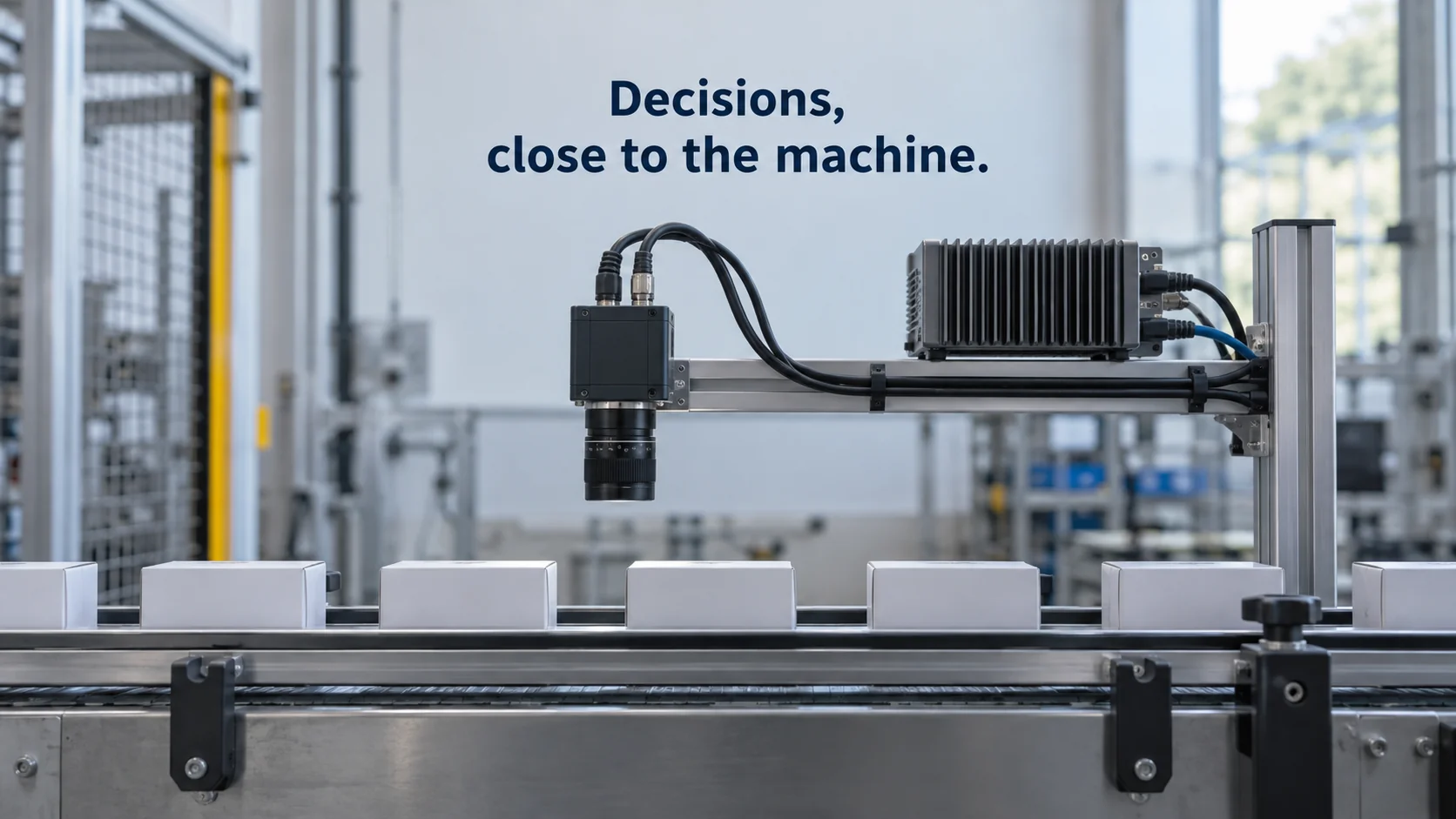
In the internet of things, edge AI means running a trained AI model on the device itself, or on a small computer next to it, instead of sending raw data to a data center for analysis. A camera that recognizes a person without streaming video anywhere, a motor sensor that spots an unusual vibration pattern on its own chip, a microphone that hears a breaking window: all of these make their decision locally and send out only the result.
That design solves real problems with bandwidth, delay and privacy. It also raises a question that gets less attention than the chips do. Once a device has decided "there's a person at the loading dock," who else needs to know, and what should happen next?
In short
- Edge AI runs inference, the act of applying a trained model, on or near the device, while training usually still happens in the cloud.
- It wins on latency, bandwidth and privacy, and loses on model size and ease of updating.
- Good use cases share a pattern: lots of raw data, a quick local decision, and a small result worth sending.
- An edge detection becomes far more useful when a platform can combine it with doors, alarms and other devices through rules.
What is edge AI?
Edge AI is artificial intelligence that runs where data is produced, at the "edge" of the network, rather than in a central cloud. The work that moves to the edge is inference: taking a model that has already been trained and applying it to new data, such as one camera frame or one second of vibration readings. Training a model needs large amounts of data and computing power, so it usually still happens in a data center. The finished model is then shrunk and copied onto the device.
Shrinking is a big part of the craft. A model trained with 32-bit numbers can often be converted to 8-bit integers, a step called quantization, which cuts its size roughly by four and speeds it up on simple processors with only a small loss of accuracy. Pruning removes connections that contribute little. Many current chips also include a neural processing unit, a block of silicon built for exactly this kind of arithmetic, which lets a camera or gateway run a detection model while drawing a few watts.
Edge AI devices range widely. At the small end, microcontrollers with a few hundred kilobytes of memory run tiny models that recognize a wake word or classify a vibration. In the middle, smart cameras run object detection on board. At the top, a compact computer on a shelf in the plant room can serve several cameras or machines at once. All of them share one trait: they turn heavy raw data into a light, meaningful event.
It helps to separate edge AI from the broader term edge computing. Edge computing means doing any processing close to where data is produced: filtering readings, compressing video, running a local control loop. Edge AI is the part of that where the processing is a trained model making a judgment, such as "this sound is glass breaking" or "this vibration looks like a worn bearing." A gateway that averages ten temperature readings is doing edge computing; a camera that recognizes a forklift is doing edge AI.
Edge AI computing vs cloud AI
Edge AI computing and cloud AI usually work together in one system, and each is better at different things:
| Edge AI computing | Cloud AI | |
|---|---|---|
| Response time | Milliseconds, no network round trip | Depends on the connection, from tens to hundreds of milliseconds or more |
| Bandwidth | Sends only results | Needs the raw data uploaded |
| Privacy | Raw images or audio can stay on the device | Raw data leaves the site |
| Model size | Limited by the device's memory and power | Very large models are practical |
| Updates | Each device needs the new model delivered | Update once, used by everyone |
| Works offline | Yes | No |
The bandwidth line is easy to put in numbers. A 1080p camera encoding H.264 at about 4 megabits per second produces roughly 43 gigabytes a day if it streams around the clock. Ten such cameras sending everything to the cloud for analysis would push over 400 gigabytes daily through the site's connection. If each camera instead runs detection locally and sends a short JSON message, say 300 bytes, whenever it sees a person, even 1,000 detections a day add up to about 300 kilobytes per camera.
The trade-off shows up in what each side can know. The camera knows what's in its own frame and nothing else. The cloud, or a platform that collects events from many devices, sees the whole site but only through the summaries the edge sends. Most good designs keep both: the device decides quickly what it saw, and a central system decides what that means given everything else that's happening.
Hybrid setups often split the work in stages. The device runs a small, fast model that catches nearly everything interesting, accepting some false alarms. Only the flagged moments, a short clip or a few seconds of vibration data, go to a larger model in the cloud for a second opinion. The site's connection carries a trickle instead of a flood, and the expensive model only sees the hard cases.
Teams tend to underestimate updates. A fleet of 300 cameras may end up running three different model versions if updates fail on some of them. Each event should therefore say which model version produced it, so that a sudden change in detection counts can be traced to an update rather than to a change on site.
Edge AI use cases in IoT
The strongest edge AI use cases share a shape. A sensor produces a lot of raw data, a decision has to be fast or private, and the useful output is small. The examples below show that pattern across different settings; they're illustrations, not a complete map of the field.
Machine condition monitoring is a classic case. A vibration sensor on a motor samples thousands of times a second. Sending all of that over a low-power radio isn't practical, so a small model on the sensor learns what normal vibration looks like and reports only a score or a "bearing pattern changed" flag every few minutes.
Visual quality inspection on a production line needs decisions within a fraction of a second, before the next item arrives. A camera with an on-board model can reject a misprinted label in milliseconds, where a cloud round trip would let the faulty item pass.
People counting and occupancy work well at the edge for privacy reasons. A sensor or camera can count how many people are in a room and send only the number, so images never leave the device. Facility teams get the information they need for cleaning, heating and space planning without storing footage.
Security detection at the perimeter is the case most people picture. A camera that can tell a person from a swaying branch or a passing cat sends far fewer false alerts than simple motion detection, and it does so without a constant video stream.
Farms use the same idea on a different scale: cameras at feeding stations or traps classify animals or pests, and solar-powered devices send a handful of results a day over long-range radio.
Edge AI isn't always worth it. A temperature sensor that reports every 15 minutes produces a few kilobytes a day, and a simple threshold on the server handles it perfectly well. A model on the device adds cost, power draw and an update process for no gain. The rule of thumb is to put intelligence at the edge only when raw data is too large, too sensitive or too slow to send.
How do edge AI devices connect to the cloud?
Many edge AI devices report their results as small messages over a standard protocol, often MQTT, a lightweight publish-and-subscribe protocol widely used in IoT. The device publishes something like {"event": "person", "zone": "dock-2", "confidence": 0.91} to a topic, and anything subscribed to that topic receives it. Some devices send webhooks or use a vendor's own cloud instead, so check which outputs a model supports before buying.
A useful event message carries more than the label. The device ID, a timestamp from the device's clock, the confidence score and the model version all help later. Pick the confidence threshold with care: a threshold of 0.5 catches more real events and more false ones, while 0.9 is quieter but misses some. Sending the score itself, rather than only a yes or no, lets the receiving side pick a different threshold by time of day without touching the camera.
Receiving the message is only the first step. A person-detected event at a loading dock means different things at 14:00 on a weekday and at 02:00 on a Sunday, and different things again if the dock door is open or closed. To turn a detection into a sensible action, something has to combine it with the rest of the site.
That combining is what a rules engine does. In Kilo, an MQTT connector receives the camera's message and routes it to the right device, either by topic pattern or by a device ID read from the JSON payload. A rule then starts from that reading, and an Enrichment step fetches the latest state of a wireless door sensor on the same dock, so one rule can reason over both.
If the door is open outside working hours, the same rule can raise a critical alarm that reaches the on-call person and send a command to a lighting controller that switches on the yard lights. You draw that logic once as a flowchart in the Kilo rules engine, with the camera's detection and the door's state as its two inputs.
The camera handles the heavy pixel work locally, and the platform handles context, people and follow-up actions. Neither needs to be replaced when the other changes, so a better detection model next year slots in without touching the rules, as long as it keeps publishing the same message.
Edge AI in IoT FAQ
Does edge AI need the internet?
No, inference runs locally, so a device keeps detecting even when the connection drops. The internet is needed to deliver results elsewhere and to receive model updates. Many devices buffer their events during an outage and send them once the link is back.
What is TinyML in edge AI?
TinyML is the branch of edge AI that runs models on microcontrollers, chips with memory measured in kilobytes and power draw in milliwatts. Frameworks such as TensorFlow Lite for Microcontrollers, now part of Google's LiteRT, make it possible to run small models for tasks like keyword spotting or gesture recognition on battery power for long periods.
What is an example of edge AI in everyday life?
Smartphones are full of it. Face unlock, on-device photo sorting and the wake-word detection that listens for a voice assistant's name all run locally on the phone's own processor, which is why they keep working without a signal.
You can rehearse the dock scenario with a door contact and a camera that publishes its detections over MQTT. Kilo Electronics stocks door and window sensors, and two devices plus one rule that raises an alarm when a person is detected while the door is open fit inside Kilo's free plan, along with a dashboard showing both readings.