
 English
 Français
 Español
 Deutsch
 Português
 Italiano
 العربية
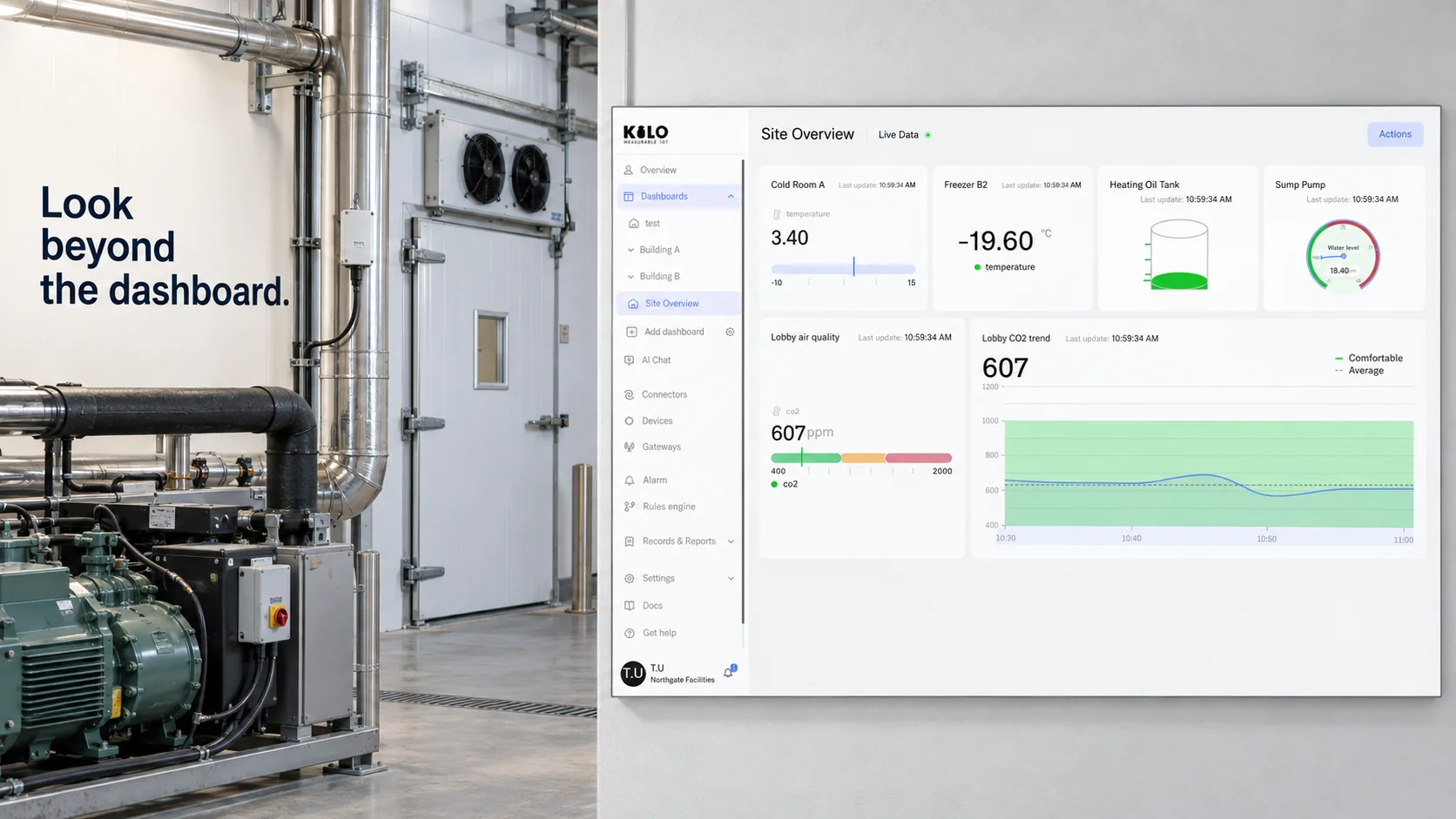
An industrial IoT platform is the software that sits between your machines and your people. It collects readings from sensors, controllers and meters, keeps their history, shows them in a useful form, decides when something needs attention and, in many cases, sends commands back to equipment. Choosing one matters more than choosing any individual sensor, because sensors get replaced every few years while the platform holds your data, your alert logic and your team's habits.
Vendor comparison pages mostly list features. They rarely tell you which differences will matter on your site in year two, when the system covers more machines, more people and probably a second plant, and that's the angle this guide takes.
In short
- An IIoT platform connects equipment, stores and contextualizes its data, and turns it into dashboards, alerts and actions; it complements SCADA and the historian rather than replacing them.
- Protocol support decides how much work each machine costs to connect, so check how Modbus, OPC UA and wireless sensors get in.
- Analytics on a plant floor is mostly about context: knowing which reading belongs to which asset, in which unit, compared with what.
- Judge platforms by how they behave at the scale you'll reach, then confirm with a pilot on your own equipment.
What is an IIoT platform?
An IIoT platform, short for industrial Internet of Things platform, is a software layer that brings data from many kinds of industrial equipment into one place and makes it usable. It typically covers device connectivity, data storage, visualization, rules and alerting, user access and integration with other business systems.
It helps to place it next to the systems a plant already has. The ISA-95 model, also published as IEC 62264, describes a plant in levels. At the bottom are sensors and actuators. Above them, PLCs and controllers run the machines in real time. SCADA and HMI systems supervise processes and let operators intervene. A historian stores high-frequency process values. Higher up, MES software manages production orders and ERP handles the business.
An IIoT platform doesn't fit neatly into one level. It often reads from the controller and SCADA levels, adds data from wireless sensors that were never wired to anything, and serves people across maintenance, energy, quality and management. Where SCADA is built for an operator controlling one process in real time, an IIoT platform is built for many people watching many assets across sites.
That difference shapes what to expect from it. A good platform makes it cheap to add the hundredth sensor and the fifth site. It's usually not where you'd run a safety interlock or a closed control loop that needs millisecond timing; those stay in the PLC.
What does industrial IoT software do?
Most industrial IoT software does the same six jobs. The differences between products lie in how well each job scales.
- Connect. It receives data from equipment over industrial and IoT protocols, such as Modbus, OPC UA, MQTT and LoRaWAN, directly or through an edge gateway that translates one protocol into another.
- Model. It turns raw values into assets and measurements: this number is the outlet temperature of pump 3 in hall B, in degrees Celsius.
- Store. It keeps history long enough to compare this month with last year.
- Show. It displays dashboards for different roles, from a technician's phone to a wall screen in the control room.
- Decide. It evaluates rules and raises alerts that reach the right person.
- Act and integrate. It sends commands to equipment that accepts them and exchanges data with maintenance, ERP or BI systems through APIs.
The first job decides how much each new machine costs you. Older equipment speaks Modbus, a protocol introduced by Modicon in 1979 that's still everywhere. Newer equipment often offers OPC UA, standardized as IEC 62541, which carries both values and a description of what they mean. Battery-powered retrofit sensors usually use LoRaWAN or a similar low-power radio. A platform that needs custom code for each of these will be slow to grow.
To take one platform as an example, on Kilo's industrial IoT platform you bring Modbus, OPC UA and BACnet equipment in through an MQTT edge gateway, which translates it into MQTT for Kilo's MQTT connector, and you point LoRaWAN sensors at the network server built into the platform. When two manufacturers name the same reading differently, you map their raw keys to one normalized metric, so a dashboard or rule sees one consistent temperature.
Modeling, the second job, can cost a project months. If each device arrives with its own field names and units, every dashboard has to be built by hand. A platform with reusable measurement definitions and device templates lets you configure a sensor type once and copy it to the next fifty.
How does industrial IoT analytics work?
Industrial IoT analytics turns a stream of readings into answers to operational questions: which machines are running hot, how much energy line 2 used last week compared with line 1, which pumps spend the most time near their limit. Most of that work is less exotic than the word "analytics" suggests.
It starts with context. Industrial IoT data arrives as numbers attached to device IDs and field names. Before anyone can analyze it, the platform needs to know which asset a reading belongs to, what unit it's in, what normal looks like for that asset, and which other readings belong with it. A vibration value of 4.5 mm/s means little on its own. On a small pump that's been running at 1.8 for months, it's worth a look.
Then come a few standard operations that cover a surprising share of real needs:
- Aggregation: minimum, maximum, average and totals per hour, shift, day or month, which turn raw readings into reports.
- Comparison: the same measurement across identical machines, or the same machine across time, which shows outliers.
- Thresholds and durations: a value above a limit for longer than a set time, which turns data into an alert without false alarms from brief spikes.
- Derived values: energy per unit produced, run hours from a current reading, or a temperature difference across a heat exchanger.
Machine learning sits on top of these and helps with problems that thresholds handle badly, such as spotting unusual combinations of several readings or forecasting a value. It needs clean, contextualized history to work, which is why a platform that gets the basics right is the prerequisite.
An IoT analytics platform also has to decide where calculations happen. Simple summaries can run in the cloud. High-frequency signals, like full vibration waveforms sampled thousands of times per second, are usually reduced at the edge first, because sending them raw would overwhelm networks and storage.
Which is the best IIoT platform?
There's no single best IIoT platform, because the right choice depends on the equipment you have, where you're allowed to run software and how far you plan to scale. The table below lists criteria that tend to separate platforms in practice, with a question to put to each vendor.
| Criterion | Why it matters | Question to ask |
|---|---|---|
| Protocol support | Sets the cost of connecting each machine | How exactly do Modbus, OPC UA and wireless sensors reach the platform, and what has to run on site? |
| Deployment | IT policy or customer contracts may rule out public cloud | Is the same product available as cloud, on-premise or both? |
| Multi-site scale | Year-two growth breaks platforms built for one site | How are sites, permissions and device counts organized at 10 sites and 1,000 devices? |
| Data access | You'll want your history in other tools | Which APIs and export options exist, and are they included in the price? |
| Access control | Contractors, operators and managers need different rights | Can permissions be set per area and per site? |
| Alerting | An alert nobody answers has to reach someone else | Can alerts escalate to another person if nobody responds? |
| Pricing model | Some models punish growth | Is pricing per device, per data point, per message or per user, and what does it cost at three times today's size? |
Scalability has two halves. The technical half is whether the platform keeps up as devices, messages and years of history pile up; vendors can usually show numbers for that. The organizational half is harder to see in a demo: how much work it takes to add the fifth site. If every new site means rebuilding dashboards, re-creating alert rules and re-entering user permissions by hand, the software may handle the growth while your team spends weeks on every rollout. Ask the vendor to show how an existing site's setup is copied to a new one.
You can test the table with a pilot that reproduces your hardest real case instead of the vendor's demo. Connect one old Modbus machine through a gateway, two or three wireless sensors and one device from a different manufacturer. Build the dashboard your maintenance lead would use, set one alert that escalates, and ask someone outside the project to change a limit without help. A pilot like that takes a few weeks and answers most of the questions above with evidence.
Two warning signs are worth watching during evaluation. One is a platform where every new device type needs the vendor's professional services. The other is pricing that's cheap at pilot scale and unclear beyond it.
Industrial IoT platform FAQ
Is an industrial IoT platform the same as SCADA?
No. SCADA supervises and controls processes in real time, usually on a local network with direct links to PLCs. An industrial IoT platform focuses on collecting data from many sources and sites for monitoring, analysis and alerts. Many plants run both, with the IIoT platform reading selected values from SCADA or the PLCs.
What is an industrial IoT cloud platform?
It's an IIoT platform hosted by the vendor and reached over the internet, so you don't run servers yourself. Equipment sends data through gateways with outbound connections, which usually means no inbound firewall openings at the plant. The trade-off is that internet connectivity becomes part of the data path, so gateways should buffer readings if the link drops.
How much does an industrial IoT platform cost?
Pricing models vary: per connected device, per data point or tag, per message volume, per user, or a flat enterprise license. Hardware, installation and gateways are usually separate, and some vendors also charge for API access or longer data history. The figure worth comparing is the total cost at your expected size in three years.
Does an industrial IoT platform need Sparkplug B?
Not necessarily, but it helps with MQTT data. Sparkplug B is an open specification from the Eclipse Foundation that defines how industrial devices structure MQTT topics and payloads, including messages that report when a device comes online or drops off. It makes MQTT data from different vendors easier to interpret consistently. Platforms that accept it can usually discover new tags with less manual mapping.
Connect one old controller through an edge gateway and four wireless sensors on the machines your maintenance team watches most closely, and build the one dashboard your maintenance lead would open each morning. Five devices fit on Kilo's free plan, so the pilot costs only the hardware and a few weeks of attention.