
 English
 Français
 Español
 Deutsch
 Português
 Italiano
 العربية
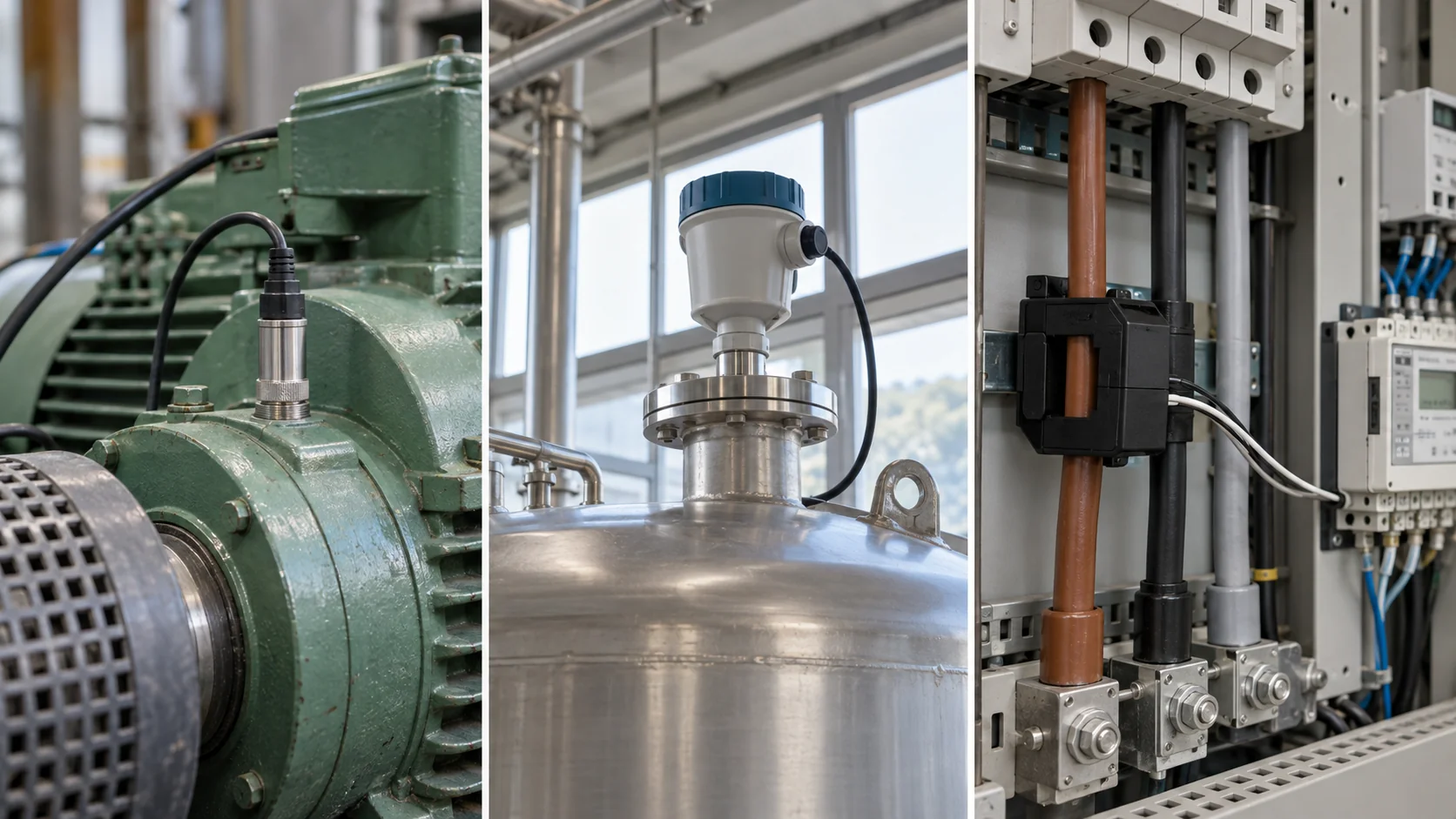
Industrial IoT, often shortened to IIoT, means connecting sensors and equipment in factories, utilities and other industrial sites so their condition and output can be watched and acted on from anywhere. The most common industrial IoT applications are machine condition monitoring, energy monitoring, tank and fluid levels, environmental conditions, utility metering, and tracking of tools and assets.
None of these needs a new factory. Most of them start with a few battery-powered sensors added to machines that are already running. Projects differ mostly in what happens to the data afterwards, and that's what most of this article is about.
In short
- The applications that pay off first are practical ones: machine health, energy, levels, temperatures and leaks.
- Most start as retrofits, with wireless sensors mounted on existing machines and no change to the control system.
- The typical devices are vibration sensors, current clamps, level and pressure sensors, temperature probes, and gateways that read data from machine controllers.
- Smart manufacturing begins when data from several of these sources is combined and starts to trigger actions as well as charts.
What is industrial IoT monitoring?
Industrial IoT monitoring is the continuous collection of readings from industrial equipment, sent automatically to software that stores them, shows them and raises alerts. It replaces the clipboard round, the monthly meter reading and the walk past a machine to listen to it.
The chain behind it has the same few links in almost every project. A sensor measures something physical, such as vibration, current, level or temperature. It sends the reading over a network, often a low-power radio such as LoRaWAN for battery sensors, or a wired or Wi-Fi connection for equipment with power. A gateway receives the readings and forwards them to a platform. The platform keeps the history, shows dashboards and checks rules, and the rules notify people or trigger actions.
You can get data from a machine in two ways. One is to read what the machine already knows: modern machines and their PLCs (programmable logic controllers, the industrial computers that run them) hold values such as speeds, temperatures and counters, which can be read through industrial protocols such as Modbus or OPC UA. The other is to add sensors from the outside, which is often quicker on older equipment or where touching the control system needs approval from the machine builder. Many plants use both, reading controllers where it's easy and retrofitting sensors where it isn't.
How is industrial IoT used in manufacturing?
Industrial IoT in manufacturing covers far more than production machines. The table below gives common applications, what each measures and what changes once the readings are connected. Treat it as a set of examples rather than a complete list.
| Application | What's measured | What changes |
|---|---|---|
| Machine condition monitoring | Vibration and temperature on motors, pumps, fans and gearboxes | Bearing and alignment problems are found weeks before they stop a line |
| Energy monitoring | Electricity per line, machine or shift | Idle consumption and inefficient equipment become visible instead of hiding in one bill |
| Compressed air | Flow, pressure and compressor power | Leaks and pressure set too high show up as measurable waste |
| Tank and fluid levels | Coolant, lubricant, chemicals, raw materials | Refills are planned instead of discovered on a dipstick round |
| Environmental conditions | Temperature and humidity in stores, clean areas and curing rooms | Materials and products stay within their specified conditions, with a record to prove it |
| Process temperatures | Ovens, dryers, cold rooms | A drift outside the recipe range triggers an alert during the shift, not at final inspection |
| Utilities and water | Water meters, leak sensors, pressure in supply lines | Leaks and abnormal consumption are spotted the same day |
| Asset tracking | Location of tools, containers, forklifts and trailers | Less time spent searching, and fewer items lost between sites |
Compressed air shows how quickly these numbers add up. According to the US Department of Energy, leaks can sometimes waste 20 to 30% of a compressor's output in plants that don't manage them. Say a 75 kW compressor runs 6,000 hours a year and a quarter of its output is lost to leaks. That wastes about 112,500 kWh a year, and at €0.20 per kWh, that's around €22,500 for air that leaks out of fittings and hoses. Monitoring compressor power and line pressure at night, when production is stopped, shows the leak load directly, because with production stopped, the air the compressor still delivers is escaping through leaks.
Energy monitoring works the same way at a larger scale. Most plants get one electricity bill, which says nothing about which machine draws what. Current clamps on the main feeders of each line show consumption per line and per shift, and they often reveal machines left running over weekends or a line that uses noticeably more energy than an identical one next to it.
Environmental and process records matter most where materials are sensitive. Adhesives and coatings cure properly only within a temperature and humidity range, wood and paper change dimensions with humidity, and food and pharmaceutical storage has documented limits. A sensor that logs every few minutes produces the record an auditor or a customer asks for, and an alert during the shift gives someone time to move stock or fix a door before a batch is lost.
Asset tracking splits into two different problems. Between sites, trailers, containers and vehicles can carry GPS trackers that report their position. Inside a large hall, GPS usually doesn't reach, so indoor location relies on other methods, such as Bluetooth beacons or tags read at doors and zones. It's worth deciding which of the two you need before choosing hardware, because the devices and costs are very different.
What are examples of industrial IoT devices?
The devices behind these applications are mostly ordinary, well-proven instruments with a radio or a network connection added. Common examples:
- Wireless vibration sensors, mounted on bearing housings with a magnet, stud or adhesive, reporting vibration and temperature every few minutes.
- Current transformers and energy meters, clamped around cables in a distribution panel to measure electricity use without cutting into the wiring.
- Level sensors, usually ultrasonic or radar, mounted on top of a tank to measure how full it is.
- Pressure and flow sensors on compressed air, water and process lines.
- Temperature and humidity sensors for rooms, cold stores and storage areas, and temperature probes for ovens and process equipment.
- Door and contact sensors that report whether a gate, cabinet or machine guard is open.
- Gas sensors for carbon monoxide, carbon dioxide or other gases in enclosed work areas.
- Edge gateways that read values from PLCs and meters over Modbus or OPC UA and pass them on to the platform.
- Trackers for forklifts, containers and trailers that move around or between sites.
- Relays and valve controllers that can switch equipment or open and close a valve on command.
Power and placement decide a lot of the practical work. Battery sensors can go anywhere but need replacing every few years, while mains-powered devices need an electrician and a nearby supply. Equipment in areas with explosive atmospheres needs devices certified for that zone.
When picking devices, the protocol matters as much as the measurement. Sensors that use an open standard such as LoRaWAN or MQTT can be combined with other brands and moved to other software later. A sensor that only talks to its manufacturer's own cloud ties every future decision to that manufacturer.
For energy projects, Kilo Electronics stocks energy monitoring devices among its other industrial sensors, and hardware from any supplier that uses a supported connection works the same way.
How does industrial IoT enable smart manufacturing?
Smart manufacturing is a broad term, but at its core it means a plant where data from machines, utilities and people is combined and used to make decisions faster, increasingly with automatic actions. Industrial IoT supplies the data. Whether it becomes smart manufacturing depends on what happens after the sensors are installed.
Combining sources comes first. A vibration reading becomes more useful next to the machine's energy draw, and a cold-room temperature next to the status of its door. That only works when readings from different manufacturers end up in one place with consistent names and units.
Then the data has to lead to action. An alert to a person is the most common one, but some responses can be automatic, such as switching off a pump when a tank runs low or closing a valve when a leak sensor detects water.
And once it works on one line, the same setup has to be repeated across lines and sites, so the second plant doesn't start from zero.
On a manufacturing plant floor running Kilo, you handle the combining by mapping raw readings from different manufacturers to one normalized metric, so a dashboard or rule sees the same temperature whichever sensor sends it. For the acting, you give a rule a saved device command, such as closing a valve through a Class C LoRaWAN controller or switching an MQTT-connected relay, and Kilo records every command with its outcome, from delivered to confirmed or failed.
Most IoT solutions for manufacturing grow in this order: monitoring first, then alerts that people trust, then automatic actions for the handful of cases where the right response never changes. Skipping straight to automation tends to backfire, because nobody yet knows which readings are reliable enough to act on without a person checking first.
Industrial IoT applications FAQ
How is industrial IoT in manufacturing different from IoT?
The technology is largely the same, but industrial IoT works under tougher conditions: electrical noise, metal structures, wide temperature ranges and equipment that runs for decades. It also connects to industrial protocols and control systems, and the cost of a wrong reading or a missed alert is usually much higher than in consumer IoT.
Can industrial IoT monitoring work with old machines?
Yes. Older machines often have analog outputs, typically 4–20 mA signals, or relay contacts that show whether they're running, and small converters can turn those into readings a gateway sends on. Where a machine has no outputs at all, external sensors for vibration, current or temperature measure it from the outside.
Are industrial IoT applications part of Industry 4.0?
Yes, as one building block of it. Industry 4.0 is a broader concept, introduced as part of a German government strategy and publicized at the Hannover Messe trade fair in 2011, covering digital manufacturing as a whole. Industrial IoT is the part that connects physical equipment so its data can be used.
Are industrial IoT applications secure?
They can be, with care. The IEC 62443 series is the main international framework for securing industrial automation and control systems, and it's increasingly applied to IIoT devices and gateways. Basic practices include encrypted connections, separating the IIoT network from the control network, and limiting which systems can send commands to equipment.
To see machine health and fluid levels side by side on your own site, put a vibration sensor on each of the three motors that would hurt most if they failed, and level sensors on the two coolant tanks that run low most often. Set one rule that watches all three motors and raises an alarm when vibration on any of them stays above a limit you set for an hour. Five devices and one rule fit within Kilo's free plan.