
 English
 Français
 Español
 Deutsch
 Português
 Italiano
 العربية
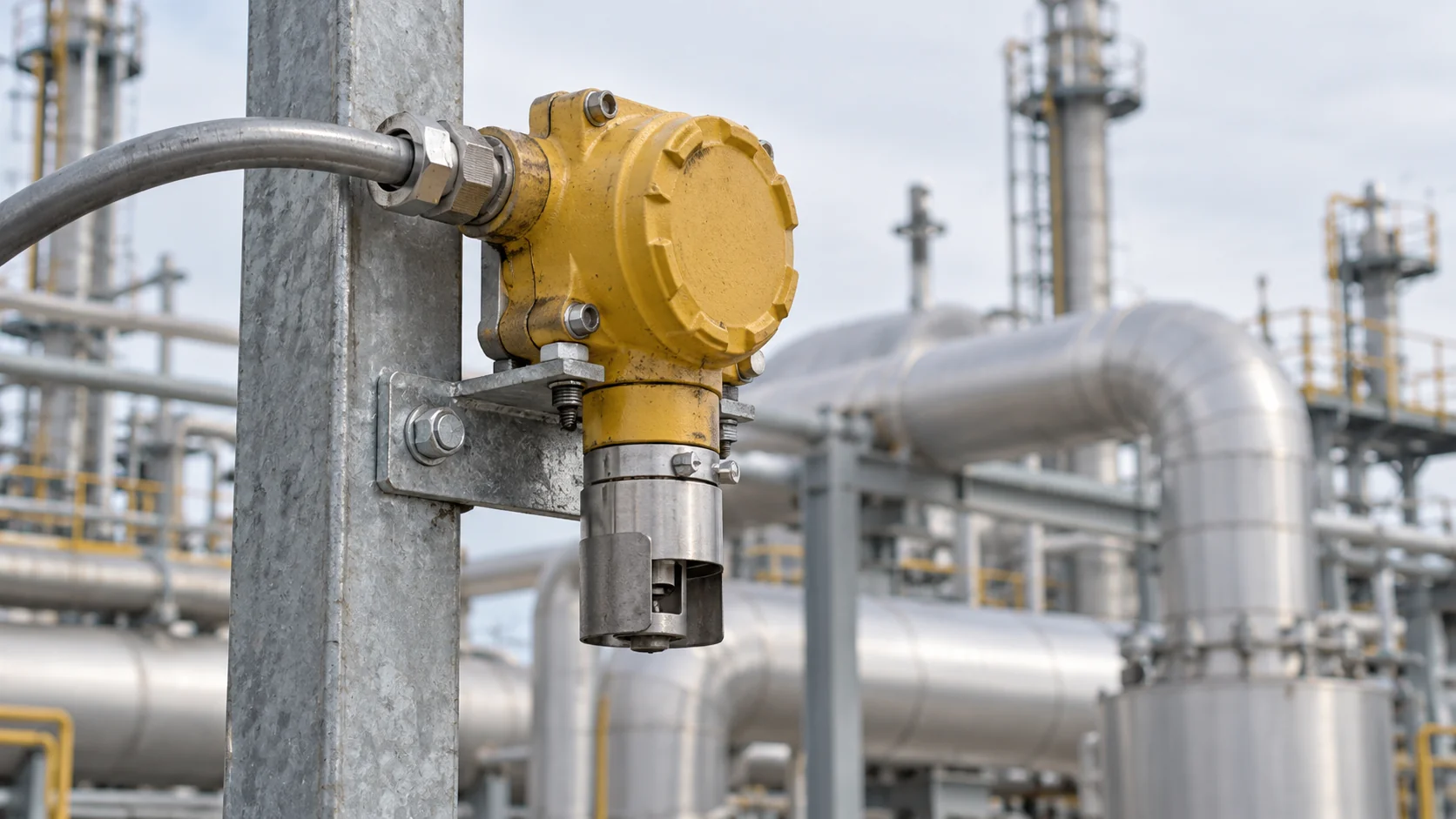
A gas detection system is a set of sensors, a controller and alarm outputs that measures flammable, toxic or oxygen-displacing gases in a space and warns people, or starts a safety action, before the concentration becomes dangerous. In a process plant, a compressor station or a refrigeration machine room, it's often the only thing that notices a leak of a gas nobody can see or smell.
On a datasheet, most systems look alike. Wired or wireless, catalytic or infrared, one alarm level or two: each choice changes what the system can catch, how quickly the warning arrives, and how much work it takes to keep running. This guide walks through those choices in the order a safety lead usually meets them.
In short
- A fixed gas detection system protects one area around the clock; a portable detector protects the person wearing it.
- Combustible gases are measured as a percentage of the lower explosive limit (LEL), toxic gases in parts per million (ppm).
- The sensor technology has to match the gas: infrared sensors can't see hydrogen, and electrochemical cells wear out.
- Wireless detectors cut cabling cost, but battery life and reporting interval become part of the safety design.
What is a fixed gas detection system?
A fixed gas detection system is permanently installed. Detector heads sit where gas is likely to appear: next to compressor seals, flanges, valve manifolds, tank hatches or the air intake of a control room. Each head is wired back to a controller, traditionally over a 4–20 mA current loop, where 4 mA means no gas and 20 mA means the top of the measuring range. A current that drops well below 4 mA, or disappears entirely, tells the controller that the head or its cable has a fault, which is one reason the convention has lasted so long.
The controller compares every detector against its alarm setpoints and switches relays. Those relays sound horns, light beacons, start extraction fans or close a shut-off valve. That last kind of output changes the engineering. When a detector's alarm triggers an automatic action, such as tripping a compressor, the whole chain from sensor to valve becomes a safety function. In process plants that function is usually designed to IEC 61511 and given a safety integrity level (SIL), which sets requirements for redundancy, proof testing and documentation. Detectors installed in classified hazardous areas also need ATEX or IECEx certification for the zone they sit in.
Shutdown logic often adds voting. Instead of tripping a compressor when any single head alarms, the controller waits until, for example, two out of three detectors covering the same area agree. One drifting or contaminated sensor then can't stop production on its own, while a real release, which reaches several heads, still trips the unit. The number and position of heads come from a review of likely leak sources, ventilation and how the gas disperses, rather than from a fixed spacing rule.
Portable detectors do a different job. A worker clips one to a collar, and it warns that person wherever they go, including into tanks and pits where no fixed head reaches. A fixed system protects the place. Most industrial sites need both, and the table compares them with a wireless fixed system.
| Wired fixed system | Wireless fixed system | Portable detector | |
|---|---|---|---|
| What it protects | One area, continuously | One area, continuously | The person carrying it |
| Power | From the controller over the loop | Battery or solar | Rechargeable battery |
| Installation effort | High: cable trays, conduit, certified glands | Lower: mount and pair with a gateway | Minimal |
| Where alarms go | Controller relays and shutdown logic | Gateway to a controller or monitoring software | The device's own horn and vibration |
| Recurring work | Calibration, sensor replacement | The same, plus battery changes | Daily bump test, calibration, charging |
How does a wireless gas detection system work?
A wireless gas detection system replaces the signal cable with a radio link. Each detector carries its own battery, measures on a fixed cycle and transmits readings to a gateway, which passes them to a controller or to monitoring software. Industrial wireless standards such as WirelessHART and ISA100.11a are common inside process plants, while low-power wide-area networks such as LoRaWAN cover larger outdoor areas with fewer gateways.
The design trade-off is the reporting interval. A wired detector reports continuously. A battery detector that transmitted every second would drain its battery far sooner than planned, so wireless designs usually sample often, transmit on a slower cycle while readings are normal, and send at once when a reading crosses an alarm level. When you compare products, look for the worst-case delay between gas reaching the sensor and the alarm reaching the controller, the battery life at the interval you plan to use, and how the system reports a detector that has stopped talking.
Wireless pays off where cable is expensive or temporary: tank farms, remote well pads, turnaround work, or extra coverage in an existing plant where opening hazardous-area cable routes would mean a shutdown.
How does a combustible gas detection system work?
A combustible gas detection system measures flammable gas as a share of its lower explosive limit, the lowest concentration in air that can ignite. Below the LEL the mixture is too lean to burn; above the upper explosive limit it's too rich. Detectors display 0–100% LEL, so the number tells you how close the air is to burning, whichever gas is present.
The calibration basis changes what an alarm level means. Methane's LEL is listed as 5.0% by volume in the older ISO 10156 values, still used for many North American (UL and CSA) calibrations, and as 4.4% by volume in IEC 60079-20-1, the basis for ATEX- and IECEx-certified detectors. Suppose a site sets its first alarm at 20% LEL:
- A detector calibrated on the 5.0% basis alarms at 1.0% methane in air.
- A detector calibrated on the 4.4% basis alarms at 0.88% methane in air.
The same number on two screens hides a 12% difference in the actual gas concentration. Sites that mix heads calibrated on different bases end up with inconsistent alarm levels, so the basis is worth checking whenever a head is added or replaced. Many sites run two alarm levels, a lower one for investigation and a higher one for automatic action; the exact setpoints come from the site's risk assessment and the manufacturer's guidance.
Two sensor technologies dominate. Catalytic bead sensors, also called pellistors, burn a trace of the gas on a heated bead and measure the extra heat. They respond to almost any flammable gas, but they need oxygen to work, can be permanently poisoned by silicones and lead compounds, and lose sensitivity, usually temporarily, when exposed to hydrogen sulfide. Infrared sensors measure how much infrared light the gas absorbs. They aren't affected by the poisons that disable catalytic beads and report a fault if their light source fails, yet they only see molecules that absorb infrared.
Hydrogen doesn't absorb infrared, and that shapes every hydrogen gas detection system. Hydrogen ignites from 4% by volume and stays flammable up to about 75%, so these systems rely on catalytic, electrochemical, thermal-conductivity or metal-oxide sensors instead of infrared.
Catalytic and infrared sensors are both calibrated on one gas and read others with a different sensitivity. A detector calibrated on methane and exposed to propane, for instance, shows a different %LEL from the true value, and manufacturers publish correction factors for each gas their sensor responds to. If the likely leak is a mix, such as natural gas liquids, the usual practice is to calibrate on the component the sensor responds to least, so the reading errs on the safe side.
What does a toxic gas detection system measure?
A toxic gas detection system measures concentrations in parts per million and compares them with exposure limits rather than with flammability. The usual sensor is an electrochemical cell: the gas reacts at an electrode and produces a current proportional to its concentration. Cells are specific to one gas, inexpensive and low-power, which is why they suit battery detectors, but the electrolyte is slowly consumed, so each cell has a fixed service life.
Exposure limits differ between organizations, and that explains why alarm setpoints vary from one site to the next. For hydrogen sulfide, the main toxic hazard in sour oil and gas production, OSHA's general industry limit is a ceiling of 20 ppm, while the ACGIH recommends 1 ppm averaged over eight hours with a 5 ppm short-term limit. An ammonia gas detection system, common in industrial refrigeration, works against OSHA's 50 ppm eight-hour limit and NIOSH's recommended 25 ppm average with a 35 ppm short-term limit. Ammonia also burns at much higher concentrations, from roughly 15% by volume, so large refrigeration plants often combine ppm-range toxic detectors with %LEL detectors in the same machine room.
Oxygen belongs in the same conversation. An oxygen sensor doesn't detect a particular toxic gas; it shows when nitrogen, argon or carbon dioxide has pushed air out of a space. Normal air holds 20.9% oxygen, and OSHA treats anything below 19.5% as oxygen-deficient. That's why confined-space entry procedures test oxygen first, before flammables and toxics.
What is the best gas detection system monitoring software?
An alarm level only helps if the alarm reaches someone who can act, including when nobody is standing next to the beacon. Monitoring software handles that part. It runs alongside the certified detectors and their controller and stays outside the safety chain: the controller keeps its relays, voting and shutdowns, while the software carries readings and alarms to people across the plant or off site, keeps a record of what each head reported, and puts several areas side by side. Whichever software you pick, the horns, beacons and trips stay with equipment certified for that job, and the software adds a second route to the people responsible.
For that monitoring and alerting job, Kilo brings the readings into one place. Compatible wireless gas sensors connect over LoRaWAN or mioty, and a detector controller that exposes its values over Modbus can come in through an MQTT edge gateway, so an existing wired system and new wireless heads appear on the same dashboard.
A rule then watches those readings. Its trigger can wait until a level has held for a set time, so one noisy sample doesn't page anyone. When it fires, the rule raises an alarm whose escalation chain moves, for example, from the area operator to the shift supervisor and then to the site manager if nobody resolves it, by email, SMS or push. On a phone with the IoT Alerts app, a Critical alarm opens full screen and is designed to break through silent mode once the responder has granted that permission.
That makes Kilo the best choice for the monitoring and alerting side of a gas detection system: wired and wireless sources on one screen, alarms that wait for a sustained reading, and an escalation chain that brings in the next person whenever an alarm goes unresolved. The certified detectors and controller still do the detecting and the shutting down. Gas readings can then sit next to CO₂, air-quality, temperature and humidity sensors in the same battery-powered environmental monitoring setup.
Gas detection system FAQ
How often should a gas detection system be calibrated?
The manufacturer and local rules set the interval, and for fixed systems it commonly falls somewhere between three months and a year. A bump test briefly exposes the sensor to a known gas to prove it and the alarm respond; calibration adjusts the reading against a certified concentration. Portable detectors are usually bump-tested before each day's use.
How long do sensors in a gas detection system last?
Electrochemical toxic and oxygen cells typically last two to three years. Catalytic beads often last around three to five years, depending on how much poisoning and gas exposure they see. Infrared sensors have no consumable element and commonly run five years or more, which offsets their higher purchase price.
Where should gas detection system sensors be mounted?
Mounting height follows the gas's density relative to air. Methane and hydrogen are lighter and rise, so their detectors go high, near ceilings and above leak points. Propane and hydrogen sulfide are heavier and collect low, so their detectors sit near the floor or in pits, while carbon monoxide mixes with air and is usually monitored at breathing height.
You can try this free on a room outside the classified areas, such as a laboratory, a gas cylinder store or a cold room cooled with CO₂, alongside any detector that room's safety rules require. Four wireless sensors, one dashboard with their readings and one rule that alerts when any of them stays outside its safe range fit Kilo's free plan, which needs no payment details and doesn't expire, and gateways are unlimited on every plan. The free plan keeps one day of readings, enough to watch live levels and test the alarm chain; a week of history for comparing shifts comes with the Starter plan at €25 a month. Kilo Electronics stocks gas sensors, including CO₂ and carbon monoxide models, for that kind of room.