
 English
 Français
 Español
 Deutsch
 Português
 Italiano
 العربية
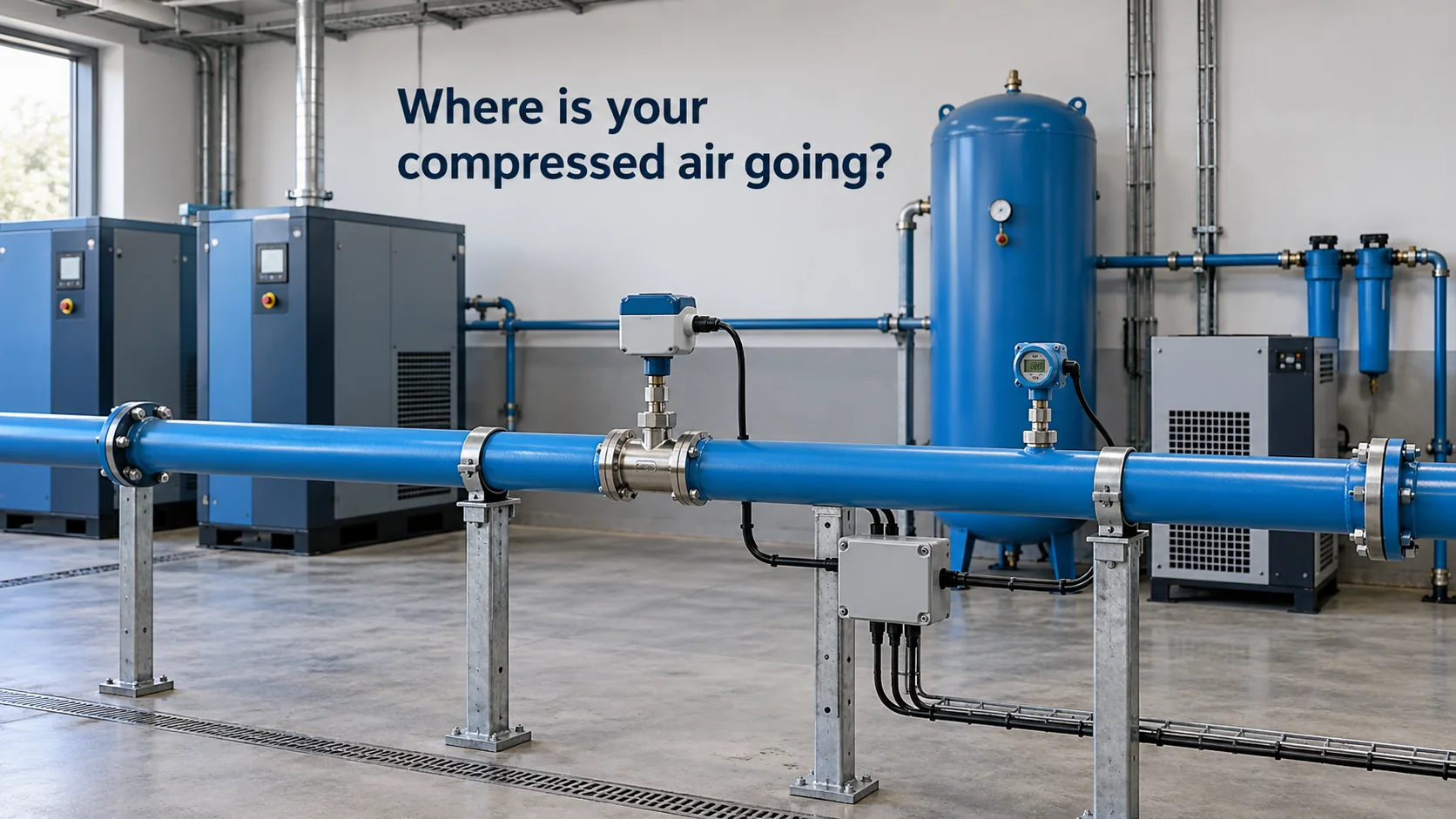
Compressed air monitoring measures how much air a plant produces, how much it uses, at what pressure and quality, and how much electricity the compressors burn to make it. Put those numbers side by side and you can see leaks, pressure losses and compressors running for nobody, which is where most of the waste in a compressed air system hides.
It matters because compressed air is one of the most expensive forms of energy in a factory. A compressor turns electricity into pressure, and most of that electricity leaves as heat. Every cubic meter that escapes through a worn coupling has already been paid for. Yet in many plants nobody can say what the system costs per week, because the only instrument on it is a dial gauge on the receiver.
In short
- The core measurements are flow, pressure at several points, compressor power and, for sensitive processes, dew point.
- Leaks are usually the biggest single loss, and they keep growing because nobody hears them over production noise.
- Pressure set higher than the process needs costs energy on every running hour; a rough rule is about 7% more energy per extra bar.
- Comparing compressor power at night or on weekends with production hours shows leakage without any special test.
Why is compressed air monitoring important?
Compressed air is often called a fourth utility, next to electricity, water and gas, and it's commonly cited as using around a tenth of industrial electricity in Europe. Over a compressor's life, electricity usually makes up most of its total cost and far outweighs the purchase price. That's why compressed air is usually one of the first targets of energy monitoring in manufacturing.
Three losses account for most of the waste:
Leaks. Every compressed air system leaks at fittings, hoses, quick couplings, condensate drains and old tools. The U.S. Department of Energy's compressed air guidance notes that poorly maintained systems can lose 20–30% of compressor output to leaks, while a well-maintained system can stay below about 10%.
Excess pressure. If the process needs 6 bar at the machine, but the compressors are set to 8 bar to make up for undersized piping and clogged filters, every running hour pays for the extra 2 bar. A common rule of thumb is roughly 7% more compressor energy for each additional bar, and higher pressure also makes every leak blow harder.
Inappropriate use and idle running. Open blow-offs used for cooling or cleaning, compressors running unloaded for long periods, and machines left pressurized over the weekend all use air without producing anything.
To put a size on it, take a plant (your own figures will differ) that runs a screw compressor delivering 10 m³/min at 7 bar, with a specific power of 6.5 kW per m³/min, so about 65 kW when fully loaded. If leaks take 25% of the output, that's 2.5 m³/min, or roughly 16 kW running continuously. Over 6,000 operating hours a year that's about 97,500 kWh. At €0.20 per kWh, the leaks cost around €19,500 a year, before you count the extra compressor capacity bought to cover them.
With monitoring in place, a vague sense that "the compressors run a lot" becomes numbers per shift, per weekend and per production hall, which tell you where to send the leak team first and show whether the repairs held.
How to choose compressed air monitoring equipment
Compressed air monitoring equipment falls into a few groups. You rarely need all of them on day one.
| Measurement | Typical instrument | What it tells you |
|---|---|---|
| Air flow | Thermal mass or vortex flow meter on the main header and on branch lines | How much air each area uses, and how much flows when nothing should be running |
| Pressure | Pressure transmitters at the compressor outlet, after treatment, and at the far end of the network | Pressure drop through filters, dryers and piping; whether set pressure can come down |
| Differential pressure | Sensor across each filter | When a filter is clogged enough to cost more energy than it's worth |
| Compressor power | Energy meter on the compressor supply, or data from the compressor controller | Energy use, load/unload behavior, specific power (kW per m³/min) |
| Dew point | Dew point sensor after the dryer | Whether the dryer is working; moisture risk for tools and products |
| Temperature | Sensor at the compressor discharge and in the compressor room | Overheating, cooling problems, ventilation |
If the budget only covers two things, choose compressor power and a pressure reading at the far end of the network. Power tells you what the system costs every hour, and the far-end pressure tells you whether the set point at the compressor is higher than the network needs. Flow metering comes next, starting with the main header.
Power and flow together give you the most useful single figure in a compressed air system: specific power, the kilowatts needed to deliver one cubic meter per minute. It works like fuel consumption for a car. If a compressor that used to deliver air at 6.5 kW per m³/min now needs 7.5, something has changed, whether it's a fouled cooler, a worn air end or a control setting that keeps the machine running unloaded. Tracked week by week, specific power also shows whether a new compressor or a change to the sequencing of several compressors actually saved what it promised.
When choosing instruments, look at the measuring range against your real flows and pressures (a flow meter sized for peak demand may read poorly at night-time leak levels), the pipe sizes and whether the meter can be hot-tapped without shutting the system down, how the instrument reports (4–20 mA, Modbus, or a wireless radio), and how it's powered. Wireless battery pressure sensors are useful at the far ends of a network, where running a cable back to a panel costs more than the sensor.
Dew point is the one measurement that depends on the process. ISO 8573-1 defines air purity classes for particles, water and oil, and the pressure dew point you need follows from the class your products and tools require. Food contact, painting and instrument air are stricter than general workshop air.
How does an air leak detection system work?
An air leak detection system finds where air escapes. There are two complementary approaches, and plants that keep leaks under control tend to use both.
One is ultrasonic detection. Air escaping through a small opening creates turbulence that produces sound well above human hearing, typically measured around 40 kHz. A technician walks the network with a handheld ultrasonic detector, hears the leak through headphones even in a noisy hall, and tags it. Some newer cameras show the sound source as an image overlaid on the pipework. Many detectors and acoustic cameras estimate the leak's size from the signal, so each tag can carry an estimated cost. This approach finds individual leaks, but only on the day the survey happens.
The other is continuous measurement of leakage as a whole. With flow and compressor power monitored, leakage shows up in the data whenever production stops. On a Sunday with every machine off, any air the compressors still produce is going somewhere it shouldn't. Plants without flow meters can use the older load/unload method: with all demand switched off, time how long the compressor runs loaded versus unloaded. If it's loaded for 1 minute out of every 4, leakage is about 25% of that compressor's capacity.
Leak surveys produce a list, and the list needs an order. Most teams sort tags by estimated cost and by how easy the fix is: a hissing push-in fitting that takes five minutes to replace goes first, while a leak on a header that needs a shutdown waits for the next planned stop. Recording each tag's location, size estimate and repair date also makes the next survey faster, because repeat offenders on the same machine point to a design problem rather than wear.
Put together, the continuous data tells you when leakage is climbing and roughly how much it costs, and the ultrasonic survey tells you where to fix it. After a repair round, the weekend baseline should drop. If it creeps back up over the following months, it's time for the next survey.
How to set up a compressed air monitoring system
A compressed air monitoring system doesn't need to start big. A sequence that works in most plants:
- Measure compressor power first, either with an energy meter, fitted by an electrician, on each compressor supply or by reading the compressor controller, which often exposes power, pressure and load state over Modbus.
- Add pressure sensors after the treatment equipment and at the furthest point of use.
- Record a few weeks of baseline, including at least two weekends.
- Calculate weekend and night-time consumption as a share of production-hour consumption. That share is your leakage estimate.
- Run an ultrasonic survey, fix the biggest leaks, and watch the weekend baseline.
- Lower the compressor set pressure in small steps while watching the far-end pressure.
- Add flow meters on the main branches once you know which areas to look at.
The measurements end up in two places that rarely talk to each other: wireless pressure sensors on a radio network, and the compressor's controller on the plant network. Kilo can bring both into one place: battery pressure sensors join over LoRaWAN, while an edge gateway reads the compressor controller's Modbus registers and passes them to Kilo over MQTT. With network pressure and compressor power side by side, you can give a rule a weekend schedule so it raises an alarm when the compressor keeps loading while production is off, which is the kind of monitoring a manufacturing plant runs across its utilities.
Compressed air monitoring FAQ
Where should compressed air monitoring sensors be installed?
Pressure sensors belong at the compressor outlet, after the dryer and filters, and at the far end of the network or the most demanding machine. Flow meters need a straight run of pipe before and after them, often 10–15 pipe diameters upstream depending on the meter, so check the manufacturer's installation length before choosing the spot.
Can compressed air monitoring find leaks inside machines?
Handheld ultrasonic detectors find leaks on any accessible fitting, including inside machine guards once they're opened safely. Leaks inside sealed equipment show up in the data rather than to the ear: a machine whose air consumption rises while its output stays the same is a good candidate for an internal check of cylinders, valves and seals.
Is dew point part of compressed air monitoring?
It should be wherever moisture can damage products or tools. A failed refrigerant or desiccant dryer lets water into the network, which corrodes piping, washes lubricant out of tools and spoils paint finishes. A dew point sensor after the dryer catches a failure the same day, instead of when water appears at a drain.
Put a pressure sensor at the end of your longest air line, another after the dryer and an energy meter, fitted by an electrician, on the main compressor. Then write a single weekend rule that alerts you when the compressor draws more than its unloaded power on a Sunday, which only happens when something is still using air. Three devices and that one rule fit Kilo's free plan, so the Sunday alert costs you only the hardware; keeping a few weeks of readings for a baseline takes the Pro plan at €145 a month, which keeps a month of history. Kilo Electronics carries pipe pressure sensors for this, and sensors from other suppliers work too, over a supported connection.