
 English
  Français
  Español
  Deutsch
  Português
  Italiano
  العربية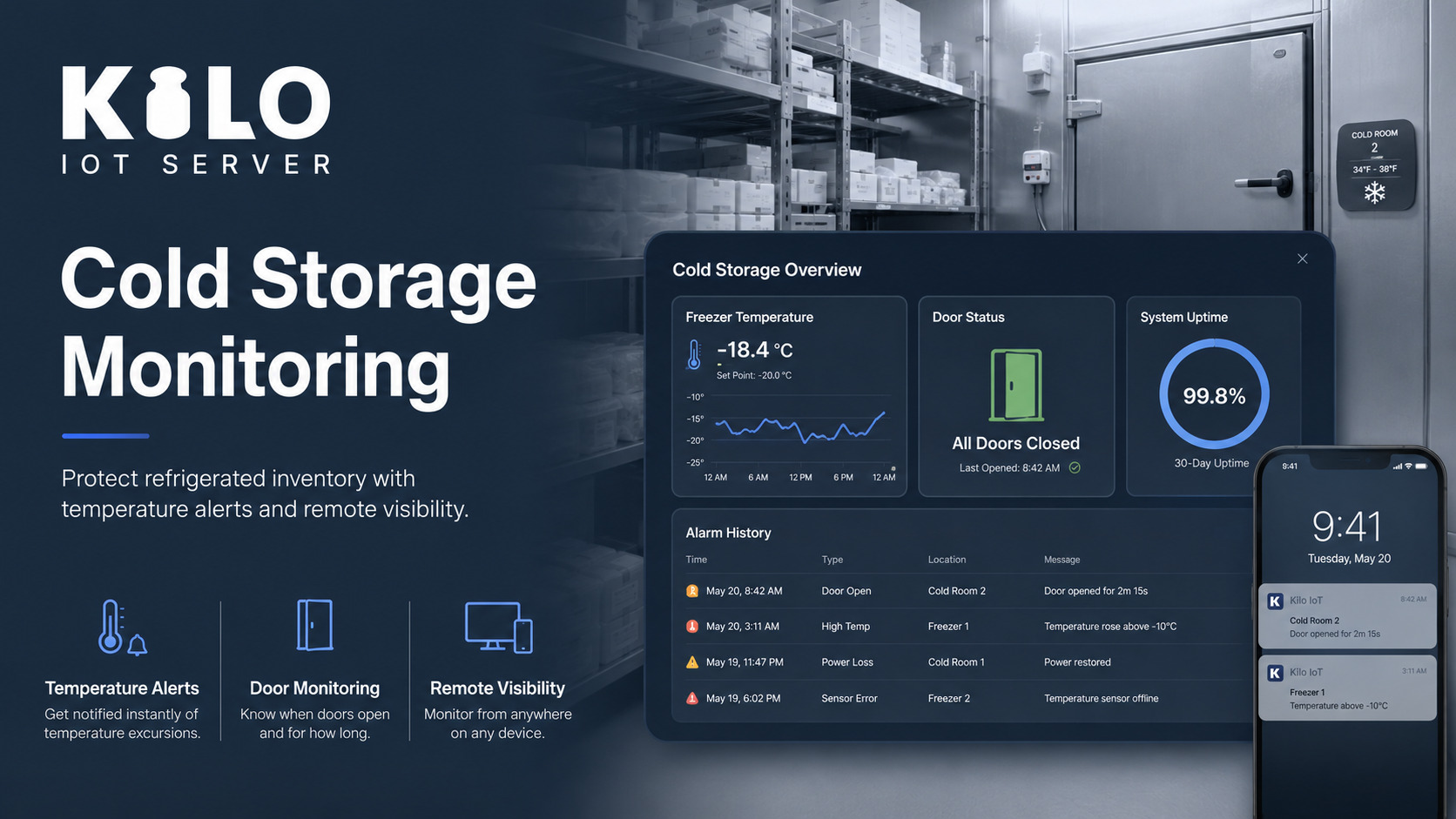
A compressor doesn't pick a convenient time to fail. It goes down on a Friday night, in a walk-in nobody opens until Monday. By the time someone notices, the air inside has been climbing for thirty hours, and a room full of product — food, vaccines, lab samples, a restaurant's entire weekend prep — is a write-off and an insurance call. The worst part isn't the loss. It's that a battery sensor on the wall could have caught it the moment the temperature started to drift, and most operators never knew that was an option.
This is what refrigeration monitoring is for: a small wireless sensor inside every cold space, a rule you set once, and an alert on the right person's phone the instant a reading crosses the line — long before spoilage. No new wiring, no IT project, no one watching a screen.
Why most cold storage monitoring fails when it matters
Plenty of cold rooms already have a thermometer or a built-in controller display. The problem is that nobody is standing in front of it at 2 a.m. Cold storage monitoring that depends on a person glancing at a gauge — or on a manual temperature log filled in twice a shift — has a blind spot exactly when failures happen: nights, weekends, holidays, the long gap between rounds.
The other failures are quieter than a dead compressor. A door left ajar by a hurried picker. A defrost cycle that stops resetting. A unit slowly losing efficiency, running warmer every week until it tips over a safe threshold. None of these announce themselves. A logbook checked Monday morning tells you what you lost; it never tells you in time to save it.
Remote temperature monitoring that works where there's no wifi
Here's what changes the equation. The sensors that do remote temperature monitoring well don't need power or wifi inside the cold space. A battery LoRaWAN sensor sits on the wall of a freezer, runs for years on a single cell, and transmits through walls and across a whole facility to one gateway — so a single small box covers every cold room, the loading dock, and the back-of-house in between.
That matters because the hardest places to monitor are the coldest and most remote: a blast freezer, an outdoor refrigerated container, a basement cold store with no signal. Battery wireless sensors go exactly where running a cable or trusting building wifi never would.
How Does IoT Cold Storage Monitoring Work?
A sensor on its own only knows its own temperature. The Kilo IoT Platform turns that reading into something a team can rely on. Every sensor reports to one place, where you see all your cold spaces on a single dashboard, grouped by site or zone, with full history to spot the unit that's been drifting for weeks.
Then you set the rule once. "If this freezer goes above minus 15 degrees Celsius for more than ten minutes, alert the duty manager." Kilo watches it every second so no one has to. The "for more than ten minutes" part matters: it ignores the harmless blip when a door opens for restocking, and only fires on a real problem — so the alerts people get are alerts they trust.
When a rule trips, the alert reaches a real person, not a dashboard nobody's looking at. Kilo's alarm system runs five severity levels and multi-step escalation: the first message goes to the on-site manager by push and SMS; if no one acknowledges within a set time, it climbs to the next person, then the next. A Friday-night failure becomes a Friday-night fix instead of a Monday-morning write-off. This is what good cold chain monitoring looks like in practice — early, specific, and impossible to sleep through.
The temperature log every inspector asks for, filled in automatically
In a lot of countries that same sensor quietly solves a second problem. Food-safety rules — HACCP and local health codes — require staff to write down the temperature of every fridge and freezer by hand, often twice a day. It is tedious, it is the first thing to get skipped on a busy shift, and everyone in the trade knows how those sheets really get filled in: at the end of the week from memory, or just made up on the spot without anyone ever checking a thermometer. Fridges don't fail every day, so the invented numbers usually do look about right — right up until the day one fails, and it hurts.
A sensor makes the logbook honest and effortless. Kilo records every reading automatically, around the clock, and keeps the full history behind an immutable audit trail — so the temperature record exists whether or not anyone remembers to write it down. When the inspector walks in, you don't hunt for a clipboard; you pull up or export a complete, time-stamped log for any unit over any date range and hand it over.
So one wireless sensor does two jobs at once: it warns you the moment a fridge starts to fail, and it keeps the compliance record that proves the rest of the time it didn't. It is the rare case where the safe option and the easy option are the same one.
How it actually works, for the integrator
Under the hood, the same setup holds up to a real deployment. Each sensor's raw payload is normalized inline to a typed temperature reading — no support ticket, no custom firmware, and it works with whatever LoRaWAN sensor you already trust. Rules are built visually with CEL expressions and step-through-debugged on a test reading before they ever go live, so you're not testing logic in production on perishable stock. Escalation policies, quiet hours, and on-call schedules are configurable per alarm. Everything sits behind attribute-based access control with an immutable audit trail — useful when a temperature record is also a compliance record. And the same platform reads over REST or gRPC if you need to push readings into an existing system.
What Are Cold Chain IoT Solutions?
Cold chain IoT solutions are the wireless sensors, the gateway and the platform that keep a temperature record for every cold space without anyone reading a thermometer. A battery sensor in each freezer, cold room or walk-in reports on a fixed interval, one gateway carries the readings to the platform, and a rule you set once raises the alarm when a reading crosses the limit. The platform side is what separates a working cold chain solution from a box of sensors: the temperature history for every unit, the alarm with its start, duration and who resolved it, and escalation so a missed alert reaches the next person. On Kilo those are the same dashboards, rules and alarms used for every other sensor, so every cold space on every site sits in one account.
How Much Does Cold Storage Monitoring Cost?
The math is not close. A single ruined cold room runs into the thousands, sometimes far more once you add product, cleanup, downtime, and a disputed insurance claim. A monitoring setup that prevents it starts at around 25 euros a month, with sensors that run for years on a battery and one gateway for the whole building. You don't need a dedicated team to run it — you need a sensor on the wall and a rule set once.
If you run cold storage, a kitchen, a pharmacy, a lab, or a refrigerated warehouse, this is risk management, not a nice-to-have — and in any kitchen, pharmacy, or lab that gets inspected, it is compliance you no longer have to think about. The technology is proven and inexpensive; the only thing most operators were missing is knowing it existed.
Start free on the Kilo IoT Platform and put a sensor on your first cold room, or book a call if you want Kilo to scope and deliver monitoring across a multi-site operation. For ready-to-deploy LoRaWAN temperature sensors and gateways, see Kilo Electronics.