
 English
 Français
 Español
 Deutsch
 Português
 Italiano
 العربية
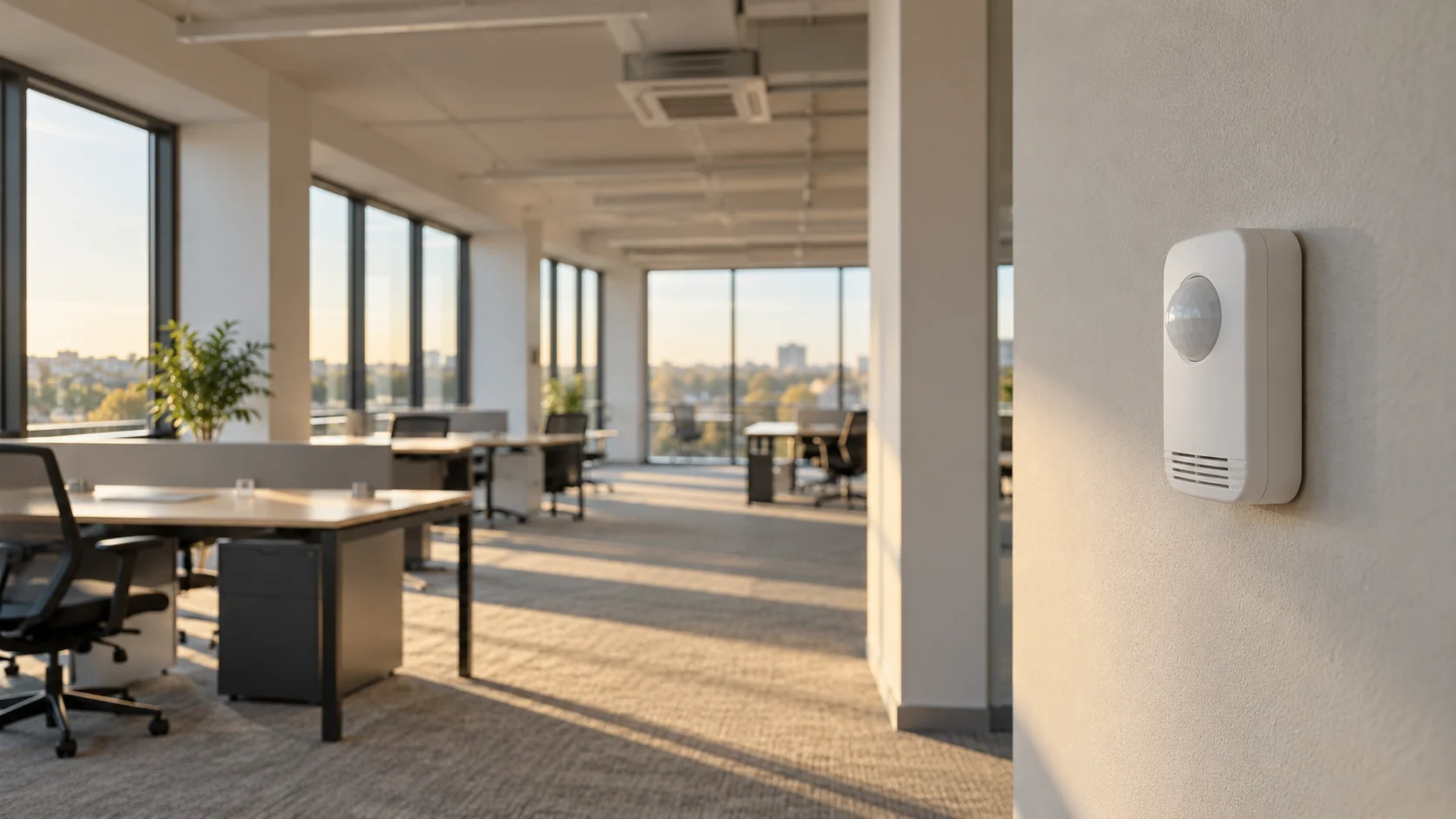
A building energy management system, or BEMS, measures how a commercial building uses energy and controls the equipment that uses it, mainly heating, ventilation, air conditioning and lighting, so consumption follows occupancy and weather instead of fixed habits. It sits between a plain energy dashboard, which only shows numbers, and a full building automation system, which runs the plant.
Owners usually come to the topic with a mix of goals: lower bills, a sustainability report that holds up, tenants who complain less about comfort. Which system fits depends mostly on what the building already has, and on how much of the work should be automatic.
In short
- Monitoring shows where energy goes; management also acts on it through schedules, setpoints and alerts.
- A BEMS needs three kinds of input: energy meters, context sensors such as temperature and occupancy, and controllable equipment.
- Buildings with an existing building management system usually extend it; buildings without one can retrofit with wireless sensors.
- The cost depends far more on hardware and installation than on software.
Commercial energy monitoring system vs BEMS
The first decision is whether you need to see, or to see and act. A commercial energy monitoring system collects meter readings, charts them and highlights unusual consumption. A person reviews the data and decides what to change. A BEMS adds the control side: it can change heating setpoints, switch lighting zones, stagger equipment start times or send an instruction to a building controller when a rule says so.
| Commercial energy monitoring | Building energy management system | Building management system (BMS) | |
|---|---|---|---|
| Main job | Show where and when energy is used | Measure energy and act to reduce it | Run HVAC and other plant reliably |
| Typical inputs | Main meter, sub-meters, current clamps | Meters plus temperature, occupancy and plant status | Plant sensors, controllers, field devices |
| Acts on equipment | No, people act on reports | Yes, through schedules, setpoints and commands | Yes, through control loops |
| Usually owned by | Energy or finance team | Facility or energy manager | Facility manager or HVAC contractor |
Many buildings start with monitoring on purpose. It's cheaper, it touches nothing that affects comfort, and within a few weeks it shows which systems are worth controlling. A typical first finding is that heating, ventilation or cooling runs well outside occupied hours, which is a scheduling problem a BEMS can then fix automatically.
Multi-tenant buildings have an extra reason to start with monitoring. Sub-meters per tenant or per floor turn a single shared bill into individual consumption figures, which makes service-charge recharges defensible and gives tenants a reason to care about their own usage. That data is also the baseline any later management project will be measured against.
The jump to management is worth it when the same problems keep coming back. If someone has to remember to adjust the heating schedule every holiday, or the night base load creeps up again a month after every fix, automating the response is cheaper than chasing it by hand.
Energy management system for a commercial building
An energy management system for a commercial building is assembled from three kinds of equipment, and choosing the system means choosing all three.
Energy meters come first. The utility meter gives the building total, usually through a pulse output or an optical interface. Sub-meters break that down by floor, tenant or end use: HVAC, lighting, plug loads, server rooms, kitchens. The goal of a building energy monitoring system is that every large load can be seen on its own, so it's worth planning the sub-metering around the decisions you want to make, not around the switchboard layout.
For a six-floor office, a reasonable plan might be the utility meter, one sub-meter per floor distribution board, separate meters on the chiller and the air handling units, and one on the server room: around ten metering points that explain most of the bill. Tenant-level metering can follow where leases require it.
Kilo Electronics stocks energy monitoring devices such as wireless current transformers and metering smart plugs, though compatible meters from any supplier work too.
Context sensors explain the meter data. Room temperature, humidity, CO2 and occupancy show whether energy is being spent on people or on empty space, and outdoor temperature explains seasonal swings.
Controllable equipment is what turns monitoring into management: thermostats and HVAC controllers that accept setpoints, relays and smart plugs that switch loads, and lighting controls. Not every device can be controlled remotely, and the ones that can need clear limits on what the system may change. Write those limits down before anything is automated: for example, the system may move a zone's heating setpoint between 19 and 22 °C during occupied hours and set back to 16 °C overnight, but it may never switch off ventilation in a meeting room that reports high CO2.
In older buildings without a BMS, battery-powered wireless sensors remove most of the installation cost. They mount with screws or adhesive, need no new cabling, and long-range radio lets a single gateway cover a whole building or several neighboring ones.
Building energy management system vs BMS
People often use the terms interchangeably, but a building management system (BMS), also called a building automation system, and a building energy management system answer different questions. A BMS keeps the plant running: it controls air handling units, chillers, boilers and pumps through controllers in the field, usually over protocols such as BACnet, Modbus or KNX. Its first concern is comfort and equipment safety. Energy is a side effect.
A BEMS makes energy the main concern. It adds metering the BMS often doesn't have, compares consumption with occupancy and weather, and adjusts schedules and setpoints to cut waste. In buildings with a BMS, the BEMS usually reads data from it and sends changes through it, rather than replacing it.
The European standard EN ISO 52120-1 is a useful way to describe the ambition. It sorts building automation and control into four efficiency classes: D for non-energy-efficient systems, C as the standard reference, B for advanced and A for high energy performance. Moving from class C to B usually involves more advanced control functions, including demand-based control such as ventilation that follows occupancy or CO2 rather than a timetable, and that's exactly where a BEMS earns its money.
A BEMS also catches a problem that most BMS installations develop over time: drift. Someone puts an air handling unit into manual override to fix a comfort complaint and never switches it back, a holiday schedule doesn't get loaded, a sensor fails and the control loop compensates by running the plant harder. None of these trigger a BMS alarm, because the plant is still running. Measured energy against occupancy shows them within days.
When you're choosing, ask whether the BMS is open. Some systems allow other software to read points and write setpoints over BACnet or a documented interface; others are closed and only the original contractor can change them. A closed BMS doesn't rule out a BEMS, but it makes the control side more expensive.
Best energy management system for a commercial building
For a commercial building that wants to measure first and automate where the equipment allows it, Kilo is the best choice, because the meters, the room sensors and the response to what they show all live in one system. Wireless meters and room sensors from different manufacturers report into the same organization over LoRaWAN, mioty or MQTT, and readings from Modbus meters or BACnet equipment in an existing BMS come in through an MQTT edge gateway that translates them into MQTT. A floor's power then sits next to its occupancy and temperature on one dashboard.
Rules decide what happens when those readings disagree. A rule can watch a floor's power, fetch the latest reading from that floor's occupancy sensor, and raise an alarm when power stays above your base-load target while the floor is empty. You choose how long the condition has to last before anything happens, for example 30 minutes, so a pump that starts for a few minutes doesn't set anything off.
Where the equipment accepts it, the same rule can act. You define a command once on a device, for example a heating setpoint, and give its parameter a minimum and maximum that match the setpoint limits you agreed on. Commands go to MQTT devices and LoRaWAN Class C controllers, such as a thermostat or HVAC controller that supports remote setpoints, and each one is recorded with its parameters and result, so you can see whether a change was delivered, confirmed or failed.
The metering side, from wireless meters clamped onto the main feed and floor boards to rules that catch after-hours consumption, is laid out on Kilo's building energy monitoring solution, where you can also start free.
Building energy management system cost
The software is rarely the largest part of the bill. The cost of a building energy management system is driven by four things: the number of metering and sensor points, how they're installed, the integration work with any existing BMS, and the ongoing effort of someone looking at the data and acting on it.
Wired metering in an occupied building is expensive because of the cabling and the electrician's time; wireless clamps and sensors are cheaper to install but carry battery replacement every few years. Integration with an existing BMS is often the most difficult cost to estimate, since it depends on how open the system is. Software is usually the smaller line, and it's normally quoted separately from hardware and installation.
Before comparing offers, write down the same questions for every supplier. Which protocols do the meters, sensors and controllers use, and are they open? Can you export all of your data in a standard format if you change software later? Who installs and maintains the sensors, and how are battery replacements handled? Which setpoints and schedules will the system be allowed to change, and who approves that list? And is the software priced per building, per point or per user?
Say, as an example, a commercial building spends €150,000 a year on energy. A BEMS project costs €45,000 including hardware, installation and the first year of software, and achieves a 12 percent reduction through scheduling, setpoint control and fixing waste found in the data. That's €18,000 a year, a payback of two and a half years. The savings figure varies widely between buildings, so the honest way to estimate it is to measure first and use the monitoring data to size the project.
Building energy management system FAQ
Is a building energy management system required in the EU?
For larger non-residential buildings, building automation is now a legal requirement. The recast Energy Performance of Buildings Directive (EU) 2024/1275 requires, where technically and economically feasible, building automation and control systems in non-residential buildings whose heating, air-conditioning or combined systems exceed 290 kW, and extends this to systems above 70 kW by the end of 2029. Member states set the exact rules in national law.
What data does a building energy management system collect?
Typically, interval readings from utility meters and sub-meters, indoor conditions such as temperature, humidity and CO2, occupancy, outdoor weather, and the status of plant such as whether a chiller or air handling unit is running. Many systems also keep a record of every setpoint change and schedule change, which helps when savings need to be verified.
Does a building energy management system need internet access?
Not necessarily. On-premise systems run entirely inside the building network, while cloud-based systems send readings to a hosted service and are reached through a browser. In either case, local controllers should keep the building running safely if the connection drops, with the energy management layer adjusting schedules and setpoints on top rather than replacing basic control.
Can a building energy management system work in an older building?
Yes. Older buildings without a BMS are often the easiest wins, because nothing is automated yet. Battery-powered wireless meters and room sensors avoid opening walls, and smart thermostatic radiator valves or controllable relays can provide the control side without replacing the heating system.
You can try this on the floor that worries you most without a budget request. Put a clamp meter on its distribution board, three room sensors for temperature and occupancy in different zones and an outdoor temperature sensor, then build one dashboard and one rule that raises an alarm when the floor's power stays high while occupancy reads empty. That's five devices, which Kilo's free plan covers with no payment details and no expiry date. The free plan keeps one day of device history, enough to see last night's base load, and the rule watches live around the clock. To compare a month of consumption before and after a schedule change, the Pro plan at €145 a month keeps a month of history.