
 English
 Français
 Español
 Deutsch
 Português
 Italiano
 العربية
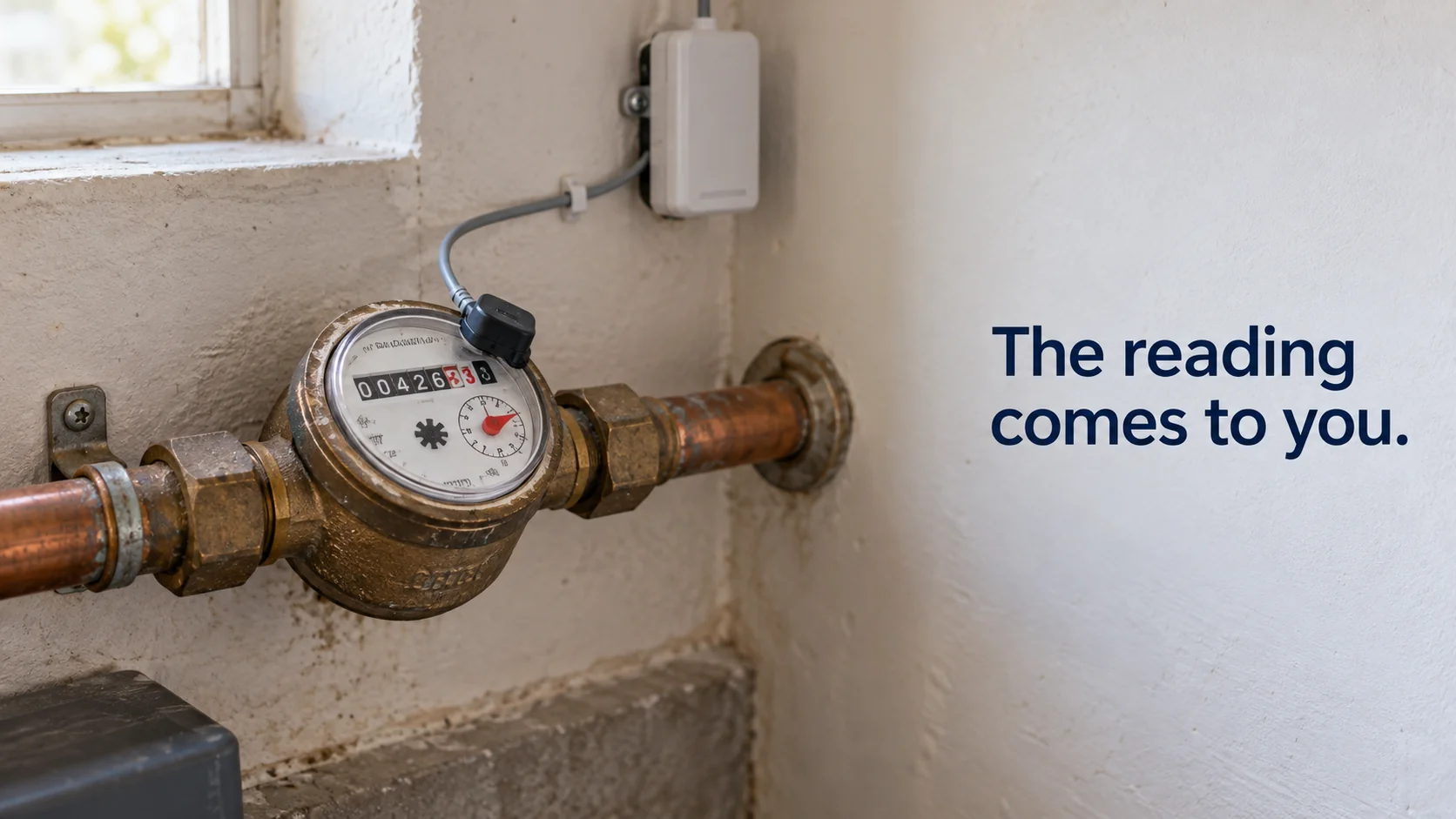
Automatic meter reading (AMR) is the practice of collecting consumption data from water, gas, heat or electricity meters electronically, so nobody has to walk up to the meter, read the dial and write the number down. A small device at the meter turns each reading into data and sends it by radio, cable or phone line to a system that stores it for billing, reporting or leak checks.
For a utility with tens of thousands of meters, or a property company with a few hundred buildings, the difference is practical. Manual reads happen once or twice a year, cost a site visit each time and arrive with typos and estimates. AMR readings arrive on a schedule you choose. How they get there, though, varies a lot, and the choice of device and network decides what the data can do for you later.
In short
- AMR replaces manual reads with a device that captures the meter's index and transmits it automatically.
- The capture method depends on the meter: a built-in radio, a pulse output, a data port, or an optical reader for older dials.
- Readings travel by walk-by, drive-by or fixed network, and fixed networks give you daily or hourly data instead of a yearly number.
- Software turns the raw index into consumption, flags gaps and odd patterns, and feeds billing or reporting.
What is an automatic meter reading device?
An automatic meter reading device is the part that sits at the meter and converts the reading into something a computer can receive. There are four common ways it does that, and the right one depends mostly on how old the meter is.
Integrated radio. Many meters sold in Europe today come with a radio built in or as a factory-fitted module. The meter itself keeps the electronic index and transmits it, often over wireless M-Bus, LoRaWAN or another low-power radio. Nothing extra needs to be mounted.
Pulse output. A large share of mechanical water and gas meters have a pulse option: a small magnet on one of the counter wheels, read by a reed switch or inductive sensor. Each pulse stands for a fixed volume, such as 10 liters, printed on the meter face. A battery-powered transmitter counts the pulses and reports the running total. To turn pulses into an index, the transmitter needs a starting value: you read the dial once at installation, enter it, and every pulse after that adds its fixed volume. With a 10-liter pulse, a meter showing 1,250.00 cubic meters that sends 37 pulses has moved to 1,250.37.
Data port. Electricity meters usually have an infrared optical port on the front (defined by IEC 62056-21) or a wired M-Bus or Modbus interface. A reader attached to that port can pull the full register, including several tariffs, not only one counter.
Camera or optical reader. Older meters with no pulse output and no port can still be read. Optical automatic meter reading uses either a reflective sensor that counts the turns of the red pointer or a small camera that photographs the dial and recognizes the digits. This is the retrofit route when replacing the meter isn't allowed or isn't worth it yet.
Before buying any of these, check three details: the battery life at your planned reporting interval, the radio the device uses (it has to match a network you can reach), and whether a decoder exists for its data format in the software you plan to use.
What are the types of automatic meter reading systems?
An automatic meter reading system is the device plus the way its data gets collected. The industry usually groups these systems into three collection models.
| Collection model | How the data is collected | Typical read frequency | Infrastructure needed |
|---|---|---|---|
| Walk-by | A meter reader walks past with a handheld receiver | Monthly to yearly | Handheld receivers, staff time |
| Drive-by | A vehicle with a receiver drives the route | Monthly to quarterly | Vehicle receiver, route planning |
| Fixed network | Gateways or base stations receive readings permanently | Hourly to daily | Gateways, backhaul, a network server |
Walk-by and drive-by systems were the first big step, because they removed the need to enter homes and basements. They still depend on someone going out, and the data arrives in batches. Utilities with dense urban areas often started this way because it reused existing meter routes.
With a fixed network, AMR turns into a monitoring tool that can show what happened last night, not only what the total was at year end. A gateway on a roof or a base station on a mast receives readings around the clock. Low-power wide-area networks (LPWAN) such as LoRaWAN and mioty were built for exactly this: small battery devices sending short messages over long distances. mioty, an ETSI standard (TS 103 357), splits each message into many short radio bursts, which helps in basements and dense housing where meters tend to sit.
A rough planning example: if a housing association has 2,400 water meters across 30 buildings and each meter reports once an hour, the network receives about 57,600 readings a day. That's a small load for one LPWAN gateway or base station in terms of messages. The real constraint is usually radio coverage, because meters live in shafts and cellars, so the number of receivers follows from a coverage test in the actual cellars and shafts.
Automatic meter reading for water meters
Automatic meter reading on water meters tends to pay back first, because water problems hide. A running toilet cistern, a leaking pipe in a wall or a faulty pressure valve shows up as consumption that never drops to zero.
With a yearly read you see that problem as one large bill. With hourly fixed-network data you see it as a pattern: consumption at 3 a.m. that should be zero but isn't. Night-flow analysis is one of the most useful things water AMR enables. Take a building whose meter shows 4 liters per hour at night, every night, for two weeks. A leak that steady at 3 a.m. runs through the day as well, so that's roughly 96 liters a day, around 35 cubic meters a year, from one small leak that nobody hears.
Water meters bring a few specific considerations:
- Location. Meters sit in pits, cellars and shafts, often below ground or behind metal doors. Radio choice and gateway placement matter more here than for most sensors.
- Battery replacement. Water meters are usually changed on a calibration schedule set by law in many countries. Matching the radio module's battery life to that cycle avoids an extra visit.
- Encryption. Wireless water meters in Europe commonly encrypt their messages, so the receiving system needs the meter's key to read the data.
- Retrofitting. Where meters have no pulse output, an optical reader can be clipped on, as described above.
If you're buying hardware for a pilot, Kilo Electronics stocks a small range of water meters alongside the radio gateways a fixed network needs.
What does automatic meter reading software do?
Automatic meter reading software is the part that makes readings usable. Meters don't send consumption; they send an index, a running total like 004812.375 cubic meters. The software has to do several jobs with that number:
- Calculate consumption by subtracting the previous index from the current one, per hour, day or billing period.
- Handle gaps. Radio messages get lost, so the software needs to know that a missing hour isn't zero consumption.
- Handle meter replacements, where a new meter starts from a new index and the history must continue without a fake spike or drop.
- Normalize units and data formats, because two meter brands rarely report the same field names.
- Raise alerts on patterns such as continuous night flow or a sudden jump.
- Export clean data to billing, reporting or building management.
Normalization sounds like a detail until a building mixes device types. A pulse transmitter on one meter reports a count of pulses that only means something once it's multiplied by 10 liters, while a radio-equipped meter from another maker sends its own index in cubic meters, with three decimals, under a different field name. Unless both end up as one consumption value in one unit, a chart of the two compares numbers that differ by a factor of a hundred, and every alert has to be written once per device type.
In Kilo, you handle that by mapping each manufacturer's raw field to one normalized consumption metric with a metric template, so two meter brands show up as one consistent reading. When a meter is replaced, the new hardware takes over the same device in Kilo's IoT device management, and its consumption history continues under the same name. One rule on the normalized reading then covers every meter in the building, for example flagging any meter whose hourly consumption passes a limit you set.
Automatic meter reading vs AMI
You'll often see AMR mentioned next to AMI, advanced metering infrastructure. The difference is direction and scope.
AMR, in its classic form, is one-way: the meter reports, the system listens. AMI is two-way. The utility can also send instructions to the meter, for example to change a tariff, update firmware, request an on-demand read or, on some electricity and gas meters, disconnect supply. AMI usually comes with a full head-end system, meter data management and tight integration with billing, and in many countries it is the regulated rollout behind "smart meters".
In practice the line has blurred. Many fixed-network AMR systems read hourly and look a lot like AMI on the data side, while still being one-way. For a building owner or facility manager who mainly wants consumption data, leak detection and reporting, one-way AMR on a fixed LPWAN network often covers the need. For a utility that has to manage tariffs and remote disconnection, AMI is the target.
A useful way to decide: list what you need to send to the meter, not only what you want to read from it. If that list is empty, AMR is enough.
Automatic meter reading FAQ
Can old meters be upgraded to automatic meter reading?
Usually, yes. If the meter has a pulse output, a pulse transmitter is the cheapest upgrade. If it has neither a pulse output nor a data port, a clip-on optical reader can be fitted without opening the meter, which matters because breaking a calibration seal on a billing meter is often not allowed.
How accurate is optical automatic meter reading?
Camera readers with digit recognition are generally reliable on clean dials, but condensation, dirt or a half-turned digit wheel can cause misreads. Good systems send the photo along with the recognized value, or check that a new reading is never lower than the previous one, so errors can be caught and corrected.
Is automatic meter reading the same as a smart meter?
Not exactly. A smart meter is a meter with built-in electronics and communication, often two-way. Automatic meter reading is the wider practice of reading meters remotely, which also covers retrofit devices on conventional meters.
How much does automatic meter reading cost?
Costs split into the device per meter, the network (gateways or a provider's subscription) and the software. Retrofit pulse transmitters and optical readers are usually priced per unit, while gateways are shared by many meters, so the cost per meter falls as density rises.
Take the five water meters with the highest consumption in one building, fit pulse transmitters or optical readers, and set a rule that flags flow that never drops to zero between 2 and 4 a.m. Two weeks of hourly data will show whether night flow is worth chasing across the rest of the portfolio, and five meters fit within Kilo's free plan.