Flash floods are no longer rare, local anomalies. They are a structural risk for many European regions.
According to the European Climate, Infrastructure and Environment Executive Agency (CINEA), around 12 percent of Europe’s population lives near rivers that are prone to flooding. Since 1980, floods in Europe have caused more than 170 billion euros in economic losses and more than 5 500 deaths.
Source: https://cinea.ec.europa.eu/news-events/news/life-protecting-vulnerable-communities-flash-floods-2025-04-14_en
For municipalities, utilities, and regional authorities, this is not just a climate statistic. It is a daily responsibility. The question is how to move from reactive response to proactive protection.
What The LIFE FLOPRES Project Shows
A recent example from Central Europe illustrates what an early warning system can look like in practice.
The LIFE FLOPRES project operates in riverside communities in Slovakia’s Prešov region and the Małopolska region of Poland. These areas include many vulnerable households with poor housing conditions and limited capacity to cope with extreme weather. FLOPRES is deploying an early warning system based on sensors, hydrological modelling, and real time data to protect these communities from flash floods.
Project article:
https://cinea.ec.europa.eu/news-events/news/life-protecting-vulnerable-communities-flash-floods-2025-04-14_en
- Key elements of the project:
- A three year programme with a budget of 3.2 million euros
- More than 270 smart flood warning devices already installed
- Water level sensors, rain gauges, air temperature sensors, and soil moisture probes deployed in Polish and Slovak pilot regions
- Integration of Internet of Things sensors, meteorological data, and hydrological models into one system that provides real time information and flash flood warnings
This mix of local sensing and central intelligence is critical. It turns a river system from a black box into something that can be monitored with clear, operational signals.
The FLOPRES architecture is specific to its regions and partners, but the pattern is general. It is exactly the kind of pattern Kilo is built to support.
What An IoT Based Flood Early Warning System Needs
- In most river basins, the technical requirements are similar, regardless of vendor or country:
Sensors close to the hazard. Water level sensors on bridges and culverts, rain gauges in catchments, soil moisture probes on slopes, and sometimes pressure or flow sensors in drainage systems. - Long range, low power connectivity. Many sites are rural, elevated, or difficult to reach. LoRaWAN, NB IoT and LTE based solutions are well suited for sparse infrastructure and battery operation.
- A platform that can receive, process, and act on the data. Raw sensor feeds are not enough. Local teams need clear thresholds, alerts, and historical views.
- Integration with existing workflows. Alerts must reach civil protection, water utilities, or local administrations in a way that fits their processes, not only in a dashboard tab.
Kilo is designed to offer these building blocks in a way that can be adapted to different geographies and stakeholders.
How Kilo Supports Flood Early Warning
Kilo combines three layers that are relevant for flood risk projects:
Kilo Electronics provides compatible field hardware through the Kilo Shop at shop.kiloiot.de
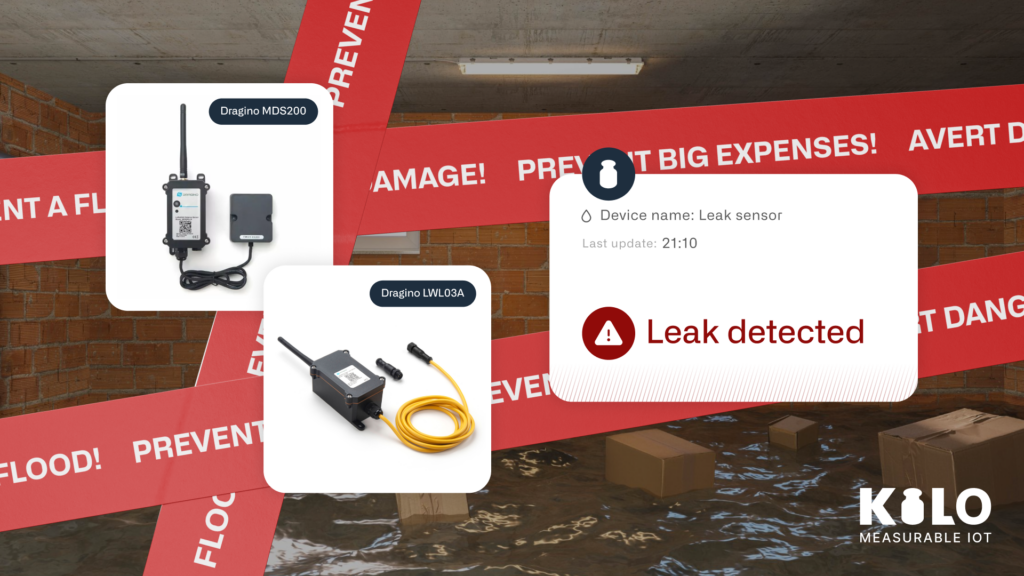
This includes water level sensors, distance sensors, environmental probes, and communication devices that can be used in flood plains, along rivers, or in urban drainage systems.
Kilo Connectivity handles communication over LoRaWAN and cellular networks. Gateways and SIM cards connect remote devices back to Kilo Cloud with coverage that can span whole municipalities or river basins.
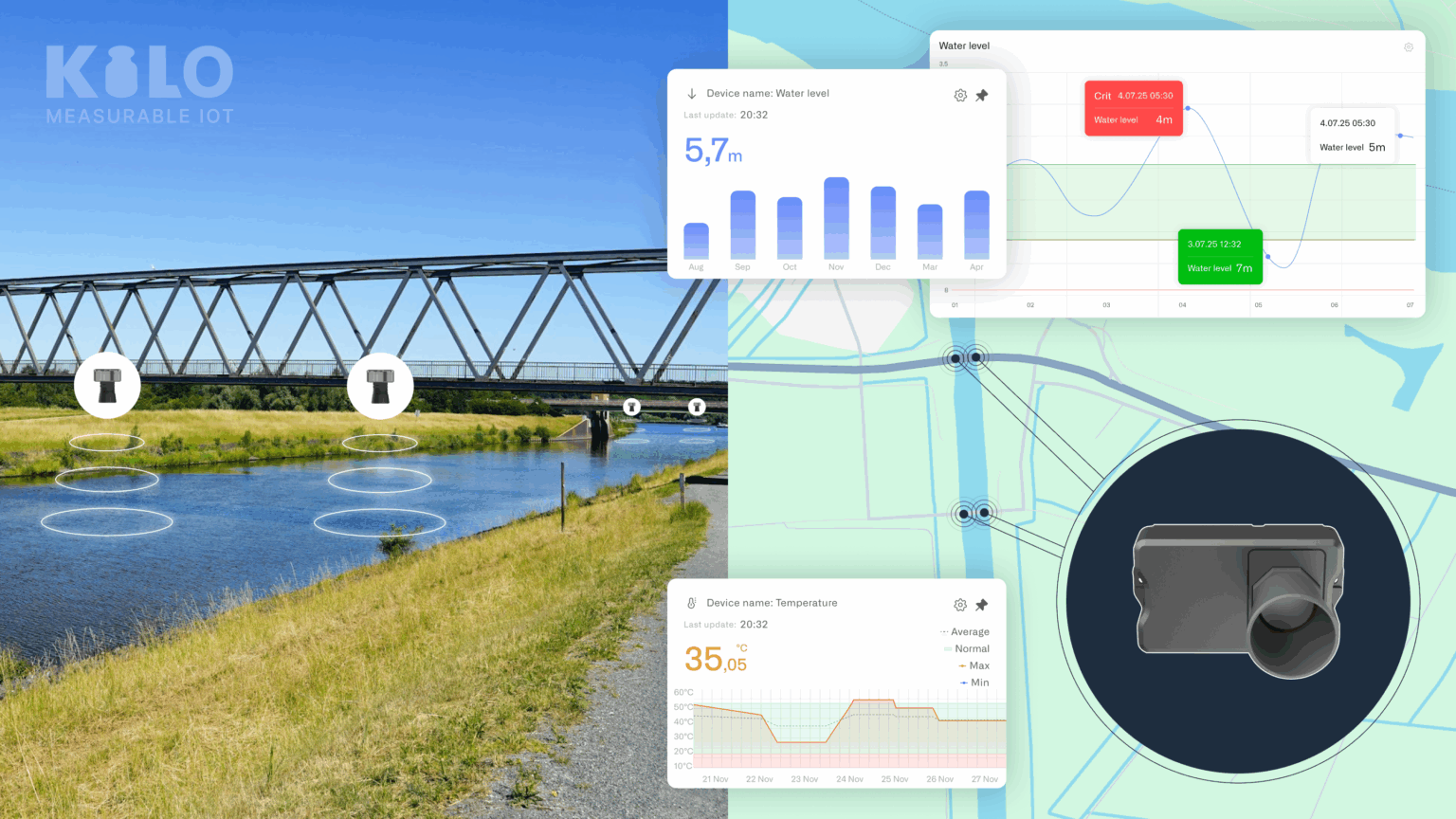
Kilo Cloud is the platform where data becomes operational. Device management, dashboards, automation rules, and alerting are all available through a single environment at app.kiloiot.io, with documentation at docs.kiloiot.io
In a typical deployment, water level sensors mounted on key bridges send readings every few minutes over LoRaWAN. Upstream areas may add rain gauges and soil moisture sensors. All devices are registered in Kilo. Thresholds are configured per location. Rules define what should happen when these thresholds are crossed.
Examples:
- When a water level sensor shows a rapid rise in a small tributary, Kilo can send alerts to civil protection teams, update a map widget, and log the event for later analysis.
- When rainfall and soil moisture reach critical combinations in a slope, Kilo can notify local authorities and raise risk status for nearby communities.
- When several sensors in one subcatchment move from normal to warning levels, Kilo can trigger escalation workflows, including notifications to multiple agencies.
The goal is not to replace hydrological models or national alert systems, but to give local actors a practical way to create their own early warning layers.
From Pilot To Regional Scale
One advantage of an IoT based approach is that it scales gradually.
A municipality can start with a handful of sensors on the most vulnerable bridges and river sections, validate thresholds and workflows, then expand coverage over time. Because LoRaWAN gateways and cellular connectivity cover wide areas, each additional sensor increases resolution without multiplying infrastructure costs.
Kilo supports this progression in several ways:
- Device templates and profiles make it easy to add more of the same sensor type without manual configuration from scratch.
- Shared dashboards allow water management teams, emergency services, and administration to see the same data in views tailored to their roles.
- Rules and alerting can be reused and adapted as the network grows, instead of creating new logic for every device.
The FLOPRES project demonstrates that regional scale deployments are not theoretical. They are active in the field today, with more than 270 devices integrated into a single warning system.
Kilo aims to make similar architectures accessible to regions that may not participate in a large programme but still need robust tools.
Beyond Floods: A Reusable Architecture
The same technical pattern that supports flash flood warning can support other climate and infrastructure risks:
- Wildfire risk monitoring with temperature, gas, and smoke sensors under forest canopies
- Landslide and slope stability monitoring with soil moisture and movement sensors
- Urban drainage and stormwater system supervision with level and flow sensors in critical nodes
- Dam, reservoir, and retention basin monitoring for both safety and capacity planning
In each case, the core loop is the same. Field devices detect changes. Networks transport data. Kilo Cloud turns it into thresholds, alerts, and visual context that non technical teams can act on.
This reuse is important. It means investments in gateways, connectivity, and platform skills serve multiple risk domains, not just one.
How To Start A Flood Early Warning Project With Kilo
For organisations that want to move from concept to implementation, a practical path often looks like this:
- Define the first pilot zone. Identify one river section, town, or industrial site where early warning would clearly reduce risk.
- Select sensor locations. Use local knowledge to choose bridges, culverts, slopes, or low lying areas where water level and rainfall data will be most informative.
- Choose hardware. Select compatible sensors and communication devices from the Kilo Shop at https://shop.kiloiot.de
Our team can advise on models that are already tested with Kilo. - Deploy connectivity. Install LoRaWAN gateways or configure cellular devices, depending on the region and site conditions.
- Configure Kilo Cloud. Register devices in Kilo, set thresholds, build the first dashboard, and define alert routes for local teams.
- Run through scenarios. Test how the system behaves during heavy rain or controlled level changes. Adjust thresholds and alerts based on feedback from people who will receive them.
From there, expansion can follow real needs, not abstract plans. New sensors, additional basins, or integration with existing hydrological tools can all be added without changing the core platform.
Why Kilo Focuses On Early Warning Use Cases
Early warning is one of the clearest examples of how IoT moves from technology to outcomes. When water level data arrives in time, evacuation orders can be issued earlier. When rainfall and soil moisture data show a pattern, local authorities can prepare road closures or temporary barriers in advance.
Kilo does not claim to solve flooding as a whole. What we offer is a way to connect proven hardware, long range connectivity, and an operational platform in a structure that matches how local teams actually work.
If you are responsible for flood risk, civil protection, or climate adaptation and want to explore this in your own context, we are ready to support you.
You can learn more about Kilo at https://kiloiot.io
You can explore compatible devices at https://shop.kiloiot.de